

by Asif Showkat Kallol (Dhaka Bureau)
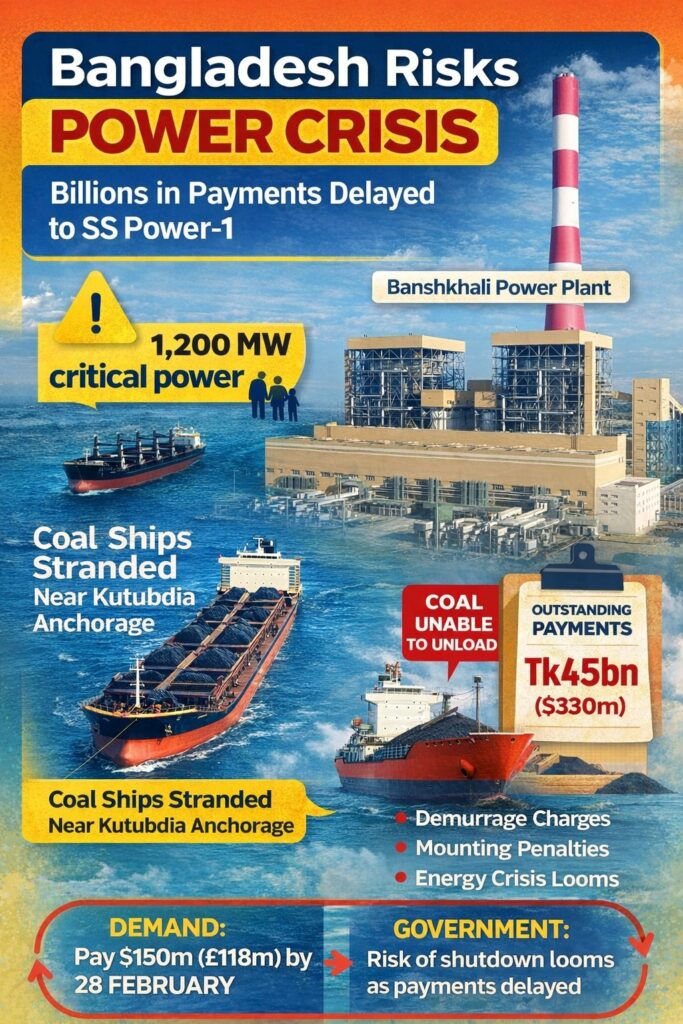
Bangladesh faces the risk of a major electricity shortfall ahead of the summer season after the interim government failed to clear more than Tk45bn (£330m) in dues to a major private power producer, leaving coal shipments stranded at sea and threatening the shutdown of a key power plant.
SS Power-1, which operates a coal-fired power plant in Banshkhali in the south-eastern port city of Chattogram, says it is unable to procure the minimum fuel required to continue operations because the government has not paid outstanding bills for electricity already supplied to the national grid.
According to company officials, several coal-carrying vessels imported from Indonesia are currently waiting at outer anchorage near Kutubdia, while more ships are scheduled to arrive in the coming weeks. Without payment guarantees or letters of credit, the company says it cannot unload the coal, exposing it to mounting demurrage charges and contractual penalties.
The Banshkhali plant contributes more than 1,200 megawatts of electricity to the national grid, making it a critical source of power ahead of peak summer demand. Energy analysts warn that any disruption could worsen load-shedding, disrupt irrigation during the dry season, and strain an already fragile power system.
Sources at the Bangladesh Power Development Board confirmed that SS Power-1 has sent seven to eight formal letters demanding payment. In correspondence addressed to the BPDB chair, the company warned that continued delays could make power generation financially impossible and could constitute a breach of international contractual obligations.
In a letter dated 18 February, SS Power-1 said a coal vessel had already been waiting for days at outer anchorage, with penalties accruing daily. Another ship carrying 60,000 tonnes of coal was due to arrive on 26 February, with three more expected on 1, 9, and 15 March. Suppliers, the company said, had made it clear that no coal would be released without full LC settlement.
The company has demanded at least $150m (£118m) by 28 February and full payment by mid-March, warning that failure to comply could trigger further financial losses and legal consequences under the power purchase agreement signed with the Bangladeshi government.
Industry experts say the cost of delayed payments extends beyond fuel shortages. ‘When vessels remain idle at sea, demurrage costs escalate rapidly, and the burden ultimately falls on the state,’ said one energy economist, speaking on condition of anonymity. ‘These are avoidable losses.’
Responding to the concerns, BPDB chair Md Rezaul Karim acknowledged the problem but said partial payments had already been made. ‘We have provided Tk5bn and another Tk1.5bn will be paid on Sunday,’ he said. ‘We are coordinating step by step so that operations do not stop. It is not possible to pay the entire amount at once, but the issue is being addressed.’
Despite the assurances, power sector insiders warn that continued uncertainty could undermine investor confidence and expose the government to greater financial and legal risks. Critics argue that ad hoc decision-making and delayed settlements reflect deeper governance problems in the energy sector.
As temperatures rise and electricity demand surges, the cost of inaction may soon be felt not only in balance sheets but also in households, farms, and factories across Bangladesh.
————————————————————————————————————————————————————————
The Author:
 Asif Showkat Kallol: Works for a German-based online outlet, The Mirror Asia, and as Head of News. Contributor, Pressenza- Dhaka Bureau.



