

by Md. Delwar Hossain
In the course of a shifting global political landscape, Bangladesh is increasingly being viewed as a significant geopolitical hub in Asia, with major regional and global powers seeking closer ties with Dhaka.
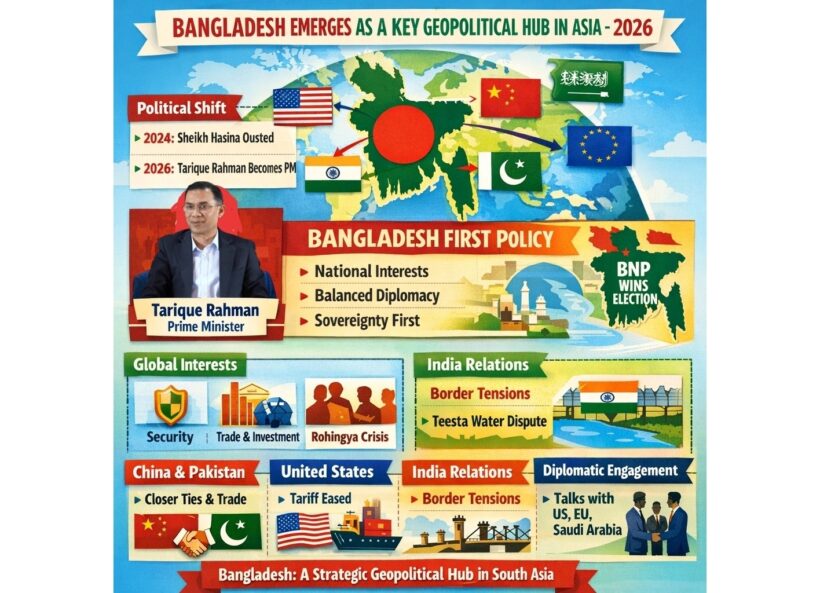
Following the ousting of former Prime Minister Sheikh Hasina in August 2024 through a student-led uprising marked by bloodshed, several influential countries have intensified efforts to draw Bangladesh into long-term strategic partnerships.
In contrast, neighboring India has maintained a noticeable distance from the interim administration led by Chief Adviser Professor Muhammad Yunus. During this period, India imposed visa restrictions on Bangladeshi nationals, including those seeking urgent medical treatment. Reports of border incidents involving India’s Border Security Force have also risen, further straining bilateral relations. Cross-border trade has declined, reflecting growing diplomatic tensions.
India has also provided shelter to former Prime Minister Sheikh Hasina, who left Bangladesh after the uprising. The interim government has repeatedly sought her extradition, but New Delhi has not responded positively to those requests. Meanwhile, other regional powers such as Pakistan and China have moved to strengthen diplomatic and economic engagement with Dhaka. Direct flights between Bangladesh and
Pakistan has resumed after a long suspension, and trade between the two nations has increased. Beijing has similarly expanded diplomatic outreach and business cooperation with Bangladesh throughout the interim period.
At the same time, the United States has signaled warmer relations with Bangladesh, including easing tariffs on certain Bangladeshi exports shortly after raising them- while maintaining higher tariffs on other countries such as India and China.
Analysts suggest that India’s longstanding influence in Bangladesh, built over 17 years during Sheikh Hasina’s tenure, has diminished. Although the interim government made efforts to rebuild ties, India’s response was perceived as cautious. The visa restrictions and diplomatic strain have also reportedly affected Indian businesses, particularly in tourism, healthcare, and retail sectors that previously benefited from Bangladeshi visitors.
Meanwhile, Bangladesh held its 13th national election on 12 February, leading to the formation of a new government headed by Tarique Rahman, chairman of the Bangladesh Nationalist Party (BNP), which secured a majority.
After taking office, Tarique Rahman pledged to cultivate relations with all countries while prioritizing national interests. Since the election, major global actors have rapidly initiated contact with the new administration, signaling strong interest in cooperation.
Political observers note that the BNP government may face a delicate balancing act in managing relations with India, given past disagreements over water-sharing of transboundary rivers and border security concerns. Critics also argue that India strongly supported Sheikh Hasina’s administration despite domestic calls for more inclusive and competitive elections.
Over the years, India and Bangladesh signed numerous agreements in sectors such as energy, infrastructure, connectivity, and security. Some analysts contend that many of these arrangements disproportionately favored Indian interests, prompting public calls within Bangladesh for a more cautious approach in future engagements.
Experts emphasize that Bangladesh’s strategic geographic position has drawn heightened attention from global powers, including the United States and other international blocs. They advise the government to pursue a balanced foreign policy to avoid overdependence on any single country.
Former ambassador Humayun Kabir said that Bangladesh must craft its diplomatic strategies carefully to safeguard national interests.
Similarly, eminent security expert, Commodore (retired) Md Jashim Uddin Bhuiyan stressed that preserving sovereignty should remain the top priority when developing alliances, warning of potential risks in aligning too closely with any major power.
Since the 12 February election and the formation of the new government, diplomats from various countries have intensified engagement with Bangladeshi leaders.
U.S. Ambassador to Dhaka Brent Christensen expressed optimism that Bangladesh and the United States would collaborate to enhance mutual security, strength, and prosperity. He recently held a courtesy meeting with Foreign Minister Khalilur Rahman and State Minister Shama Obaed Islam at the Ministry of Foreign Affairs. While he did not brief the media afterward, details were later shared on social media.
Chinese Ambassador Yao Wen reaffirmed Beijing’s commitment to supporting Bangladesh’s ‘Bangladesh First’ policy and said that China would not accept third-party interference in its relations with Bangladesh or other South Asian countries. Discussions during his meeting with Bangladeshi officials included the Teesta River project and the Rohingya crisis, with China expressing readiness to move forward based on Bangladesh’s decisions.
Indian High Commissioner Pranay Verma also conveyed hope for strengthening Bangladesh-India ties through a people-centric approach focused on mutual benefit. He noted that high-level communications had taken place following the election, including congratulatory messages from Indian Prime Minister Narendra Modi and subsequent exchanges between the two governments.
Foreign Minister Khalilur Rahman reiterated that Bangladesh would uphold its independence and sovereignty while avoiding interference in the internal affairs of other nations. He emphasized that the country’s foreign policy would be guided by mutual respect, national dignity, and the principle of putting ‘Bangladesh First.’ He added that Bangladesh seeks constructive and mutually beneficial relations with all countries.
Meetings have already been held with envoys from Saudi Arabia, China, India, Pakistan, the United States, and the European Union, many of whom expressed confidence in the new government and a strong willingness to deepen cooperation with Bangladesh.
The Author:

Md. Delwar Hossain: Senior Reporter and Contributor, Pressenza- Dhaka Bureau



