

On the same day, two things happened that had no direct connection—but when I thought about them together, I began to see a relationship that wasn’t obvious at first.
The first concerned artificial intelligence. AI does not experience what it does. It does not know when it makes a mistake because it lacks what humans have: a feedback loop we call consciousness. When you hit the wrong key on a keyboard, even without looking, you correct it—you feel the error. AI cannot do that. As John Werner argues, “not just yet,” but the push toward so-called “physical AI” suggests an attempt to simulate that missing loop.
The second moment came during lunch with a friend who works with high school students. Inspired by one of my earlier articles on meaning, he asked his students a simple question: Which class inspired you the most? Which one felt meaningful?
The answer surprised him—and affirmed the argument of that article. Across the entire curriculum, one subject stood out: religious studies. Everything else was described in transactional terms—getting good grades, getting into college, and making money. Education, it seems, functions less as a nurturer of meaning than as a formatting process.
You might ask: What do these two stories have in common? Everything. They point to where we now stand—with knowledge, systems, objects, and ideas everywhere, yet with little clarity about what we are actually experiencing.
There is a crucial difference between what we believe about things—war, democracy, education—and what we personally experience of them. That gap matters.
Today, it is easy to understand why so many people turn to sports, music, food, or sex with such intensity. These offer immediate, embodied experiences, sometimes collective, sometimes deeply personal. Social media has captured and amplified this tendency, delivering instant pleasure and validation through likes, comments, and endless scrolling. The dopamine loop is short, powerful, and often addictive, privileging immediate rewards over long-term meaning.
But how do we experience nuclear weapons? Democracy? Peace? Climate change—if we experience them at all? These operate on entirely different scales. I do not experience nuclear weapons. If democracy is reduced to voting for five minutes every few years, the experiential register is almost empty.
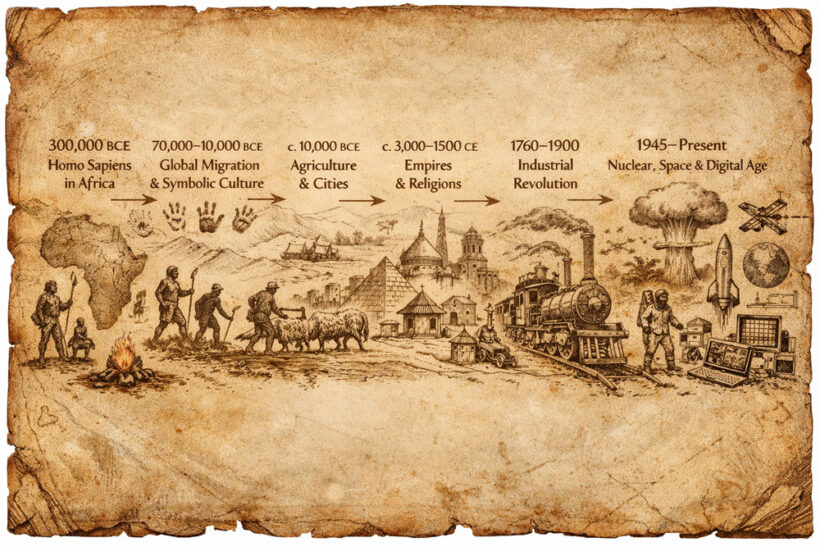
The gap becomes even clearer when we consider something far larger: human history itself. We can recite its milestones—300,000 BCE: Homo sapiens emerge in Africa; 70,000–10,000 BCE: global migration and symbolic culture; c. 10,000 BCE: agriculture and cities; c. 3,000 BCE–1500 CE: states, empires, religions; 1760–1900: the Industrial Revolution; 1945–present: the nuclear, space, and digital age—an era of planetary-scale responsibility.
The development is extraordinary. But can we imagine this journey from the standpoint of lived experience rather than as dates in a textbook? There remains an underdeveloped dimension of human consciousness: the capacity to experience ourselves as participants in a long historical process.
How, then, do we experience life itself? Is it merely to be born, grow up, work, form a family, retire, and die? If that were sufficient, we would not care so deeply about history, legacy, or what comes after us.
When experience contracts to the immediate present, life begins to resemble what Jean-Paul Sartre and Albert Camus described as the absurd—a sequence of events without direction. But the present situation is pushing us, whether we acknowledge it or not, to deepen our inner experience and expand our sense of connection across time.
The question is no longer only how to manage the present, but how to open humanity’s future. How do we cultivate in new generations the capacity to experience life across its full horizon—past and future, individual and collective, darkness and light?
This is the challenge of our moment.
In this sense, Silo insisted on a decisive point: the future is the priority. Not the inertia of the past, nor the urgency of the present, but the direction toward which human experience is moving. “It is the future,” he wrote, “that gives meaning to the present.”
Without a future horizon, we remain trapped in immediacy—repeating patterns, generating motion without transformation, mistaking reaction for direction. The task before us is not simply to solve problems, but to expand the depth and scale of human experience itself.



