

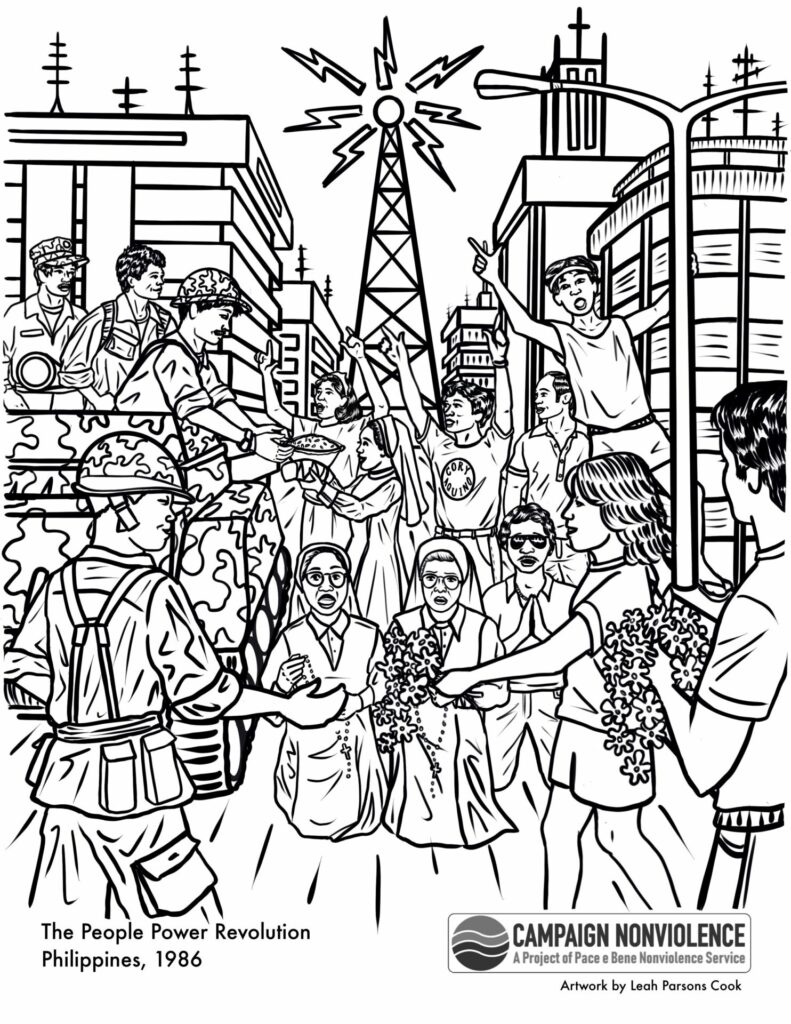
Filipinos Commemorate the EDSA PEOPLE POWER REVOLUTION, Now in its 40th YEAR
February 25, 2026. The day ends a 4-day commemoration of the Edsa People Power Revolution, the four days of peaceful rallies and social protests that ended the Marcos dictatorship and ushered in a return to democracy.
Forty years have passed. Activities and events were lined up to help us, Filipino citizens, remember the lessons we learned from a revolution that ended the tyranny of a long-running dictatorship— peacefully. It was the Edsa Revolution, when not one of the thousands, the many who came out to call for an end to the Marcos dictatorship and a return to democracy, received any harm.
The EDSA People Power Revolution. On February 23, 1986, Filipinos from all walks of life massed together in EDSA, a main thoroughfare leading to Camps Crame and Aguinaldo. They came to support the supposed ‘rebels’ who were holding out and calling for President Marcos to step down from the power and autocracy he held since he declared Martial Law on September 21, 1972, to address the supposed threats from communist insurgents and Muslim separatists. Then, he continued to hold on tightly to his reins of power. I was one of the thousands who massed and filled EDSA, a main thoroughfare of Metro Manila. The 4 days of remembering this historical event, now in its 40th year, brought back my memories of those heartwarming days.
Sept 21, 1972. Martial law was imposed on the country. The long martial days that ensued meant that we ordinary folks had to go on our way and just focus on what we were meant to be doing. In my case, I graduated from high school, leaving an all-girls exclusive school, and entered the Philippine State University, the University of the Philippines. My university days ensued under the mantle of Martial Law, when we had a daily curfew. This meant that we had to be home or inside by 12 midnight and never venture out unless we wanted to be picked up by the police and be imprisoned for not following one of the rules of Martial Law.
Jan 17, 1981. Martial law was “officially lifted”. They said it was because there was going to be a papal visit. But Marcos continued to rule as a dictator, extending his stay in power beyond the terms a Philippine president could stay in his position. But in the years that followed, some events began to catalyze the public, us.
August 21, 1983. Ninoy Aquino Jr. was assassinated on the tarmac as he disembarked from his flight, shot by state forces. His death began to unite different sectors of society, which included the middle class, the church, and the military, to protest against President Ferdinand Marcos’s authoritarian rule. Aquino’s assassination became a turning point. Popular discontent started to become a mass movement that led to the peaceful People Power Revolution in 1986, which ended the Marcos regime.
February 22, 1986. The day before, we heard news that the Minister of Defense, Juan Ponce Enrile, and the Chief of the Constabulary of the Armed Forces, Fidel V. Ramos, broke away from the Marcos chain of command. They went to the only media outlets available at the time to appeal to the people. (There were no mobile phones or the internet at that time). They called for people to support them and a small group of mutineers at Camp Aguinaldo. Within hours, people were at EDSA, and that was just the beginning.
February 22, 1986 – February 25, 1986. The day that the People Power Revolution started, February 22, was a Saturday. Since it was a weekend, no work for us young employees, it was the day we usually went to visit my family, bringing my young son so his grandparents could see him. (My partner and I were already active in the Community for Human Development, doing some personal and social work, inspired by a vision to help humanize the earth.)
News reached us about the huge social protest happening along EDSA. News that the Armed Forces were about to use their arms to quell the massive protest and open fire on the breakaway group of Juan Ponce Enrile and Fidel Ramos. Initially, we were expressly forbidden by my parents to leave the house. We even heard news that people fearlessly massed around the breakaway group in front of the tanks. Thankfully, the Armed Forces desisted and didn’t open fire. And thankfully, this led to the 4-day, peaceful EDSA People Power Revolution.
More people were streaming into EDSA, calling for President Ferdinand Marcos to resign, calling for a return to democracy. Seeing that the military would not open fire, my parents finally allowed us to go and be part of this historic moment in our country’s socio-political history.
February 25, 1986. Given the strong outpouring, the President (and his family) was forced to leave the Malacañang Palace on February 25 and became an exile in Hawaii, where he later died. Well, that was the EDSA People Power Revolution.
For us, life returned to normal. On the political scene, elections were held, and Filipinos went out to vote for a new President to take over. Cory Aquino, wife of the slain Benigno Aquino, became the next president.
FAST FORWARD TO FEBRUARY 22 TO 25, 2026. The country commemorated the 40th anniversary of the EDSA People Power with activities in remembrance of the 4 days that ended an autocratic regime and a return to democracy. On Feb 25, 2026, at the National Shrine of Mary, Queen of Peace, EDSA Shrine, Archdiocese of Manila, the Trillion Peso March Movement, religious groups, and political leaders marched from the EDSA Shrine to the People Power Monument. A program ensued, with speeches and songs, calling for reforms, accountability for all the corrupt, and the return of the people’s money to address the key needs of the bayan (addressing flood control, for one) amid the 40th anniversary of the 1986 People Power Revolution.
For me, and maybe for those who could no longer actively go out to participate in the slated activities, news streaming online about events and activities being done by NGOs and groups was the way to get cued in. The activities held the sincere hope that we, all, and the youth, who may not have been born yet during those days, would not forget this milestone in our shared history.
I hear that the EDSA People Power Revolution, those 4 days, 40 years ago, inspired other countries (like some countries in South America who were struggling with autocratic regimes) to find peaceful ways as well.
They say that the Philippines’ EDSA People Power Revolution, which ended an autocratic regime peacefully, is the first and is one of a kind.
* The source of the image: https://www.pressenza.com/2025/02/keeping-the-spirit-of-the-nonviolent-edsa-people-power-revolution-alive/



