

By Burhanuddin (Dhaka Bureau)
After a decade and a half of street struggles, legal battles, and a history of sacrifice, a massive brigade of former Student Dal (Chhatra Dal) leaders has secured their place in the country’s legislature.
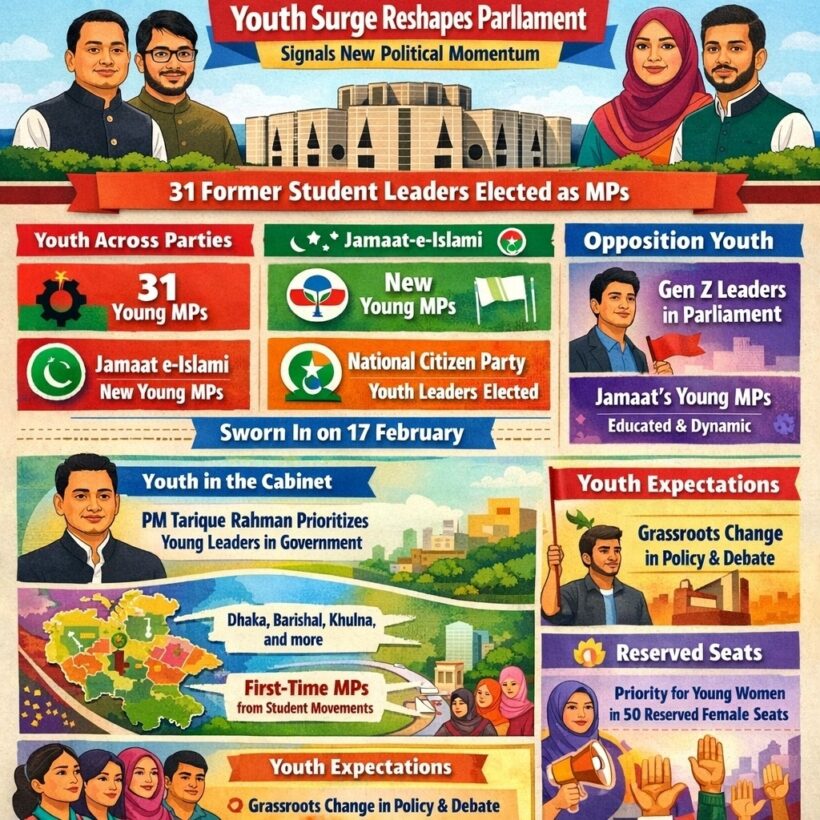
In the 13th National Parliament Election, 31 former student leaders emerged victorious and are set to take their oaths as lawmakers. A significant portion of them are entering Parliament for the first time, a move expected to infuse new momentum into the country’s parliamentary politics.
The influx of new faces isn’t limited to the ruling BNP; the opposition Jamaat-e-Islami and the youth-led National Citizen Party (NCP) have also seen new representatives elected. Consequently, the new Parliament is expected to be vibrant with the presence of a large youth demographic. These former student leaders officially began their journey as the nation’s lawmakers following the swearing-in ceremony of the new government on February 17.
Dominance in Parliament and Cabinet
The Bangladesh Nationalist Party (BNP) has formed the government after securing an absolute majority in the general elections. Tarique Rahman, the party’s new Chairman and an icon of youth to his supporters, has been elected as a Member of Parliament for the first time. He was subsequently elected as the Leader of the House during the BNP’s parliamentary committee meeting. Thus, after contesting a national election for the first time, Tarique Rahman has simultaneously assumed the roles of MP, Leader of the House, Minister, and Prime Minister.
Tarique Rahman has prioritized the youth in his administration. In this Parliament, approximately 31 former student leaders from the BNP alone have been directly elected. Many of them faced imprisonment and persecution during the past 17 years. The new cabinet includes prominent young faces such as Sultan Salahuddin Tuku, Shama Obayed, Bobby Hajjaj, Zonayed Saki, Nurul Haque Nur, and Engineer Ishraque Hossain.
Veteran Faces from Student Politics Returning to Parliament
Several seasoned leaders who rose through student politics and previously served as MPs have won their respective seats under the ‘Sheaf of Paddy’ (Dhaner Sheesh) symbol: Aman Ullah Aman (Dhaka), Khairul Kabir Khokon (Narsingdi), AKM Fazlul Haque Milon (Gazipur), Barrister Mahbub Uddin Khokon (Noakhali), Ruhul Kuddus Talukdar Dulu (Natore), Ehsanul Haque Milon (Chandpur), Shahid Uddin Chowdhury Annie (Lakshmipur), Abdul Wadud Bhuiyan (Khagrachari)
The First-Timers: From Activists to Lawmakers
The biggest surprise of this election is the cohort of former student leaders becoming MPs for the first time. Transitioning from ‘street fighters’ to ‘lawmakers,’ the list includes:
Dhaka Division: Khandaker Abu Ashfaq, Hamidur Rahman Hamid, Habibur Rashid Habib, S.M. Jahangir (Dhaka), Anisur Rahman Khokon (Madaripur), Sultan Salahuddin Tuku (Tangail), Kamruzzaman Ratan (Munshiganj), Shahidul Islam Babul (Faridpur) and Nuruddin Ahmed Opu (Shariatpur).
Barisal & Khulna Divisions: Nurul Islam Nayan (Bhola), ABM Mosharraf Hossain (Patuakhali), Rajib Ahsan (Barisal), Rokibul Islam Bakul, and Azizul Bari Helal (Khulna).
Other Regions: S.M. Jilani, Selimuzzaman Molla (Gopalganj), Amirul Islam Khan Alim (Sirajganj), Barrister Kaiser Kamal (Netrokona), Mahbubur Rahman Liton (Mymensingh), Adv. Nurul Islam Nurul (Sunamganj), Rafiqul Alam Majnu (Feni), Shahadat Hossain Selim (Lakshmipur), and Farhad Hossain Azad (Panchagarh).
Youth Icons from NCP and Jamaat
The triumph of the youth is also evident in the opposition benches. A group of young leaders from the National Citizen Party (NCP)- formed following the student-led mass uprising- and Jamaat-e-Islami are entering Parliament.
Frontline leaders of the July Revolution will now represent the ‘Gen-Z’ generation in Parliament. This group includes: Nahid Islam, Hasnat Abdullah, Abdul Hannan Masud, Akhter Hossain, Abdullah Al Amin, and Atiqur Rahman Mujahid. Meanwhile, Jamaat-e-Islami’s roster includes Dr. Shafiqul Islam Masud and several other highly educated former student leaders.
Prospects in Reserved Seats
The preference for youth is also expected to extend to the 50 reserved women’s seats. Based on the current seat distribution, the BNP may secure 35 to 36 of these seats. Party hints suggest that a large portion of these nominations will go to former female student leaders.
Expert Analysis and Grassroots Enthusiasm
Analysts believe that having a brigade of former student leaders alongside seasoned influential ministers will make Tarique Rahman’s governance more effective. These young MPs are expected to play a pivotal role in state affairs.
At the grassroots level, the victory has sparked celebrations. Newly elected MPs, such as Habibur Rashid Habib (Dhaka-9) and Nurul Islam Nayan (Bhola-4), stated that after the struggle on the streets, their primary goal is now to protect the public’s trust.
Opportunity for Qualitative Change
Political observers note that the presence of these spirited leaders in Parliament is not just a numerical victory but will add a new dimension to parliamentary debates. Having experienced the struggles of the common people firsthand, these leaders are expected to make the legislative process more vibrant and effective.
The Author:
 Burhanuddin: Chief Reporter, Dhaka Mail and Contributor, Pressenza- Dhaka Bureau.


