

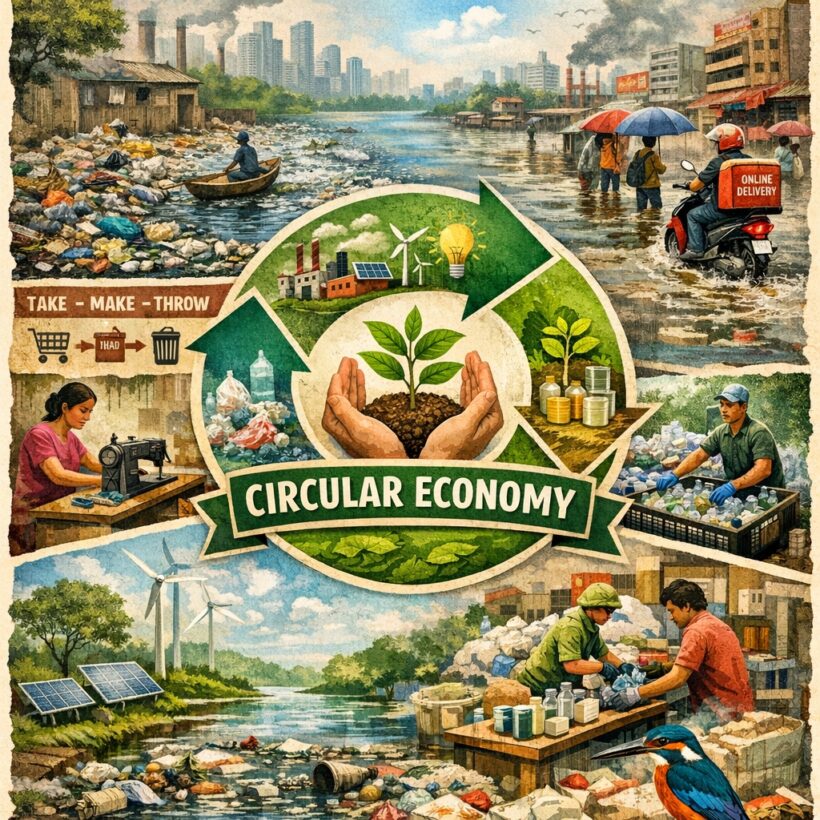
‘Take-Make-Waste’ no more; the new mantra is ‘Take-Remake-Restore’
by Zahida Parvez Chhanda (Dhaka Bureau)
Under the pressure of rapid urbanization, burgeoning waste, and climate vulnerability, Bangladesh is seeking alternative paths for sustainable growth. According to policymakers and environmental analysts, the ‘Circular Economy’ model holds significant potential for this transition.
Society is traditionally accustomed to the ‘Take-Make-Dispose’ linear model. Moving away from this, the circular economy emphasizes waste reduction, extending product lifespans, and the regeneration of natural resources. Dr. Md. Manjure Mowla, Sociologist, University of Helsinki professor, and Founder Chairman of Circular Family in Bangladesh, notes that this concept is gaining global importance amidst climate change and resource scarcity.
Dr. Mowla highlights that Bangladesh generates a massive volume of solid waste daily. The capital, Dhaka, is the largest contributor, with millions of tons of refuse piling up. While a large portion of this waste is recyclable, recovery remains impossible due to a lack of effective waste segregation systems and infrastructural limitations.
Key Challenges and Opportunities
Plastic Pollution: Single-use plastic has become a major concern. The expansion of retail markets and online delivery services is driving an increase in plastic waste, heightening the risks of river pollution and waterlogging. ‘This creates additional pressure on a climate-vulnerable nation,’ Dr. Mowla added.
Economic Potential: Economists believe that transitioning to a circular economy is not just about environmental protection; it can create new industries and employment. Significant potential exists in sectors like recycling, repair services, sustainable textile production, and waste-to-energy conversion.
The RMG Sector: Bangladesh’s Ready-Made Garment (RMG) industry, a global leader, is facing increasing pressure from international buyers to adopt eco-friendly production. Textile recycling, reduced water consumption, and circular design are becoming essential for competitiveness in the global supply chain.
The Path Forward
Experts and sociologists argue that circularity is no longer just an environmental issue; it is a prerequisite for a better quality of life. To survive, export-oriented industries must adapt to this shift as the global market moves in this direction. To institutionalize this sector, it is vital to ensure clear policies, incentives for green investment, and Extended Producer Responsibility (EPR).
Currently, the primary obstacles in Bangladesh include:
1. Infrastructural limitations.
2. Lack of public awareness.
3. Lack of coordination between various agencies.
Analysts suggest that a large-scale transition is impossible without Public-Private Partnerships (PPP) and regulatory reforms. As a climate-vulnerable nation, Bangladesh must balance economic growth with environmental conservation. Policymakers believe that integrating circular policies into national development plans can achieve both economic resilience and environmental protection.
A Structural Shift
This transition demands more than just technological change; it requires a structural overhaul of production processes, product design, and consumer behavior.
Environmentalists believe the question is no longer if a circular economy is needed, but how quickly and effectively it can be implemented.
By shifting from a ‘culture of disposal’ to a ‘culture of reuse,’ Bangladesh can unlock potential in the garment, plastic, and e-waste sectors while securing a sustainable future.
———————————————————————————————————————————————————————-
The Author:
Zahida Parvez Chhanda: Correspondent, Pressenza- Dhaka Bureau.



