

by Asif Showkat Kallol
Global politics often features characters whose mere presence shakes the stage. Donald Trump belongs to that rare category of politicians who treat law as an obstacle, courts as inconveniences, and tariffs as a universal political weapon. When the US Supreme Court struck down his retaliatory tariff program as unlawful, many assumed the chapter had closed. In Trump’s theatre, however, closure never arrives- only intermission, followed by a louder act.
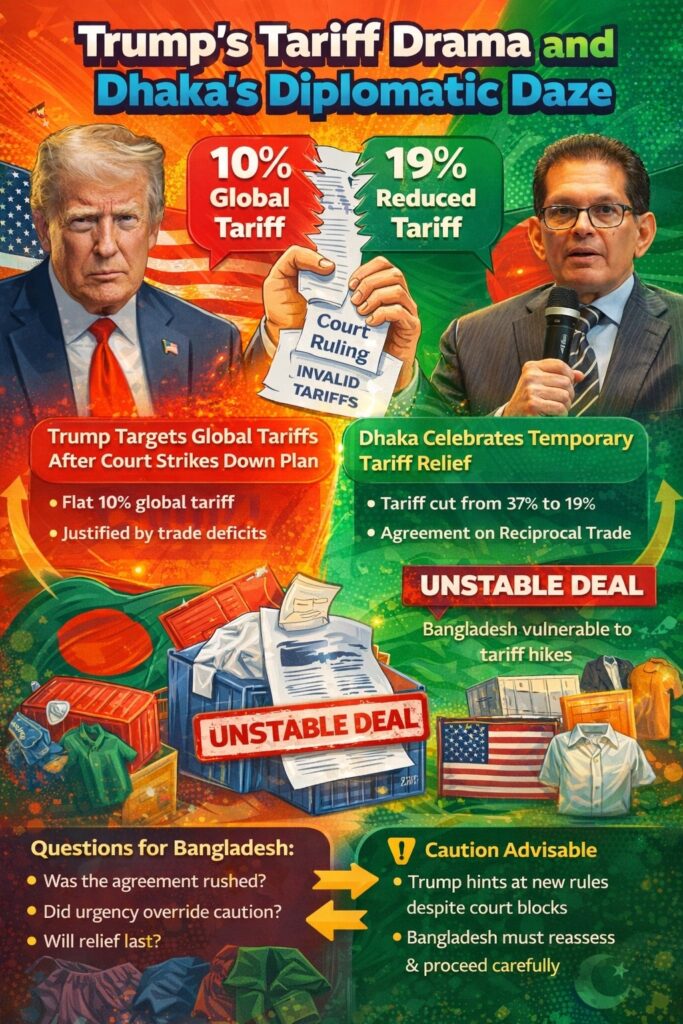
Within hours of the ruling, Trump reached for his pen again. From the grave of an illegal tariff regime rose a new structure, this time under Section 122 of the 1974 Trade Act. The justification stayed simple: trade deficits demand punishment. A flat 10 percent global tariff emerged, with selective exemptions. The legal wrapper changed; the impulse stayed intact.
Satire writes itself here. Trump attacked judges, mocked the court, and dismissed constitutional restraint, while simultaneously hunting for legal loopholes to revive the same policy. In his worldview, the constitution functions like an elastic- stretchable, disposable, and replaceable whenever convenience demands.
The audience for this drama extends far beyond American voters. Economies large and small sway under these tariff tremors. Bangladesh stands among them, sometimes as spectator, sometimes as unwilling participant.
Dhaka recently celebrated a so-called Agreement on Reciprocal Trade with Washington. Officials framed tariff reduction from 37 percent to 19 percent as a diplomatic success. The court ruling now exposes fragility beneath that celebration. A deal resting on an invalid tariff foundation loses certainty. In international commerce, ink alone carries little weight; enforceability carries everything.
Here lies Bangladesh’s discomfort. Officials rushed toward applause before checking durability. Trump’s trade politics recognize no permanence. Today offers 19 percent, tomorrow 10, next week 50. Policy shifts follow mood swings, not planning.
Bangladesh’s policymakers now face unavoidable questions. Did urgency override prudence? Did fear of export collapse force a premature compromise? Reality likely sits between both answers. The interim government confronted pressure from looming tariffs and grabbed relief where available, exit clauses included. Yet the court ruling now hands Dhaka unexpected leverage.
Irony deepens further. Trump once labeled his tariff announcement ‘economic independence day.’ For export-dependent countries, that day signaled uncertainty, not freedom. The court verdict now strips that slogan of legitimacy. Independence sounds easy in speeches; legality proves harder.
Bangladesh’s garment sector absorbs the sharpest shock from this oscillation. Lower tariffs offer temporary relief; higher ones threaten orders and employment. Long-term survival, however, depends not on tariff percentages but on predictability. Business avoids chaos. Trump-style trade policy thrives on it.
Dhaka therefore needs calculation, not celebration: strategy, not speed. The court ruling does not demand cancellation of agreements; it invites reassessment. Costly commitments, large import promises, aircraft or energy purchases now require sober review. Diplomacy demands arithmetic, not applause.
As for Trump, he already hints at ‘many great alternatives.’ In his vocabulary, alternatives mean new rule-bending routes. Yet when domestic courts block those routes, external partners must proceed with caution.
This episode reinforces an old lesson. Global trade rarely follows principles; interests dominate. Trump merely voices that truth loudly. Bangladesh must learn to read risk beneath rhetoric.
A 10 percent tariff may soothe nerves today. What follows after 150 days remains unknown, perhaps even to Trump himself. This moment calls for preparation, not satisfaction. In Trump-era politics, instability alone guarantees permanence.
Failure to act wisely will invite history’s satire- Bangladesh clapping at opportunity while losing ground, remaining a silent spectator inside another leader’s chaotic drama.
##########
The Author:
 Asif Showkat Kallol: Works for a German-based online outlet, The Mirror Asia as Head of News. Contributor, Pressenza- Dhaka Bureau.