

Democrats are riding high in recent polls, but this surge may owe more to the current administration’s missteps than to their own vision. Without a generative, long-term blueprint—like Project 2025 on the right or the Green New Deal—liberal gains risk feeling reactive rather than transformative. What might a durable Democratic project look like, and how could it turn short-term momentum into lasting influence?
The current liberal surge feels real, a swell in public sentiment that suggests energy and possibility. Polling numbers rise, and political commentators point to renewed enthusiasm for Democrats, but beneath the surface, the vitality is uneven. Polls show Democrats holding a seven-point advantage over Republicans on voting intention for Congress—their largest lead since the Economist/YouGov polls resumed after the 2024 election. Part of this advantage reflects the fact that Republicans are more likely to express uncertainty or abstain from voting, highlighting that much of the surge is contingent rather than driven by a fully cohesive vision. The strength is reactive, a response to errors, missteps, and stumbles by the administration in power, rather than an expression of an internally coordinated strategy. It is the kind of strength that appears in contrast, that feeds on the visible failures of others rather than articulating its own direction. This is hollow power—energy that circulates because of the misfortunes of an opponent rather than the initiative of those who seem to ride its wave.
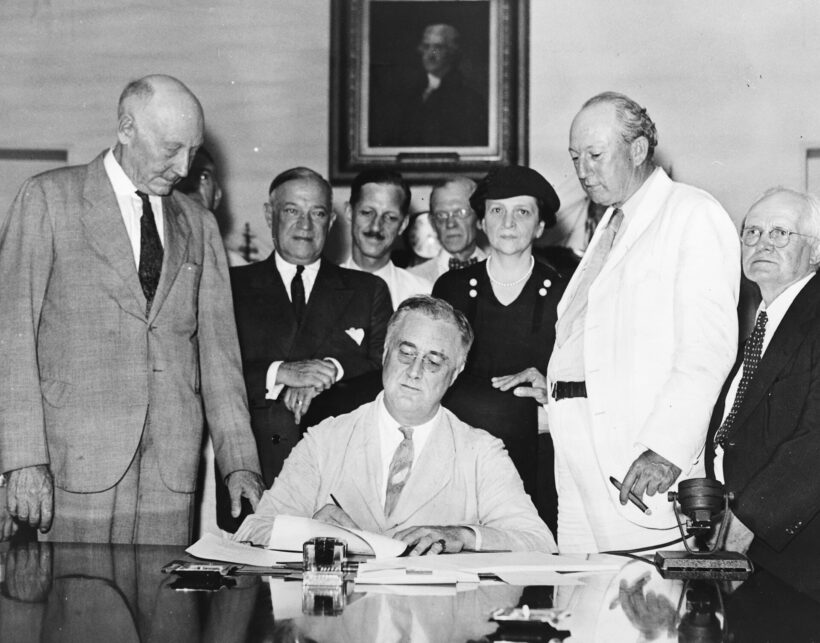
History provides clarity on why reactive momentum is not the same as lasting influence. Franklin Delano Roosevelt’s New Deal offers an instructive example of political energy structured with purpose. Programs like Social Security, the Works Progress Administration, and labor protections were not merely responsive to immediate crises; they created durable frameworks that reshaped governance and society. They laid a foundation, a scaffold upon which public life could be stabilized, organized, and expanded. Strength anchored in vision is enduring. Strength that responds only to crises is often temporary, leaving gains vulnerable to reversal when circumstances shift.
Civil Rights legislation demonstrates a similar principle. The movement of the 1950s and 1960s mobilized coalitions across regions, races, and political affiliations. The Voting Rights Act and Civil Rights Act were structural interventions, designed to ensure fairness and access, and they carried moral authority that lent weight to the policies themselves. Generative power, as these efforts show, is built not on opposition missteps but on coordination, legitimacy, and purpose. Political gains built on reaction lack these foundations.
More recent attempts to unify liberal energy, such as the Green New Deal, reflect the same desire to create cohesive frameworks. Climate, labor, and social equity were framed as interconnected, each element supporting the others. Yet, as currently implemented, this vision remains more aspirational than operational, a set of principles without the infrastructure to sustain them fully. Momentum exists, but without the scaffolding of legislation and durable institutional design, it risks remaining symbolic rather than transformative.
Meanwhile, conservative initiatives have shown a capacity for long-term strategic coordination. Project 2025 exemplifies the deliberate cultivation of personnel, judicial appointments, and policy networks designed to achieve systemic influence. This approach demonstrates the difference between reactive energy and structural power: the former is visible and immediate but ephemeral; the latter is calculated, sustained, and prepared to endure through shifts in circumstance.
Negative partisanship is an important factor in this dynamic. Many voters express enthusiasm for Democrats not because of a deep connection to the party’s policy vision, but out of frustration or fear toward the opposing party. This form of motivation is potent in the short term, capable of generating spikes in polling numbers or mobilizing turnout, but it is not the same as a unifying programmatic vision. Sustained political strength, in contrast, requires affirmation: what a party stands for, not merely what it stands against. The recent seven-point lead illustrates this dynamic perfectly—Democrats appear ahead in raw numbers, yet the advantage is partly shaped by uncertainty and abstention among their opposition. Momentum, therefore, is evident, but not fully self-generated.
Philosophical and literary perspectives illuminate the fragility inherent in reactive politics. Alexis de Tocqueville observed that the health of a democracy relies on active civic engagement, on systems and habits that maintain balance. Hannah Arendt distinguished between mere power, which can be temporary and coercive, and authority, which is grounded in recognition and legitimacy. John Dewey emphasized democracy as an ongoing moral and social project that requires continual investment in the structures that support communal life. Without this grounding, political energy resembles a pulse without direction—felt, visible, but easily dissipated.
Writers and poets echo similar lessons. Langston Hughes chronicled the simultaneous hope and vulnerability of communities in flux, showing that social energy without supportive structures can falter. Toni Morrison explored the ways societal neglect and trauma shape collective potential, demonstrating that vitality must be accompanied by care, coordination, and deliberate cultivation. Political movements, like societies, cannot rely solely on responsive or reactive energy; without deeper integration, gains are unstable.
For contemporary liberal strategy, the implication is clear. Short-term momentum is not a substitute for a coherent project. To transform current polling advantages into lasting influence, Democrats need a vision that aligns policy, civic engagement, and moral authority. Reliance on opposition missteps alone is insufficient; it produces transient gains that can vanish once external pressures shift. A robust approach would integrate several pillars: climate policy that frames environmental and economic transformation as linked; social and economic justice that ensures opportunity is broadly accessible; civic renewal that strengthens institutions, public engagement, and trust; and reforms that stabilize and modernize governing structures.
The contrast between reactive and generative approaches is evident in comparing Democratic initiatives with conservative strategies such as Project 2025. While the latter has emphasized long-term planning, personnel development, and systemic alignment, the former has often depended on seizing openings created by external failures. Polling surges, though encouraging, risk being provisional when not embedded in broader frameworks of vision and infrastructure.
History, philosophy, and literature together underscore a recurring theme: durability in politics requires more than surface vitality. Roosevelt’s New Deal, civil rights legislation, and aspirational programs like the Green New Deal illustrate that policy must be both visionary and concrete, principle and infrastructure. Philosophical reflection—from Tocqueville to Arendt to Dewey—reminds us that legitimacy, authority, and ongoing civic investment are critical to sustaining influence. Literary reflections provide insight into the human and social dimensions of momentum, showing that morale, coordination, and the ability to respond to systemic needs are what translate energy into durable impact.
Ultimately, liberal energy today is a mixture of promise and precariousness. Polling shows engagement, enthusiasm, and potential; media coverage highlights visibility and responsiveness. Yet the underlying structural deficits are apparent. Without a defined, coherent project, gains remain provisional, dependent on external circumstances rather than internally generated strength. Momentum alone is insufficient; to become transformative, it must be guided by deliberate vision, integrated policy, and sustained civic engagement.
The current moment is both an opportunity and a cautionary tale. Democratic energy could be translated into lasting influence if paired with strategic planning, coalition-building, and structural vision. It will require moving beyond reactive policies to crafting ones that are not only responsive to current crises but also anticipatory, durable, and morally grounded. Visionary projects such as the Green New Deal hint at the possibilities, but their promise must be realized through the hard work of implementation and coordination. Without this, even the most striking gains risk fading as circumstances evolve.
The liberal surge, impressive as it may appear, is not a substitute for vision. History teaches that momentum must be coupled with structural foresight; philosophy teaches that power without legitimacy is unstable; literature teaches that energy alone cannot sustain complex social bodies. To ensure that current gains endure, Democrats must articulate projects that integrate policy, civic engagement, and moral clarity—projects capable of translating reactive momentum into generative, lasting strength. Without such integration, present successes remain ephemeral, a series of responsive gestures that will not survive the next phase of political challenge. The imperative is clear: the party must move from reactive pulse to coherent project, from hollow power to generative force, crafting a vision capable of sustaining both influence and the public good.



