

Diplomacy at the Brink: Iran, the United States, and the Stakes of Peace in the Middle East
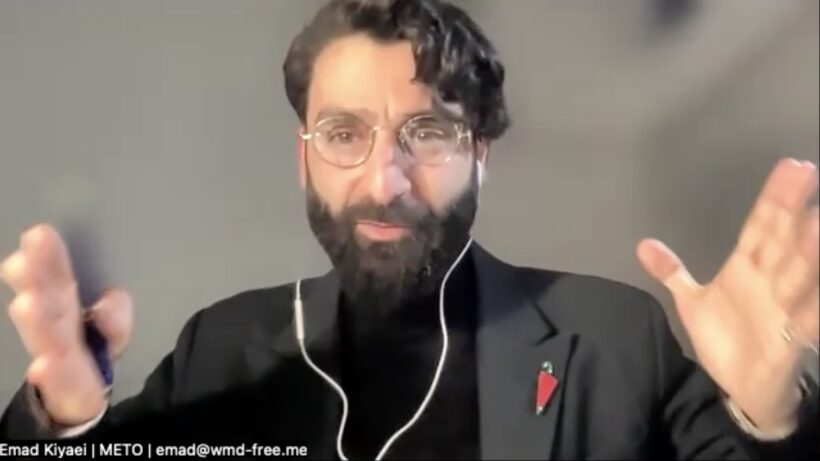
David interviewed Emad Kiyaei, co-director of the Middle East Treaty Organization, to discuss the ongoing negotiations between Iran and the United States currently taking place in Geneva. Their conversation explored not only the technical dimensions of the talks but also the broader geopolitical forces shaping the future of peace and security in the Middle East.
Emad began by situating Iran within its geographical and historical context. Positioned at the crossroads of Central Asia, the Middle East, and South Asia, Iran has long been a strategic actor in a region marked by chronic instability, foreign intervention, and unresolved conflicts. This reality, he explained, makes Iran both a focal point of regional tensions and a potential key to broader stability—if approached through diplomacy rather than coercion.
The discussion quickly turned to the fragile state of peace in the Middle East and the dangerous possibility of a direct military confrontation between the United States and Iran. Emad warned that such a conflict would not remain contained but would likely escalate into a regional war with devastating global consequences—economically, politically, and humanly.
A central concern raised was the persistent narrative surrounding Iran’s nuclear program. Emad emphasized that Iran does not possess nuclear weapons, in contrast to Israel, whose nuclear arsenal remains outside international oversight. He cautioned against the repetition of false or exaggerated claims used to justify military action, drawing parallels to the Iraq War and its long-lasting destabilizing effects. Once again, he noted, accusations risk being weaponized to legitimize war rather than to prevent it.
Beyond nuclear issues, Emad highlighted Iran’s strategic importance as a major energy supplier, particularly to China, alongside other Persian Gulf countries. This economic reality, he argued, makes Iran indispensable to regional and global stability. He referenced warnings from Iran’s leadership that any U.S. attack would inevitably trigger a wider regional response—underscoring Iran’s determination to retaliate if militarily targeted.
The conversation then broadened to the global balance of power. Emad argued that attempts to curb China’s rise are no longer realistic, as Beijing has already established deep economic ties and long-term strategic interests across the Middle East and beyond. He stressed the importance of understanding China as a “civilization state” with a tradition of long-term planning—contrasting this with the relatively short historical arc of U.S. global dominance. David agreed, suggesting that negotiations in Geneva must be reframed to reflect these evolving realities rather than clinging to outdated power assumptions.
At the technical level, Emad outlined the three core issues at the heart of the negotiations: uranium enrichment levels, verification mechanisms, and assurances that Iran will not develop nuclear weapons. He explained that Iran has expressed willingness to cap enrichment at 3.67 percent—the level agreed under previous accords—and to accept intrusive international inspections. However, the U.S. demand for zero enrichment remains a major obstacle, as Iran retains the legal right to enrich uranium under the Nuclear Non-Proliferation Treaty.
For Emad, the nuclear file itself is not the real problem. The deeper issue, he argued, lies in the political and governance system ruling Iran and its adversarial relationship with the West. Yet even here, he insisted, war would be catastrophic and counterproductive. Only sustained diplomacy, international engagement, and multilateral pressure can create conditions for long-term change.
David echoed this perspective and pointed to possible actions by the international community, including convening discussions at the United Nations Security Council and mobilizing political forces—particularly within the U.S. Congress—to actively prevent another war in the Middle East. Both emphasized the need for regional solutions supported by international consensus rather than imposed by force.
The conversation concluded on a sober but hopeful note: the Middle East remains central to global peace, energy security, and economic stability. Whether it becomes a theater of perpetual conflict or a space for diplomatic renewal will depend on the willingness of global actors to abandon militarized reflexes and invest in genuine, inclusive negotiations. In Geneva, the stakes could hardly be higher.
At this critical juncture, the role of the American public itself becomes essential. Preventing another catastrophic war in the Middle East cannot be left solely to closed-door diplomacy. Recent efforts by Ro Khanna and Thomas Massie to force a congressional vote under the War Powers Resolution signal that space still exists within U.S. institutions to restrain unilateral military action. But such efforts will only succeed if they are backed by public pressure. Americans who oppose a new war with Iran must make their voices heard—by calling, writing, and urging their representatives to assert Congress’s constitutional authority and demand diplomacy over escalation. History has shown the cost of silence. At a moment when the consequences of conflict would reverberate far beyond the region, civic engagement may once again prove to be one of the most powerful tools for peace.



