

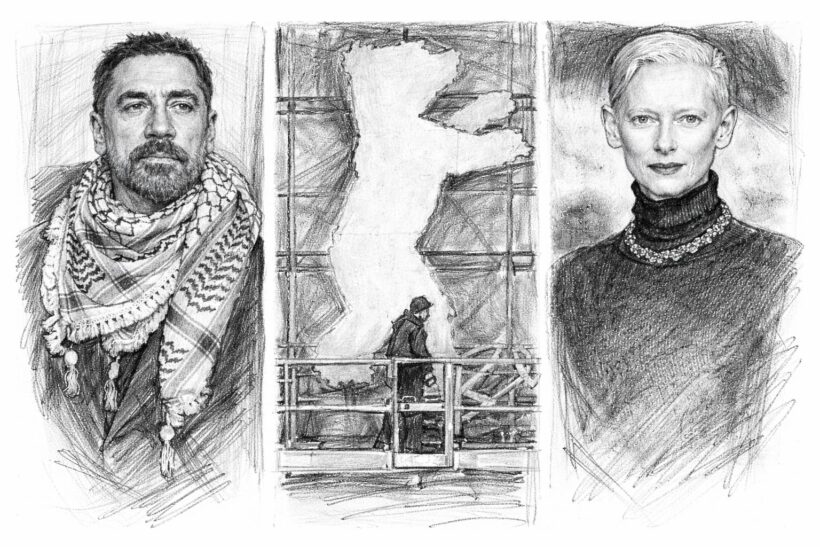
More than eighty figures from the international film community, including Javier Bardem, Tilda Swinton and Adam McKay, publicly challenged the Berlin International Film Festival over its silence regarding Gaza. Their letter is not a symbolic gesture: it is a direct ethical indictment of institutional indifference at a time of mass crimes documented by the United Nations.
On February 17, 2026, during the 76th edition of the Berlin International Film Festival, more than 80 filmmakers and artists — among them Javier Bardem, Tilda Swinton and Adam McKay — signed an open letter that breaks with the comfortable diplomatic language of the cultural sector. They did not speak of “concern.” They did not call for “dialogue.” They named things for what they are: genocide, crimes against humanity and war crimes.
The letter accuses the Berlinale of maintaining “institutional silence” regarding what is happening in Gaza and of censoring artists who have publicly denounced the Israeli offensive. It goes further: it argues that failing to take a stance in a context of systematic extermination amounts to shielding the perpetrator from accountability.
This is neither an isolated nor a rhetorical claim. The United Nations Special Rapporteur on the Occupied Palestinian Territories, Francesca Albanese, has documented in her reports patterns which, according to her legal analysis, fit the definition of genocide under the 1948 Convention. She has spoken of the deliberate destruction of conditions of life, of collective punishment, of massive forced displacement and of a regime that structurally dehumanizes the Palestinian population. This is not an activist slogan; it is a legal qualification emerging from the normative framework of the United Nations itself.
In this context, the signatories’ thesis is clear: silence is not neutrality. It is a form of alignment.
The Berlinale, as a festival largely funded by German public funds, is not a private entity without political responsibilities. It is a cultural institution with global symbolic weight. In the past, it has issued firm statements regarding repression in Iran or Russia’s invasion of Ukraine. Why now invoke the supposed “autonomy of art from politics”? Why does the principle of non-intervention appear only when the accused is a strategic ally of the West?
The letter also points to a troubling fact: filmmakers who, in the previous edition, defended from the festival stage the Palestinians’ right to life and freedom were reportedly aggressively reprimanded by festival programmers. If cultural space cannot host the denunciation of massive human rights violations, what kind of artistic freedom is being defended?
The argument that “cinema should remain outside politics” ignores an elementary historical truth: art has always been a field of moral dispute. From Italian neorealism to Latin American cinema of denunciation, and from films against South African apartheid, cinema has been a vehicle for memory, resistance and critical awareness. Pretending that art must remain aseptic in the face of the devastation of a civilian population is, in itself, a political act.
What the signatories are asking is not that the festival adopt an ideology, but that it assume a minimum standard of ethical coherence: affirm the Palestinians’ right to life, condemn crimes documented by international bodies and guarantee that artists can speak without reprisal.
In legal terms, complicity does not require holding a weapon. It can consist of facilitating, legitimizing or covering up. In moral terms, it can consist of looking the other way. When a major cultural festival chooses silence in the face of well-founded accusations of genocide, the message it sends is not prudence: it is normalization.
The letter of February 17 is not an isolated gesture by celebrities. It is part of a growing fracture within the Western cultural world, where artists, academics and cultural workers reject the double standard with which human rights violations are judged. They demand coherence: if the principle is universal, it must be applied without exception.
The question this controversy leaves us with is uncomfortable but unavoidable: can a cultural institution claim moral authority while avoiding taking a position in the face of the systematic destruction of a people?
Failing to take a stance in the face of genocide is not neutrality. It is passive participation in its normalization. And history, when it judges, does not distinguish between those who executed and those who remained silent.
Annex
Substantial paragraphs
Open letter to the organizers of the Berlin International Film Festival
February 17, 2026
We write as film workers, all of us past and current Berlinale participants, who expect the institutions in our industry to refuse complicity in the terrible violence that continues to be waged against Palestinians.
We are dismayed at the Berlinale’s institutional silence on the genocide of Palestinians in Gaza and the German state’s key role in enabling it.
We are appalled by the Berlinale’s involvement in censoring artists who oppose the genocide that Israel continues to perpetrate against Palestinians in Gaza and the German state’s key role in enabling it. As the Palestine Film Institute has stated, the festival has been “policing filmmakers alongside a continued commitment to collaborate with Federal Police on their investigations.”
Last year, filmmakers who spoke out in favor of Palestinian life and freedom from the Berlinale stage were aggressively reprimanded by festival programmers.
Many major international film festivals have backed the cultural boycott of apartheid Israel, with thousands of film professionals, including major Hollywood figures, announcing they will not collaborate with complicit Israeli film companies and institutions.
However, the Berlinale has so far failed even to meet the demands that its community issue a statement affirming the right of Palestinians to life, dignity and freedom; condemn Israel’s ongoing genocide against Palestinians; and pledge to defend the right of artists to speak without restriction in support of Palestinian human rights. This is the least it can and should do.
We call on the Berlinale to fulfill its moral duty and clearly state its opposition to Israel’s genocide, crimes against humanity and war crimes against Palestinians, and to end entirely its involvement in shielding Israel from criticism and accountability.



