

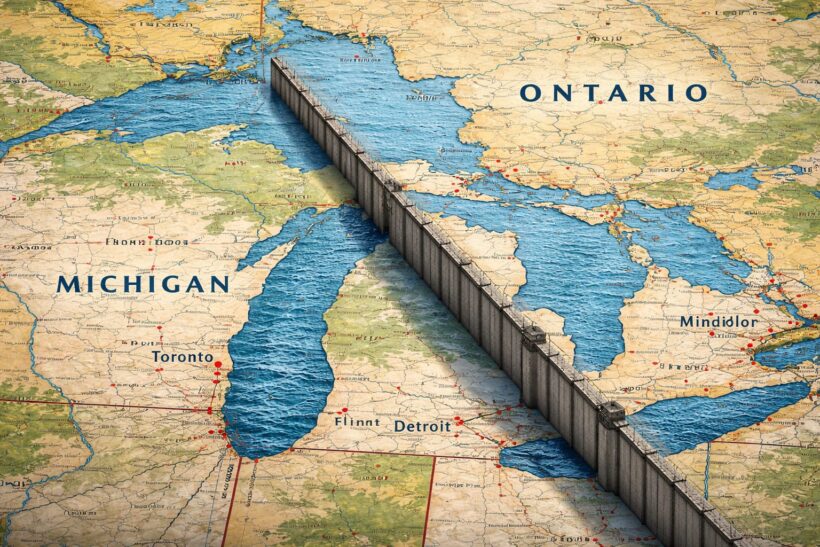
The White House warning that it could halt or condition the new binational bridge connecting Michigan and Ontario deepens the deterioration of relations between the United States and Canada. In a corridor through which nearly a quarter of bilateral trade flows and tens of thousands of people cross each day, the signal is not only economic: it is political and strategic.
The bridge at the center of the controversy is the Gordie Howe International Bridge, a key infrastructure project that will link Detroit, in the state of Michigan, with Windsor, in the province of Ontario. It is estimated that up to 40,000 people could cross daily through this passage, in addition to a significant volume of goods. This is not solely industrial trade: thousands of students, cross-border workers and tourists use this corridor every day, one of the most dynamic in North America.
Approximately 25 percent of total trade between the United States and Canada moves through this axis. The bilateral economic relationship is one of the most integrated in the world, with deeply intertwined supply chains in sectors such as automotive manufacturing, energy, agribusiness and advanced industry.
The symbolism of the bridge
The new bridge is not merely an engineering project. It represents the continuity of an economic architecture that, since the signing of the North American Free Trade Agreement in 1994 and its subsequent renegotiation as the USMCA, has turned the border into a space of productive interdependence.
Detroit and Windsor form a shared industrial ecosystem, particularly in the automotive sector. Components cross the border multiple times before becoming a finished vehicle. Any disruption in the fluidity of passage directly impacts production chains operating under just-in-time systems.
Threat and deterioration
The threat to block or condition the functioning of the bridge must be understood within a broader context of tension. Since returning to power, Donald Trump has revived a nationalist discourse centered on economic sovereignty, industrial reshoring and aggressive review of trade commitments.
Although Canada has not traditionally been portrayed as a strategic adversary, it has been the subject of recurring trade frictions: disputes over steel and aluminum tariffs, controversies regarding dairy products, disagreements over industrial subsidies and pressures related to energy and environmental policies.
Protectionist rhetoric has generated uncertainty in Ottawa and in provincial governments, particularly in Ontario, whose economy depends heavily on trade with the United States.
Impact on mobility and tourism
Beyond commerce, the Michigan-Ontario corridor is a zone of intense human mobility. Thousands of people cross daily to work or study. Universities and research centers maintain constant cross-border links.
Tourism, traditionally fluid between the two countries, has shown signs of slowdown since the return of a more confrontational discourse in Washington. Although figures fluctuate due to multiple factors — exchange rates, transportation costs, perceptions of safety — the symbolic dimension of a politicized border influences travel decisions.
The potential economic blow
A significant blockade or restriction of the new bridge would have immediate consequences.
First, it would raise logistical costs for companies dependent on the smooth transit of goods.
Second, it could encourage diversions to other border crossings already operating at or near capacity.
Third, it would send a signal of regulatory instability that affects long-term investment decisions.
Given that around 25 percent of bilateral trade crosses through this region, any interruption constitutes a direct blow to the most important economic relationship for both countries.
Milestones in the recent estrangement
The current deterioration did not arise in a vacuum. A sequence of frictions can be identified.
The renegotiation of NAFTA under the first Trump administration, accompanied by explicit threats of unilateral withdrawal.
The imposition of tariffs on Canadian steel and aluminum under the argument of “national security,” a measure that generated strong resentment in Ottawa.
Pressures regarding agricultural quotas and rules of origin in the automotive sector.
Energy disputes linked to pipelines and environmental standards.
Each episode left political scars, even as trade continued to flow due to the structural depth of interdependence.
What Washington seeks
The central question is strategic. The hostility does not appear aimed at a total rupture with Canada, whose market and security cooperation are essential for the United States. Rather, it responds to several simultaneous logics.
To reinforce a nationalist narrative for the domestic electorate, where the defense of economic sovereignty functions as a political tool.
To pressure for specific sectoral concessions in trade negotiations.
To reaffirm U.S. primacy within the North American space, setting limits on Canadian industrial or environmental policies that Washington may view as misaligned with its interests.
However, this strategy carries risks. The relationship with Canada is not merely commercial: it includes continental defense cooperation through NORAD, coordination on border security and a unique density of cross-border social ties.
A border turned into a political instrument erodes trust accumulated over decades.
A strategic relationship under strain
The threat to block the new binational bridge is more than a tactical gesture. In a region where commerce, work, study and daily life depend on a functional border, the signal of confrontation has structural impact.
If Washington’s objective is to rebalance trade terms or strengthen its internal nationalist narrative, the cost may be the erosion of one of the most stable bilateral relationships in the Western Hemisphere.
When interdependence becomes a tool of pressure, the bridge ceases to be a symbol of integration and becomes a point of strategic vulnerability. In that shift, both countries have more to lose than to gain.



