

by Asif Showkat Kallol (Dhaka Bureau)
In a move set to redraw the economic map of South Asia, the United States and Bangladesh have signed a comprehensive Reciprocal Trade Agreement, signaling a ‘new era’ of bilateral cooperation that moves beyond traditional aid and toward a robust commercial partnership.
The agreement, signed on Monday in Washington, marks the most significant diplomatic shift since Bangladesh’s political transition. At its core, the deal aims to balance a lopsided trade relationship that has historically seen Bangladesh as a garment supplier and the US as a distant donor. Commerce Advisor Sheikh Bashir Uddin has said Bangladesh will receive duty-free access for 85 to 86 per cent of its exports under the reciprocal trade agreement with the United States.
He made the remarks on Tuesday afternoon at a press conference at the Secretariat to brief the media on the reciprocal trade agreement, also known as the ART, with the United States. ‘Readymade garment products account for 86 per cent of our total exports. If we use US cotton in these garments, then the garments will have access to the US market at zero supplementary duty,’ he said. ‘Simply put, 85 or 86 per cent of our exports will be duty free, while the remaining 14 to 15 per cent of exports will be subject to a supplementary duty of 19 per cent,’ Bashir added.
He assured that Bangladesh can withdraw from the trade deal through an ‘appropriate notice.’ ‘We were also mindful of the possibility that a future government may feel that, for some reason, this agreement is not suitable for them. That is why we have incorporated this (exit clause) into the agreement. This, in broad terms, is our achievement,’ he added.
The ‘Fiber for Fabric’ Exchange
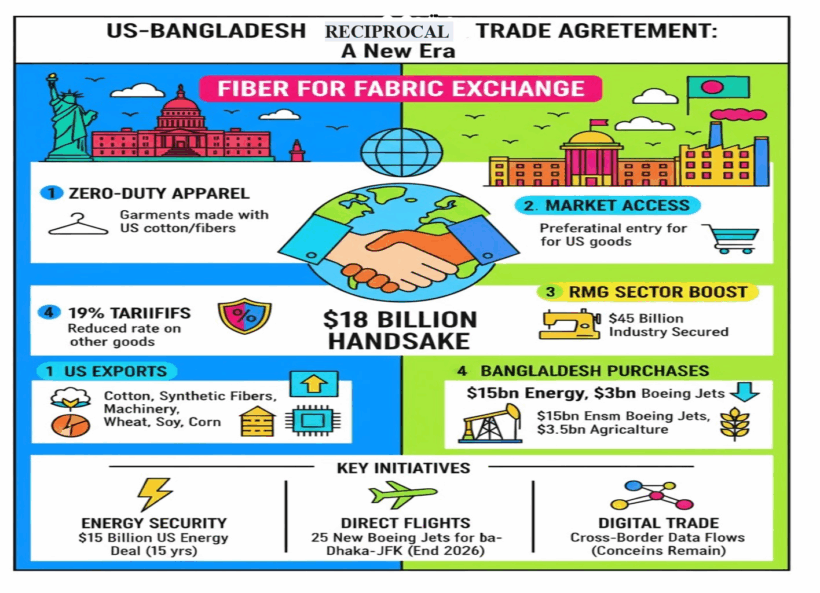
The centerpiece of the deal is a sophisticated ‘reciprocal tariff’ mechanism. For the first time, the US has lowered its average tariff on Bangladeshi goods to 19%, with a groundbreaking provision for zero-duty access on apparel.
However, the ‘reciprocity’ comes with a strategic string attached: the duty-free status applies specifically to garments manufactured using US-grown cotton or synthetic fibers. This “circular trade” model is designed to bolster US agricultural exports while securing the future of Bangladesh’s $45 billion Ready-Made Garment (RMG) sector against rising regional competition.
Wheat, Soya and Wings
In exchange for textile concessions, Dhaka has opened its doors to a flood of American industrial and agricultural products. The agreement includes:
Energy Security: A $15 billion commitment by Bangladesh to purchase US energy products over the next 15 years.
The Boeing Dividend: A $3 billion deal for 25 new Boeing aircraft, a move intended to help the Civil Aviation Authority of Bangladesh (CAAB) finally secure the coveted FAA Category 1 safety rating required for direct flights to New York and beyond.
Agricultural Market Access: Preferential access for $3.5 billion worth of US wheat, soy, and corn, effectively making the US a primary food security partner for the delta nation.
A Pivot of Necessity
For Washington, the deals are a clear attempt to ‘friend-shore’ supply chains and reduce reliance on Chinese manufacturing. For Dhaka, it is an economic lifeline. `This is no longer a donor-recipient relationship,’ said a senior trade official in Dhaka. `This is a partnership of equals. We are buying their technology and energy, and they are buying our craftsmanship.’
Critics, however, raise concerns about the `digital reciprocity’ clauses, which require Bangladesh to allow cross-border data flows. Human rights advocates warn that without stringent local protections, such “trusted border” data transfers could be exploited.
The Road Ahead
While the paperwork is signed, the true test lies in the infrastructure. The resumption of direct flights between Dhaka and the US remains the `holy grail’ of this reciprocal traffic. Industry experts suggest that with the new Boeing fleet and updated safety protocols, direct ‘Dhaka-JFK’ flights could be operational by the end of 2026.
As the global economy faces continued volatility, this $18 billion handshake suggests that both Washington and Dhaka are betting on each other to navigate the coming decade.

The Author:
Asif Showkat Kallol: News Head of the Mirror Asia and Contributor, Pressenza- Dhaka Bureau.



