

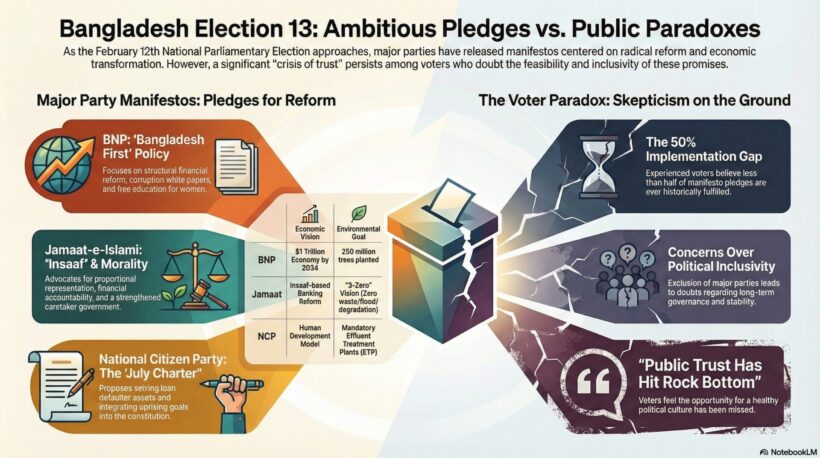
As the 13th National Parliamentary Election in Bangladesh approaches on February 12, political tension has reached its peak. Major political parties have unveiled their election manifestos, filled with ambitious promises of reform, governance, and public welfare. However, interviews with general voters reveal a deep-seated skepticism regarding the implementation of these pledges.
Major Parties and Their Pledges
The Bangladesh Nationalist Party (BNP), the primary opposition, has introduced its ‘Bangladesh First’ policy. Their key promises include ‘Family Cards’ providing 2,500 BDT monthly or equivalent food aid to low-income families, free education for women up to the Master’s level, and mandatory vocational training at the secondary level. In healthcare, they pledge to recruit 100,000 health workers and ensure quality service at the district level. Their governance model vows ‘Zero Tolerance’ for corruption and the publication of a white paper on the corruption of the past 16 years. Internationally, they emphasize friendship without hegemony, specifically prioritizing the cessation of border killings and the Teesta water-sharing treaty with India.
Bangladesh Jamaat-e-Islami has prioritized 26 points based on ‘Insaaf’ (Justice) and Morality. They advocate for a Proportional Representation (PR) system in elections and a strengthened Caretaker Government system. Their manifesto promises reduced working hours and safe environments for women, while aiming to place youth in central administrative roles. They have also committed to ensuring justice for past enforced disappearances, extrajudicial killings, and the July Revolution massacres. Economically, they aim to restore discipline in banking and ensure adulteration-free food by 2030.
The National Citizen Party (NCP), born from the spirit of the Anti-Discrimination Student Movement following the July uprising, has announced a 36-point manifesto. Central to their agenda is the inclusion of the ‘July Charter’ in the constitution. They propose severe penalties for loan defaulters, including the seizure of assets and the stripping of political rights. The NCP also promises a mandatory Effluent Treatment Plant (ETP) for factories and the creation of a separate ministry for the ‘Teesta Master Plan.’
Religious political groups, including Islami Andolan Bangladesh and allied Islamic parties, have centered their manifestos on religious and moral values. They pledge to establish a rule of law based on the Quran and Sunnah, ensuring no laws are passed contradictory to Islamic principles. They aim for an interest-free (Riba-free) economy to eliminate social inequality.
Economic and Environmental Visions
The manifestos shift focus from GDP-centric growth to improving the quality of life. The BNP aims for a $1 trillion economy by 2034, focusing on production rather than a ‘plunderer’s economy’ and raising FDI to 2.5% of GDP. Jamaat-e-Islami emphasizes an ‘Insaaf-based economy’ through banking reforms and an agricultural revolution. The NCP’s ‘Human Development Model’ prioritizes health, education, and internet accessibility over traditional GDP metrics, promising a minimum wage of 100 BDT per hour.
Regarding the environment, the BNP’s ‘Green Bangladesh’ plan includes excavating 20,000 km of rivers and canals and planting 250 million trees. Jamaat-e-Islami has introduced a ‘3-Zero’ Vision: Zero environmental degradation, Zero waste, and Zero flood risk. The NCP focuses on the Teesta Master Plan and mandatory ETPs to protect ecology.
Voices from the Ground: A Crisis of Trust
Despite these grand promises, the mood among voters remains somber. Speaking to Pressenza’s Dhaka Bureau, Mr. Abdul Khalek Bhuiyan, a retired bank official residing in Mirpur, expressed his disappointment.
‘Excluding a major party like the Bangladesh Awami League from the polls makes it hard to call this an inclusive election. Even if the election proceeds, there are serious doubts about whether the winner can govern peacefully for a full term,’ he noted.
When asked if the ‘1 Trillion Dollar Economy’ or ‘Insaaf-based Economy’ would lower daily commodity prices, his answer was a flat ‘No.’ He added, ‘We have a long history of manifestos. Everyone knows not even 50% of these are ever implemented.’
Mrs. Sajeda Begum (40), a government official from Uttara, shared similar sentiments. Regarding the promises of employment and cracking down on loan defaulters, she said, ‘Realistically, I don’t believe either of these. After the July uprising, there was hope for a healthy political culture, but that opportunity has been missed. Public trust in conventional politics has hit rock bottom.’



