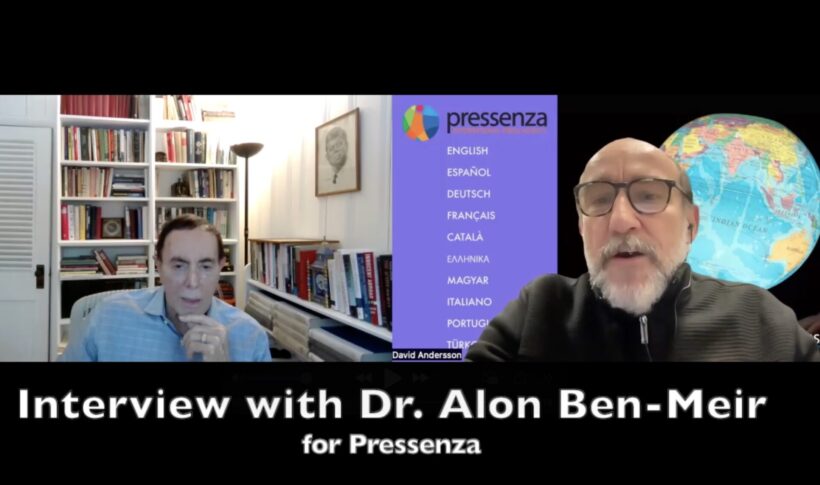
David interviews Dr. Alon Ben-Meir, retired professor of International Relations and Middle East Studies, for a wide-ranging conversation on the Davids Campaign and the urgent need to renew nonviolent strategies in the Middle East. The campaign seeks to support individuals and movements working to transform destructive and abusive power dynamics in Israel, Palestine, and Gaza—particularly those opposing the current Israeli government and the ongoing war.
The conversation opens with reflections on the lack of international support for Israeli opposition voices, a concern echoed by activist Sophie Bessis, and sets the context for a broader discussion on peace prospects, U.S. policy, and regional dynamics. While David initially hoped to also explore the Trump peace plan and Iran, the discussion remained focused on the Israeli-Palestinian conflict.
Israeli-Palestinian Peace Skepticism
Dr. Ben-Meir expresses deep skepticism about the Trump administration’s peace initiative, arguing that it lacks a genuine Israeli commitment to accepting an independent Palestinian state. He strongly criticizes the Netanyahu government for continuing military operations in Gaza, citing widespread destruction and civilian casualties since the October 2025 ceasefire. He also questions the Israeli public’s limited mobilization against the ongoing violence and calls for a profound transformation of Israeli society as a prerequisite for peace.
Challenges to the Two-State Solution
The discussion turns to the viability of a two-state solution. Dr. Ben-Meir explains why a single democratic state is rejected by Israel, given demographic realities, and argues that Israel’s de facto approach—maintaining control over the West Bank and Gaza without granting Palestinians political rights—is unsustainable. He warns that prolonged occupation and denial of Palestinian national aspirations will inevitably fuel continued violence. As an alternative, he advocates for a long-term process of reconciliation and normalization, anchored in a clear and credible commitment to a two-state outcome.
U.S.–Israel Policy Constraints
David and Dr. Ben-Meir examine the role of the United States, emphasizing how domestic political pressures—particularly from pro-Israel lobbying groups and evangelical constituencies—limit Washington’s ability to act as a balanced mediator. They agree that meaningful progress would require the U.S. to adopt a firmer and more independent stance, even at the cost of political backlash.
Reevaluating the Conflict’s Trajectory
Dr. Ben-Meir highlights the long-term human consequences of the occupation, noting that the overwhelming majority of both Israelis and Palestinians have lived under its reality. He warns that without a fundamental change in direction, the cycle of violence will continue. David raises concerns about the absence of a structured and effective opposition, both in Israel and in the United States, and questions how constructive change can emerge under current conditions.
Strategies for Social and Political Change
The conversation concludes with reflections on pathways for change. Dr. Ben-Meir stresses the importance of sustained public protest and civil disobedience. David suggests high-visibility actions—such as postponing the FIFA World Cup in the United States—as potential leverage points to shift public attention and political pressure. Both agree that changes in leadership, in Israel and the U.S., alongside a transformed public narrative centered on peace and mutual recognition, are essential.
Toward Future Negotiations
In closing, David and Dr. Ben-Meir reaffirm the necessity of a genuine two-state solution, the inclusion of all Palestinian factions in negotiations, and reciprocal recognition of security and existence for both peoples. They underline the need for the United States to play a more balanced role and for international engagement to move beyond rhetoric toward concrete commitments.