

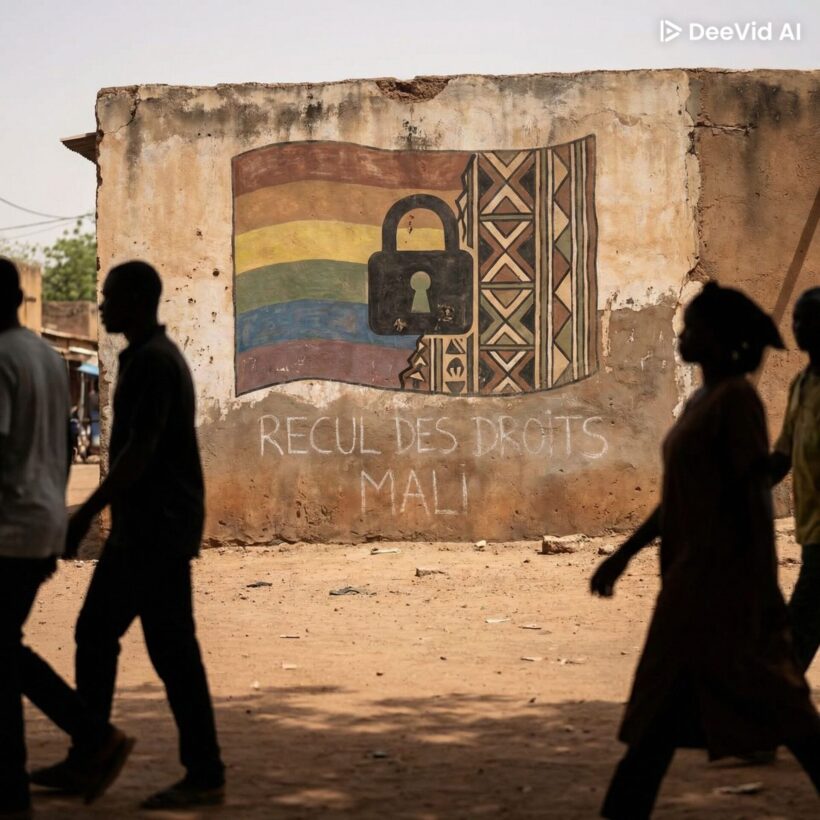
The recent reform of the Penal Code in Mali marks a critical turning point for human rights in the country and, in particular, for the situation of LGBTIQ+ people. By explicitly criminalizing same-sex relationships, the State has not merely introduced a new criminal offense; it has redefined the framework of social legitimacy, enabling a climate of persecution, fear and structural violence that extends far beyond the legal sphere.
The legal change cannot be understood as a simple normative adjustment. It operates as a performative political act: by turning certain identities and affective bonds into crimes, the State sends a clear signal to society about who is excluded from the legitimate body of the nation. In this gesture, the law does not simply sanction conduct; it produces vulnerable, exposed and unprotected subjects.
Since the reform entered into force, local and international human rights organizations have documented an increase in arbitrary arrests, extortion and threats against people perceived as LGBTIQ+, even in the absence of material evidence. Mere suspicion, rumor or informal denunciation has become sufficient to justify detention, police abuse and blackmail, both by state agents and by private actors acting under the protection of the new legal framework.
Criminalization has also had an immediate effect on the social fabric. Spaces that functioned as informal networks of support, meeting or refuge have been dismantled or forced to operate clandestinely. The reduction of these safe spaces is not collateral damage, but a direct consequence of the law: when the very existence of a group becomes illegal, every form of collective organization turns into a penal risk.
This process is embedded in a broader political context marked by the advance of nationalist, moralizing and authoritarian discourses. In Mali, as in other Sahel countries, the instrumentalization of “traditional” values and of a homogeneous national identity has become a tool of political legitimation. The stigmatization of LGBTIQ+ people serves a precise function within this framework: it provides an easily identifiable internal enemy, diverts attention from deeper structural crises—such as insecurity, poverty, corruption and institutional collapse—and reinforces a narrative of order and social purity.
From a human rights perspective, the reform violates fundamental principles of international law, including the right to privacy, equality before the law, and freedom from discrimination based on sexual orientation or gender identity. Its impact, however, goes beyond legal violation: it consolidates a hierarchy of lives, in which certain existences are declared less worthy of protection, or even expendable.
The psychological and social effects on LGBTIQ+ people are profound. Fear of being reported, arrested or attacked restricts access to basic services, including health care and justice. In particular, criminalization undermines access to HIV prevention and treatment programs, as seeking medical assistance may expose individuals to reprisals. In this way, the law not only punishes identities, but also generates indirect harm in terms of public health.
The international community has responded with condemnations and calls to reverse the reform, but the scope of external pressure is limited in a context in which the Malian government has deepened its distancing from multilateral frameworks and strengthened a sovereigntist discourse that presents any international criticism as foreign interference. In this scenario, LGBTIQ+ people are trapped between a State that criminalizes them and an international community whose capacity for effective protection is increasingly weakened.
What is happening today in Mali is not an isolated phenomenon, but part of a broader trend in which governments in crisis resort to the criminalization of identities to reassert political control. Criminalizing same-sex relationships resolves none of the country’s structural problems, but it does produce a clear symbolic order: it defines who belongs and who can be excluded at no cost.
In this sense, the penal reform represents not only a setback for LGBTIQ+ rights, but a broader warning sign of the deterioration of the rule of law in Mali. When a law turns the existence of a group into a crime, what is at stake is not only the safety of a minority, but the very architecture of human rights as a limit on power.



