

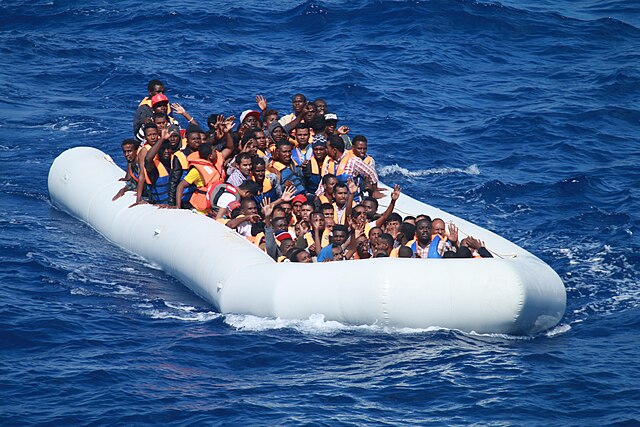
In January 2026, following a series of shipwrecks in the central Mediterranean that left nearly one thousand people dead or missing, the situation of migrants in Tunisia entered a new and more severe phase. These deaths did not occur in a political vacuum, nor were they solely the result of adverse weather conditions. They constitute the visible outcome of a migration regime designed to displace violence beyond European territory and to transform the sea into a space of lethal management of human mobility.
Complaints filed by Italian human rights organizations, including Mediterranea Saving Humans, Refugees in Libya, and independent monitoring networks, indicate that after the January shipwrecks, Tunisian security forces intensified practices of harassment against sub-Saharan migrants. These practices included arbitrary arrests, raids on informal camps, destruction of precarious shelters, use of police violence, collective expulsions toward desert or border areas, and direct pressure to force people to embark again toward Europe under manifestly dangerous conditions.
The central issue is not only the violence exercised by the Tunisian state, but the political structure that renders it functional. Tunisia does not act as a fully sovereign actor in migration matters. It operates as a buffer state within a system of border externalization promoted by the European Union since at least the 2010s and reinforced after the 2015 migration crisis. Within this system, North African countries are transformed into containment managers in exchange for funding, trade agreements, energy cooperation, and diplomatic recognition.
Border externalization allows Europe to preserve internally its liberal and rights-based rhetoric while displacing coercion, illegality, and death to peripheral spaces. The border ceases to be a legal line and becomes a chain of distributed violence. Each actor can claim to be merely fulfilling a technical function, but the aggregate result is a regime of systematic death.
In the Tunisian case, this dynamic is intensified by a context of deep economic crisis, structural debt, inflation, unemployment, and institutional weakening. The government of President Kais Saied, facing a deterioration of internal legitimacy, has increasingly resorted to nationalist, sovereigntist, and racialized discourses. Sub-Saharan migrants have been constructed as a demographic, economic, and cultural threat, functioning as scapegoats in a context of social collapse.
Violence against migrants is not an accidental excess. It fulfills precise political functions. Internally, it channels social discontent toward a vulnerable and rightless enemy. Externally, it demonstrates repressive efficiency to European partners, especially Italy, one of the main drivers of bilateral migration containment agreements with Tunisia in recent years. These agreements, negotiated in parallel with financial aid packages and energy cooperation, explicitly or implicitly condition European support on Tunisia’s ability to halt departures toward Sicily and southern Europe.
It is essential to reject interpretations that frame this situation as a mere localized human rights violation in Tunisia. Such readings reproduce a colonial narrative in which the global South appears as a space of barbarism and the North as an external moral judge. The politically honest question is different: who benefits from deaths occurring before people reach European soil.
The answer is structural. Each person who dies in the central Mediterranean reduces internal political pressure in European countries. Each illegal expulsion on Tunisian territory avoids an asylum procedure, a legal obligation, a parliamentary debate, and a political cost. The sea functions as an externalized mass grave, indirectly managed by states that proclaim themselves defenders of international law.
Reports that migrants are forced to embark after raids or threats do not represent a contradiction of the system, but its internal logic. If the objective is that people are not here, it does not matter if they die in the attempt. What matters is that they disappear from the European field of visibility. Violence is not a failure of the contemporary migration regime. It is its operational mechanism.
International responsibility does not rest exclusively with Tunisia. The European Union, as a bloc, and several of its member states have been repeatedly warned by human rights bodies about the consequences of border externalization. The Office of the United Nations High Commissioner for Human Rights has expressed concern over collective expulsions, the use of force, and the criminalization of migration in Tunisia. Amnesty International has documented patterns of violence, arbitrary detention, and illegal deportations, as well as the de facto closure of asylum pathways following the suspension of UNHCR activities in the country in 2024.
Nevertheless, European cooperation has continued, in many cases without effective human rights safeguards. This persistence reveals an implicit hierarchy of lives. Migrant lives, especially African and racialized ones, are treated as expendable variables in the management of the border order.
This crisis is not only humanitarian. It is deeply political and economic. Human mobility is treated as a threat because it calls into question a global order based on structural inequality. People migrate not by abstract choice, but as a consequence of wars, extractivism, climate change, debt, and the collapse of peripheral economies, many of them historically linked to policies promoted from the global North.
As long as these structural causes are not addressed, borders will continue to produce death as a form of governance. Tunisia is not an anomaly. It is a visible node in a system that requires violence to sustain itself without assuming its direct political cost.
What is at stake in the central Mediterranean is not only the fate of thousands of migrants. It is the normalization of a geopolitical model in which the global North preserves its internal stability by displacing death to the South, without assuming legal, moral, or historical responsibility. Naming this architecture of power is not a rhetorical option. It is a political obligation.



