

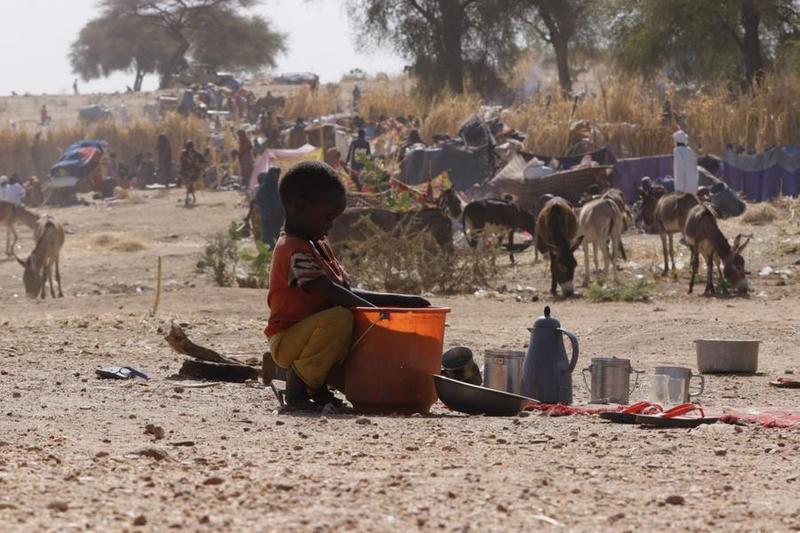
Behind this architecture of power and crossed vetoes lie concrete bodies. In Sudan, women have been systematically used as spoils of war: gang rapes, sexual slavery, abductions, and forced pregnancies form part of a pattern documented by humanitarian organizations and by survivors who, in many cases, have no access to medical or psychological care. Girls and adolescents have been attacked during displacement, in makeshift camps, or inside their own homes occupied by combatants. Sexual violence is not collateral damage: it is a deliberate weapon of domination and terror.
The figures are staggering. Tens of thousands of people have died since the beginning of the conflict, although the real number is likely far higher due to the impossibility of recording killings in vast areas of the country. More than ten million people have been displaced, making Sudan one of the largest displacement crises in the world. Entire communities have been wiped out in Darfur and other regions, with summary executions, village burnings, and ethnically motivated persecution. Hospitals have been destroyed or militarized, leaving the population without basic care while outbreaks of preventable diseases spread unchecked.
Hunger is advancing as a silent form of extermination. Millions face extreme food insecurity, with areas on the brink of famine. Children are dying of severe malnutrition in a country where humanitarian access is blocked or manipulated as a weapon of war. Each data point represents a broken life; each statistic, a story that finds no justice.
To speak of Sudan is not to speak of a distant or abstract conflict. It is to speak of a society pushed to the brink, of women marked for life, of entire generations growing up amid violence and displacement. It is to speak of a political failure measured in violated bodies, unnamed dead, and a human crisis of a magnitude the world knows, yet has chosen to tolerate.
The conflict in Sudan continues to constitute one of the most severe humanitarian disasters of the present, not only because of the scale of direct violence, but because of the combination of armed actors, external interests, and institutional collapse that blocks any sustainable political solution. Since the outbreak of open war in April 2023 between the Sudanese Armed Forces and the Rapid Support Forces, the country has been trapped in a dynamic of total war that exposes millions of people to systematic human rights violations.
The confrontation between the regular army, led by Abdel Fattah al-Burhan, and the paramilitary militia led by Mohamed Hamdan Dagalo, known as Hemedti, cannot be understood as a simple internal power struggle. It is a war for control of the state, resources, and strategic routes, in which the civilian population has been turned into a hostage. Urban areas, including the capital Khartoum, have been scenes of indiscriminate bombardment, extrajudicial executions, mass looting, and military occupation of hospitals, schools, and homes.
Peripheral regions, particularly Darfur, have once again experienced patterns of violence reminiscent of the worst episodes of the early 2000s. Human rights organizations have documented ethnically targeted killings, systematic sexual violence, forced displacement, and the deliberate destruction of entire communities. In this context, the war not only reproduces old racial and territorial fractures, but deepens them, consolidating a model of structural violence that has accompanied the Sudanese state for decades.
The humanitarian dimension is catastrophic. More than half of the population now depends on aid to survive, while millions have been internally displaced or have fled to neighboring countries such as Chad, South Sudan, and Egypt. Humanitarian access is severely restricted by insecurity, the use of hunger as a weapon of war, and the fragmentation of territory into zones of armed control. The destruction of the health system and the collapse of basic services intensify the impact of violence, especially on women, children, and older persons.
To this internal crisis is added the direct and indirect involvement of external actors. Regional and global powers have supported, financed, or tolerated different sides of the conflict, prioritizing geopolitical, economic, or security interests over the protection of the civilian population. The result is a prolonged proxy war, in which calls for peace coexist with arms flows, logistical support, and strategic calculations that render any lasting ceasefire unviable.
From the perspective of international law, Sudan has become a space of near-total impunity. The documented violations include war crimes and crimes against humanity, without any effective capacity for investigation, prosecution, or punishment. The weakness of international mechanisms and the lack of political will to impose real costs on those responsible reinforce the perception that violence is a tolerated instrument of governance.
The Sudanese case is not isolated. It forms part of a broader trend of protracted conflicts in regions where the erosion of the international order, the weakening of multilateralism, and the normalization of war as a political tool have drastically reduced incentives to protect human rights. In this context, Sudan appears as an extreme laboratory of a world in which civilian life becomes negotiable in the face of power interests.
As long as there is no coherent international pressure that prioritizes civilian protection, humanitarian access, and accountability, the conflict will continue to produce victims on a massive scale. In Sudan, as in other regions marked by persistent wars, the crisis is not only humanitarian: it is the expression of a global political failure to uphold human rights as a real limit on the exercise of violence.
That political failure is not an accident nor a simple accumulation of errors. It is structural. It stems from a combination of factors that, taken together, have emptied the international system of human rights protection of real effectiveness. For more than a decade, major powers have actively weakened multilateral frameworks capable of imposing limits on violence. The United Nations Security Council is paralyzed by crossed vetoes and geopolitical calculations. In the case of Sudan, any attempt at strong sanctions, an effective arms embargo, or a robust protection mandate is blocked by divergent interests of actors with veto power or strategic influence. Multilateralism persists in discourse, but not in coercive practice.
Added to this is the primacy of a narrow notion of stability over the protection of civilians. For years, international actors tolerated or negotiated with figures responsible for serious crimes under the argument of avoiding greater collapse. This logic produces a perverse effect: it turns armed actors capable of exercising violence into indispensable interlocutors. Human rights cease to operate as a limit and come to be perceived as an obstacle.
The Sudanese conflict is also shaped by concrete economic interests: control of natural resources, trade routes, gold, land, and strategic positions on the Red Sea. Regional and global actors have indirectly supported the warring sides through financing, weapons, or diplomatic cover. In this context, war ceases to be a failure to be corrected and becomes a functional tool for power projection. When violence produces benefits, the incentive to stop it disappears.
Impunity thus consolidates as a de facto international norm. Although the violations committed in Sudan clearly meet the criteria for war crimes and crimes against humanity, accountability mechanisms are weak or nonexistent. The International Criminal Court lacks real enforcement capacity without state cooperation, and many powerful countries refuse to submit themselves or their allies to its jurisdiction. The implicit message is that impunity is not an exception, but a structural condition of the system.
This scenario is reinforced by a geopolitical hierarchy of lives. Not all conflicts generate the same international reaction. Wars in Africa, in particular, are often treated as chronic crises, almost naturalized, rather than as political emergencies demanding urgent intervention. There is an implicit hierarchy in the global order: some deaths shock, others are normalized. Sudan suffers this structural indifference, where civilian suffering does not alter strategic agendas.
The hollowing out of human rights discourse completes this picture. For decades, such language has been instrumentalized as a selective tool of pressure, not as a universal principle. When it ceases to serve power interests, it is abandoned. This erodes its credibility and normative force. In Sudan, as in other conflicts, human rights exist as humanitarian rhetoric, but not as an effective limit on the use of force.
Not using the available international instruments does not stem from technical incapacity or lack of information. It stems from a conscious political decision. Using them would imply assuming real costs for those who hold power. In the case of Sudan, that paralysis has names, vetoes, and identifiable motives. The main blockage occurs in the Security Council, where the veto of a single permanent member is enough to prevent strong sanctions, effective arms embargoes, robust protection missions, or automatic referrals to the International Criminal Court.
In this scenario, Russia has been one of the main obstacles to strong coercive measures. Its military and economic interests in Sudan, including strategic negotiations on the Red Sea and links to gold extraction networks, explain its systematic opposition to binding embargoes and to any language that clearly characterizes crimes against humanity. Beyond Sudan, Moscow seeks to avoid precedents that could be used against it in other theaters of war.
China, without always vetoing explicitly, has resorted to veto threats or to diluting resolutions until they are emptied of content. Its doctrine of non-interference, combined with strong investments in infrastructure, energy, and resources, leads it to block automatic accountability mechanisms and to prioritize investment stability over civilian protection. The result is stability for business, even when it rests on a field of corpses.
The United States, for its part, rarely vetoes directly in the Sudanese case, but blocks by omission or through negotiating resolutions downward. The priority given to regional stability, control of strategic routes, migration policy, and the preservation of alliances with actors supporting different sides of the conflict leads to the acceptance of weak resolutions, ambiguous language, and commitments without real cost. This is not neutrality, but strategic calculation.
The combination of formal vetoes, credible veto threats, and deliberate dilution of resolutions produces programmed institutional impotence. The result is repeated: generic calls for moderation, humanitarian aid without armed protection, and a total absence of consequences for perpetrators. The shared fear of setting precedents unites all actors with veto power. Fully applying international mechanisms in Sudan would imply accepting real limits on sovereignty and automatic consequences for crimes against civilians. No major power is willing to assume that framework, because all require, at some point in the international system, room to use force, support violent allies, or look the other way.
Sudan does not fail because the international system does not work. It fails because it works exactly as it was designed to.



