

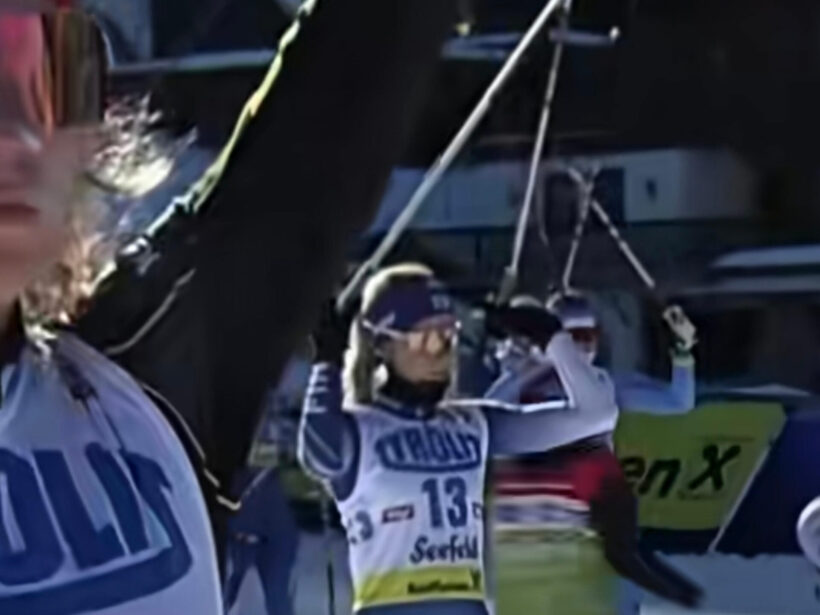
In January 2026, during official Nordic Combined World Cup events held in Central Europe —with visible actions in venues such as Seefeld, Austria, and Oberstdorf, Germany— athletes from the women’s circuit staged the most forceful protest to date against their exclusion from the Olympic program. In finish areas, ceremonies and media spaces, dozens of competitors demonstrated in a coordinated manner to denounce that Nordic Combined remains, well into the twenty-first century, the only Olympic winter discipline reserved exclusively for men.
The protest was neither spontaneous nor isolated. It was the result of years of postponements, broken promises and dilatory decisions by the International Ski Federation and the International Olympic Committee. Only weeks earlier, both institutions had once again ruled out any binding inclusion of women’s Nordic Combined in future Olympic programs, confirming for the athletes that the blockade was no longer technical or temporary, but structural.
Nordic Combined brings together two highly demanding disciplines: ski jumping and cross-country skiing. Women have competed for years at the highest level in both disciplines separately, including world championships and Olympic competitions. The exclusion therefore does not respond to physical incapacity or lack of preparation. It is an institutional anomaly: no other winter sport today maintains an exclusively male category.
For more than a decade, governing bodies have relied on three arguments to justify this exclusion. The first points to an alleged lack of critical mass of athletes. However, by 2026 there are stable women’s circuits, international rankings and consolidated national programs in countries such as Germany, Norway, Austria, Japan and the United States. The second argument claims that the competitive level of women would be insufficient, despite the fact that the athletes perform jumps and cross-country races with technical standards comparable to those of men in other disciplines. The third invokes the saturation of the Olympic program, a justification contradicted by the recent addition of new men’s and mixed events in other sports.
The 2026 protest erupts precisely because these arguments have lost all credibility. The athletes themselves stated it clearly in public declarations and joint statements: what is lacking is neither level nor participation, but political will. What is being denied to them is not training or competition, but institutional recognition — the recognition that defines which disciplines deserve Olympic visibility and which are relegated to the margins.
The background of the conflict is cultural and political. Nordic Combined has historically been constructed as a symbol of extreme endurance and traditional masculinity within European Nordic skiing. That narrative has functioned as a persistent barrier to women’s access, even as sports science and competitive practice have dismantled any biological justification for exclusion. Keeping the discipline as a male-only space preserves internal hierarchies, unequal distribution of resources and a restrictive definition of who is entitled to occupy the center of the Olympic stage.
Unlike previous protests, fragmented or channeled through internal mechanisms, the mobilization of January 2026 was collective, international and openly political. The athletes stopped asking for gradual development and began to denounce discrimination. They named the problem without euphemisms: institutional machismo. In doing so, they shifted the debate from sports administration to the terrain of rights and equality.
The consequences of this exclusion are concrete and material. The absence of Olympic status limits public funding, reduces access to sponsorship, shortens athletic careers and condemns athletes to marginal visibility. In high-performance sport, Olympic status defines which disciplines fully exist and which remain in competitive limbo. The exclusion of women’s Nordic Combined is not symbolic: it has direct effects on lives and careers.
The prolonged silence of the International Olympic Committee in the face of this demand reinforces the perception of a double standard. While official discourse promotes equality and diversity, structural decisions perpetuate exclusion. The 2026 protest exposed this contradiction clearly: it is not a technical delay waiting to be resolved, but resistance to relinquishing historically male spaces of power.
What is at stake goes beyond a single discipline. The conflict surrounding women’s Nordic Combined has become an emblematic case of how Olympism manages change: not by conviction, but by pressure. The athletes are no longer asking for patience. They are demanding equal access, recognition and the right to compete in a sport they practice and master.
In January 2026, in the middle of the international season and under the gaze of the global circuit, women in Nordic Combined decided to stop accepting silence as an answer. In doing so, they made it clear that exclusion can no longer be hidden behind the language of tradition. Olympic machismo was exposed not by an external slogan, but by the organized voice of those who have been systematically left out.
Lo que está en juego supera una disciplina específica. El conflicto del Combinado Nórdico femenino se ha convertido en un caso emblemático de cómo el olimpismo gestiona el cambio: no por convicción, sino por presión. Las atletas ya no piden paciencia. Exigen igualdad de acceso, reconocimiento y el derecho a competir en un deporte que practican y dominan.
En enero de 2026, en plena temporada internacional y ante la mirada del circuito mundial, las mujeres del Combinado Nórdico decidieron dejar de aceptar el silencio como respuesta. Al hacerlo, dejaron en evidencia que la exclusión ya no puede ocultarse bajo el lenguaje de la tradición. El machismo olímpico quedó expuesto no por una consigna externa, sino por la voz organizada de quienes han sido sistemáticamente dejadas fuera.