

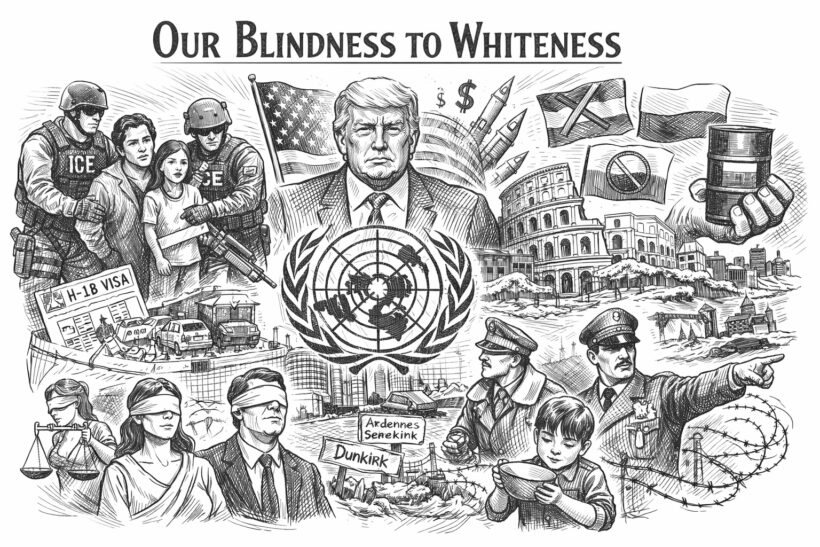
During the COVID pandemic, I published a book titled The White-West: A Look in the Mirror. At the time, I did not imagine that only a few years later the dynamics I described would become so stark, so violent, and so openly visible.
Today, many struggle to understand what is happening in the United States—and what radicalized power looks like when it feels threatened. This moment is not fundamentally about immigration, security, or geopolitics. It is about the collapse of the White-West’s moral authority and its turn toward racialized domination as a means of survival.
The actions of ICE and the growing militarization of U.S. city streets are officially framed as responses to an “immigration problem.” In practice, they function as a bleaching of multicultural America’s major urban centers. Military personnel patrol neighborhoods, targeting Latino communities and people of color. Skilled immigrants are no longer exempt. The assault on H-1B visas has thrown thousands of Indian families into crisis, with jobs, legal status, and stability stripped away overnight. This is not policy failure; it is ideological intent.
Few believed the United States would go this far. Yet the pattern is not new. Why Venezuela? As Craig Murray observed in “Trump, Pirate of the Caribbean,” Venezuelan politics are “basically racial.” The offense was not merely political defiance, but the fact that power was exercised by a government that was not white enough—and that its oil flowed toward non-white hegemonic powers such as China and Russia.
Europe, meanwhile, remains dangerously complacent. Many Europeans continue to view Russia or China as greater threats than the United States has become, while indirectly supporting the war in Ukraine and the assault on Gaza. In doing so, they enable the spread of white supremacist and far-right movements across the continent. The propaganda apparatus functions efficiently: Islamophobia, anti-immigrant panic, and anti-LGBTQ+ and anti-trans narratives circulate freely, normalizing exclusion and fear.
The United States is not at war with Europe, despite popular rhetoric. It is at war with the expansion of non-white political, economic, and cultural power wherever it emerges—including within European societies themselves. This creates friction with the European Union, whose legal framework obliges member states to apply common laws, many of which protect human rights and prohibit discrimination. These frameworks enforce social and cultural diversification—precisely what the White-West resists. The backlash is visible in Hungary, Poland, and Italy.
Trump’s hostility toward the United Nations is not primarily about institutional authority. The United States did not abandon the Security Council. Rather, the White-West has moved beyond its period of guilt—over colonialism, slavery, and genocide—and is now actively dismantling the humanitarian architecture constructed over the past eighty years.
Whiteness, understood here not as individual identity but as a global power structure rooted in racial hierarchy, no longer feels obliged to fund development in non-white countries, support global health systems, or sustain initiatives such as HIV treatment and disease prevention. In a recent Semafor article, Gates Foundation CEO Mark Suzman warned that philanthropists are “losing the argument” for foreign aid, even as budget cuts drive rising child mortality. The U.S. withdrawal from 46 UN agencies, including the World Health Organization, enables the redirection of resources away from multilateral cooperation and toward coercion—economic, political, and military—against institutions, states, and populations that resist U.S. supremacy.
Equally striking is Europe’s silence. No major European power has stepped forward to compensate for the U.S. retreat or to assume leadership within the UN system. Instead, European governments deepen their investment in U.S. militarism even as the multilateral order erodes beneath them. And in South America, white elites continue to accept the role of “the United States’ backyard,” mobilizing right-wing movements to preserve power and social control. This alignment prevents broader populations from articulating autonomous political, cultural, and historical identities outside the shadow of the White-West.
None of this was unforeseeable. What is happening in Gaza and Palestine was predictable. What is happening in Ukraine was preventable. What is happening through ICE was foreseeable. The failure is not a lack of warning, but a refusal to believe. We did not believe it could go this far.
Many Latinos who voted for Trump did not believe they would be deported. Skilled immigrants did not believe legal status would cease to offer protection. Europe did not believe the United States would dismantle the humanitarian order it once claimed to lead. We mistook stability for permanence and power for restraint.
Until we confront the belief system that normalizes domination, hierarchy, and racialized fear, movement forward will remain impossible.
History offers a brutal reminder. In 1940, France possessed a stronger army than Germany. Yet French military planners did not believe Hitler would take the “impossible” route—through the Ardennes, across forests, rivers, and mountains. They assumed rationality, precedent, and limits would hold.
They were wrong.
Within weeks, Germany occupied northern France and reached Dunkirk.
Today, the same disbelief paralyzes us. Whiteness, as a global power structure, no longer seeks consensus or legitimacy. It seeks survival through force. History does not collapse because warnings are absent, but because they are dismissed.