

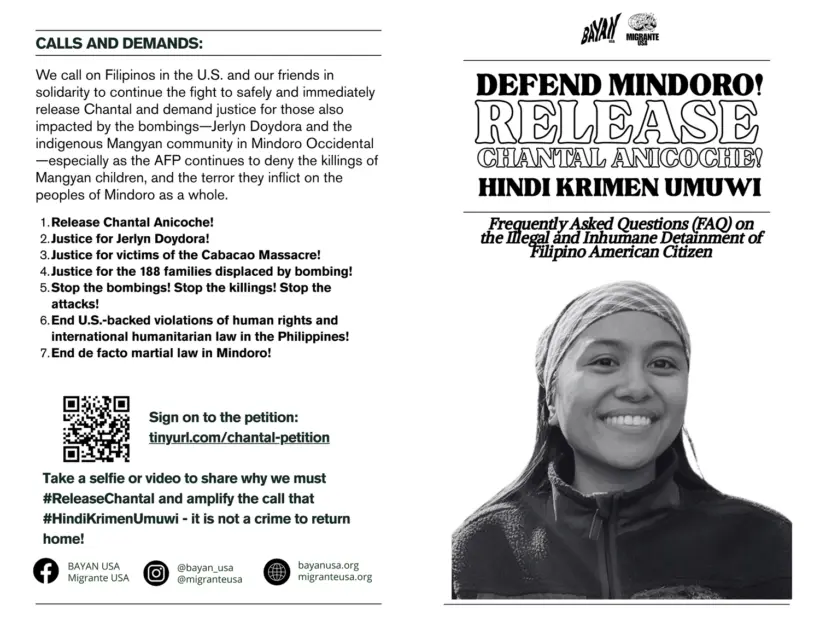
Loved Ones and Advocates in the U.S. Demand Her Immediate Release
Chantal Anicoche—a U.S. citizen and Filipino-American community leader from Maryland—remains detained by the Philippine military more than two weeks after her surfacing, despite no charges being filed against her. Anicoche went missing on January 1, following the Armed Forces of the Philippines’ (AFP) indiscriminate aerial bombing and strafing over Barangay Cabacao, Abra de Ilog, Occidental Mindoro on New Year’s Day. Anicoche was in the community studying the conditions of the indigenous Mangyan-Iraya, who have long been targets of corporate land-grabbing in the name of “development” and “eco-tourism.”
Aside from the disappearance of Anicoche, the bombings caused a massive displacement of 188 families, the deaths of 3 Mangyan children and injuries to their mother, and the death of 2 student researchers integrating in the community. After a collective outcry from friends, family, allies, and the international community to surface Anicoche, she was found to be alive in the custody of the AFP on January 8.
Chantal is a 24-year-old B.S. Psychology graduate from the University of Maryland, Baltimore County (UMBC). Her passion for environmental justice and indigenous people’s rights inspired her to volunteer in the Philippines to support rural communities impacted by environmental disasters, especially after witnessing the devastation caused by back-to-back typhoons in the Philippines this year.
Together with human rights groups in the Philippines, Anicoche’s loved ones and fellow community organizers in the U.S. have embarked on a campaign for her immediate release from military detention.
“There was no celebration the morning my friend, Chantal Anicoche, was ‘rescued’ by the military,” expressed Lena Adlawan, a friend of Anicoche. “The soldiers who rescued her carried high-powered assault rifles, and were from the very same military that bombed the community where she disappeared.”
After widespread condemnation of Anicoche’s illegal detention, the AFP released a statement saying she had chosen to stay in the military camp “voluntarily” to seek medical treatment. Organizers familiar with the AFP’s publicity tactics, however, believe otherwise. Human rights advocates have questioned the credibility of these videos, pointing to the unlikelihood that the military would have only found her 8 days after the bombings if she was supposedly less than 500 meters from the site of the army’s attack, and given that they had conducted prior “clearing operations”.



