

When Senator Tim Kaine told Secretary of State Marco Rubio at a recent Senate hearing on Venezuela that the administration’s announcement of a new Monroe Doctrine “does not land well in the Americas,” he was putting it mildly.
By Medea Benjamin
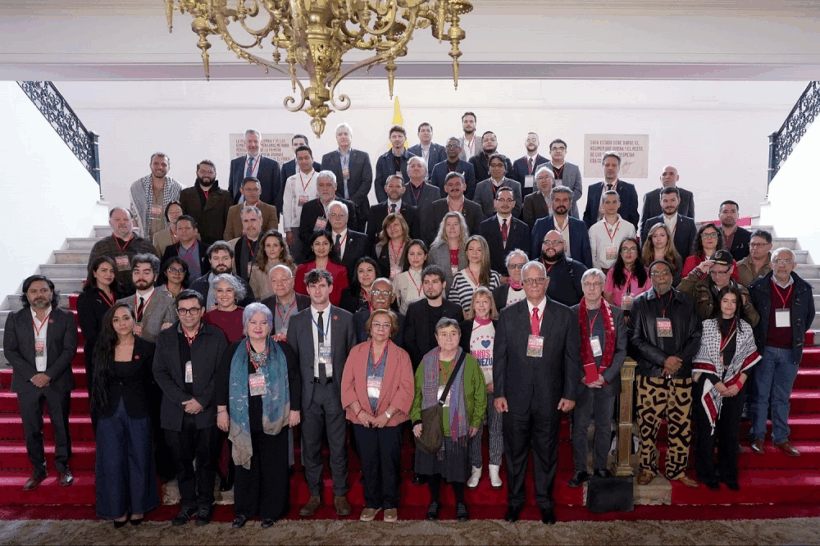
I just returned from an emergency gathering in Bogotá on January 24-25 with about 90 delegates from 20 countries, where speaker after speaker denounced the open revival of this doctrine — and its companion, the so-called Trump Corollary or “Donroe Doctrine” based on raw coercion— as a blatant, illegal, and reprehensible interference in their internal affairs. The message from Latin America could not have been clearer: the future of the Americas must be decided by its peoples, not imposed by the U.S. empire.
The gathering, called Nuestra América and convened by Progressive International, brought together ministers, parliamentarians, diplomats, trade unionists, and grassroots movement leaders from across Latin America, the Caribbean, North America, and Europe. After two days of intense closed-door deliberations and public assemblies, we adopted the San Carlos Declaration, launching a new continental project to defend sovereignty, democracy, and peace.
Delegates spoke with urgency about the most egregious U.S. interventions shaping hemispheric affairs. Delegates from Argentina described how Trump openly backed right-wing president Javier Milei, including the announcement of a $20 billion loan during the presidential campaign — a brazen attempt to tilt the vote by offering a financial lifeline in exchange for political alignment. They also condemned the lawfare-driven persecution and unjust imprisonment of Cristina Kirchner, emblematic of how courts are being weaponized to crush leaders who challenge U.S.-aligned economic and political power.
Hondurans condemned electoral interference in their country, including Trump’s efforts to shore up the National Party, and his hypocritical pardon of former president and convicted narco-dictator Juan Orlando Hernández. Updating the old adage about Nicaragua’s strongman Somoza — “he might be a son of a bitch, but he’s our son of a bitch” — he joked that Washington’s line on Juan Orlando Hernández is: “He might be a drug trafficker, but he’s our drug trafficker.”
The Venezuelan ambassador in Colombia denounced U.S. aggression against his country, including the kidnapping of President Nicolás Maduro and First Lady Cilia Flores and the bombings in Caracas that left more than 100 people dead. The Trump administration is offering sanctions waivers to U.S. oil companies amidst threats of further strikes should Venezuela defy its demands.
Colombians took aim at Trump’s arrogance, his reckless threats to bomb Colombia, and his offensive attacks on their democratically elected president, Gustavo Petro. Delegates spoke with a mix of hope and trepidation about Petro’s upcoming February 3 meeting with Trump, wondering whether it would mark a genuine attempt at reconciliation — or turn into a setup reminiscent of Ukrainian President Zelensky’s humiliating White House visit. They also voiced deep concern about U.S. interference in their upcoming May presidential elections, as Petro’s term comes to an end and left candidate Iván Cepeda faces an emboldened right. Many warned that the vote represents a pivotal moment not only for Colombia but for the entire region, which has already swung sharply to the right in recent elections.
A narcotics expert condemned strikes on civilian vessels in the Caribbean and Pacific carried out with absolutely no due process, resulting in the extrajudicial killing of more than 100 people, including fishermen. Delegates spoke of coastal communities paralyzed by fear, with many fishermen no longer daring to go out to sea, afraid their boats will be blown up. This sparked calls for a “Reclaim the Seas” campaign to defend the right to fish without fear — along with proposals to organize solidarity flotillas to Venezuela and Cuba.
The Cuban ambassador to Colombia denounced the unprecedented escalation of the economic blockade against Cuba, including efforts to cut off oil supplies, aimed at plunging the country into total economic crisis to force regime change. Delegates voiced strong solidarity with Cuba, and Progressive International announced that the next Nuestra América gathering will take place in Havana. Trump’s new order threatening tariffs on any country that “directly or indirectly” supplies oil to Cuba only heightens the urgency of building international solidarity — and finding concrete ways to break the siege.
Representatives from Mexican President Claudia Sheinbaum’s Morena Party denounced Trump’s escalating attacks on Mexico — from branding the country a “narco state,” to threatening military action across the border, to using tariffs and migration enforcement as weapons — all aimed at destabilizing Mexico’s democratically elected government and undermining its project of social transformation.
Jana Silverman, one of three delegates representing Democrat Socialists of America, addressed the systematic violation of the rights of millions of migrants living in the United States — overwhelmingly from Latin America — who face detention, deportation, and repression by state authorities. She raised the powerful concept of the “right not to migrate”: the often overlooked human right to remain in one’s homeland with dignity, rather than being forced to flee due to poverty, violence or foreign intervention.
Taken together, delegates said, these attacks form a coherent U.S. strategy: a revived Monroe Doctrine asserting the hemisphere as an exclusive U.S. sphere of control, where sanctions replace diplomacy, coercion replaces cooperation, and military force lurks behind every negotiation.
The Trump administration thrives on division, betting that countries will confront Washington one by one. But the only way to withstand the world’s largest military and financial machine is through collective action — a task complicated by today’s political fractures across the region.While some governments align closely with Trump, others, like Venezuela and Cuba remain squarely in the crosshairs. Meanwhile, international institutions are largely paralyzed: the UN is constrained by U.S. vetoes, the Organization of American States functions as Washington’s echo chamber, and regional mechanisms (such as CELAC, ALBA and CARACOM) are fragile and must be revitalized.
Ultimately, the most decisive force against U.S. aggression is popular power–the power of social movements, trade unions, youth organizations, and community groups, backed by renewed solidarity in the Global North. Sovereignty, the delegates agreed, must be defended in the streets, workplaces, classrooms, and communities.
As Colombian Senator Gloria Florez told us, “The U.S. is on trial throughout the Americas, and people are answering with courage, solidarity, and dignity — from migrants to Afro-descendants, Indigenous peoples, and women. This is Our América, and it includes social movements in the United States. Together, we must bury the Monroe Doctrine, once and for all.”