
‘This news is available in Bengali’
by Rita Bhowmick
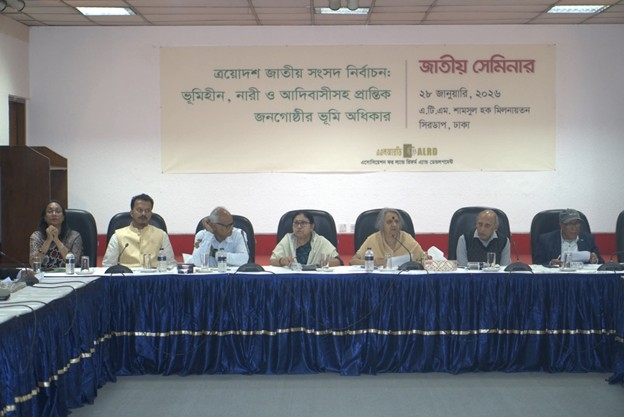
Ahead of the 13th National Parliamentary Election in Bangladesh, scheduled for February 12, prominent civil society members and rights activists have raised a strong demand to ensure the land rights of marginalized groups, including the landless, women, and indigenous communities. The call was made at a national seminar titled ‘13th National Election: Land Rights of Landless, Women, and Indigenous People,’ organized by the Association for Land Reform and Development (ALRD) at the CIRDAP Auditorium in the capital on Wednesday.
At the seminar, speakers urged political parties and candidates to include pledges in their election manifestos to amend and implement ILO Convention 141. Key discussions also focused on simplifying cooperative society registration for collective farming, legal recognition of women as farmers, and the protection of customary land rights for indigenous people.
Women’s Contribution vs. Deprivation in Agriculture
Presenting the keynote paper, ALRD Deputy Executive Director Rowshan Jahan Moni stated, ‘According to the BBS Labour Force Survey 2022, although women constitute nearly 58% of the agricultural labour force, they own only 2% of the land. Furthermore, despite being the vast majority, actual farmers have received less than 24% of the total agricultural subsidies provided over the last three decades.’
Presided over by ALRD Chairperson and Nijera Kori Coordinator Khushi Kabir, speakers at the seminar lamented that the fundamental rights of marginalized people are not receiving adequate priority in the current election campaigns.
GDP vs. Grassroots Reality
Razequzzaman Ratan, Assistant General Secretary of BASAD, presented a striking picture of the economy: “Economists and politicians express frustration over the declining share of agriculture in GDP, but this does not reflect the actual employment and development status of the masses. While 113 loan defaulters- owing $1.5 billion (18,400 cores BDT)- are contesting this election, the producers of our food live in fear.” He noted that with an investment of only 10,000 BDT per person, cooperative fish farming could create employment for 4.8 million women. He alleged that land, food, and voting rights are now being overshadowed by ‘fear’ and ‘fraudulence.’
Cries from the Grassroots
Grassroots women leaders from different parts of the country shared their experiences:
Rahela Akter (Muktagacha): ‘As landless women, we practice collective farming but receive no support from the Department of Cooperatives. Simplifying the registration process is urgent.’
Sabina Hembrom (Dinajpur): ‘Indigenous women are directly involved in farming but do not receive ‘Farmer Cards.’ We demand guaranteed settlement of Khas (government) land for indigenous communities.’
Mita Rani (Bauphal): ‘Female farmers do not receive fair wages. We demand that future lawmakers ensure legal recognition for women as farmers.’
Demands for Structural Reform
Didarul Bhuiyan, General Secretary of the State Reform Movement, emphasized, ‘The dignity of marginalized people will not be secured until the power structure is aligned with the interests of the people.’ Renowned journalist Sohrab Hassan added, “We live in a discriminatory society where women are excluded from the centers of power.’
Suraiya Begum, Director of Research Initiatives, Bangladesh (RIB), highlighted that chemical-based agriculture contributes 33% to climate change. She argued that if women held land rights, they could ensure ‘safe agriculture’ through organic fertilizers, aiding in the fight against the climate crisis.
Key Demands at a Glance:
- Amendment and full implementation of ILO Convention 141.
- Formation of a National Land Commission and establishment of a Land Bank.
- Amendment of Cooperative Laws to simplify registration for marginalized farmers.
- State recognition and ‘Farmer Cards’ for women and indigenous farmers.
- Ensuring customary rights of indigenous women over forest resources.
Other speakers included ALRD Executive Director Shamsul Huda, Shamsul Islam Dipu of Speed Trust, and Afzal Hossain of Rulvao. They collectively vowed that the struggle for land rights must continue both inside the parliament and on the streets.
About the Author:

Rita Bhowmick: Senior Journalist and Correspondent, Pressenza- Dhaka Bureau.