
Residents of Villa Montahue, a neighborhood surrounded by forest plantations, face increasingly frequent fires. Experts warn that climate change, lack of urban planning, and an unregulated extractivist forestry model are turning the territory into a recurring trap, while the country will soon forget once again.
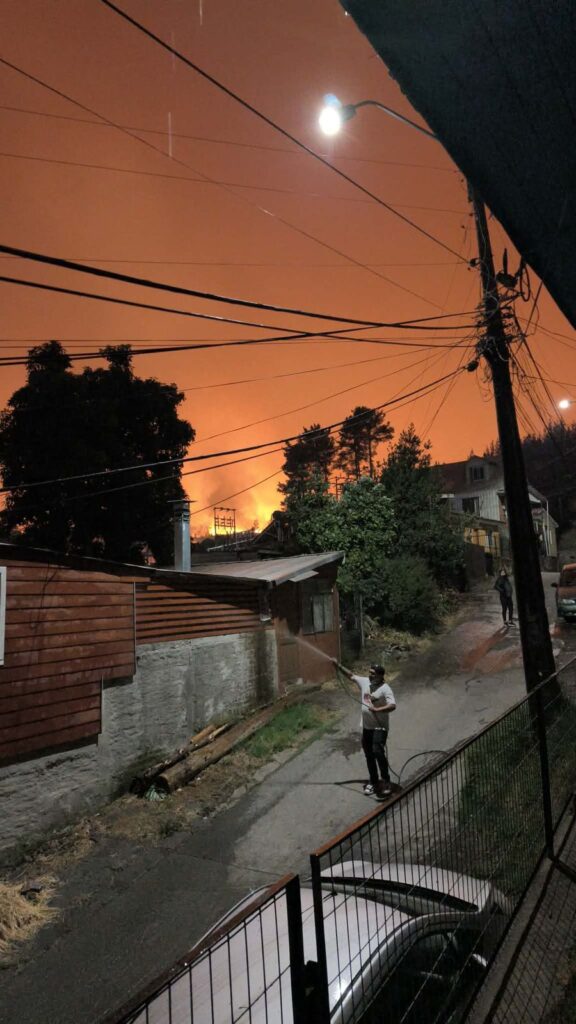
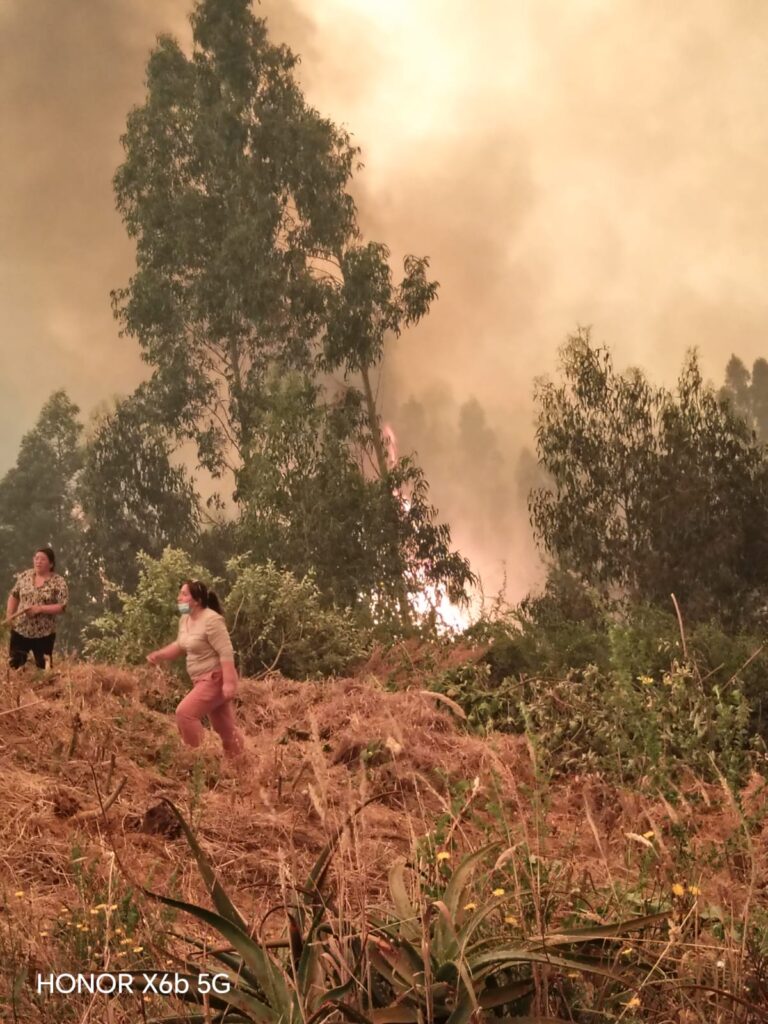
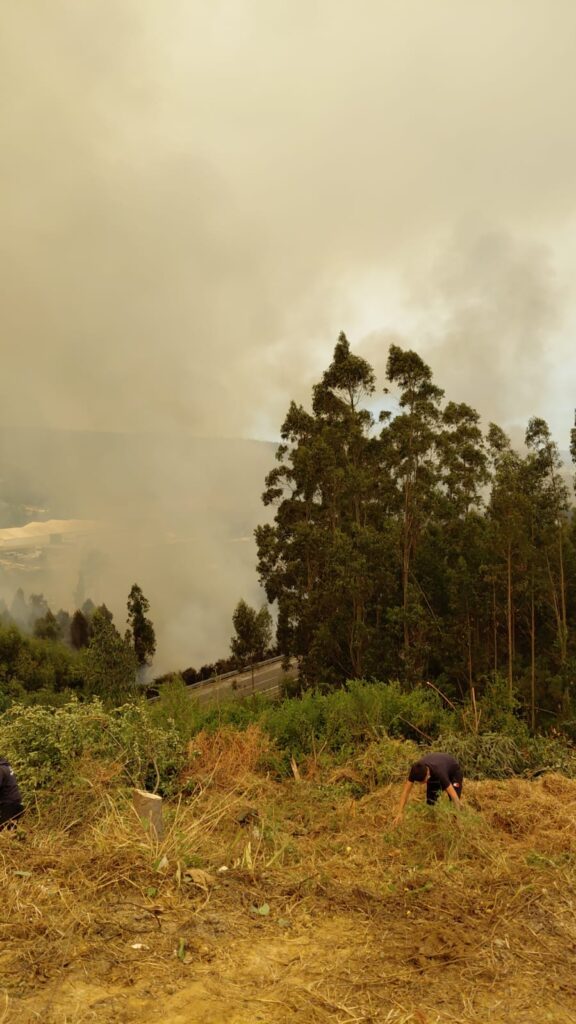
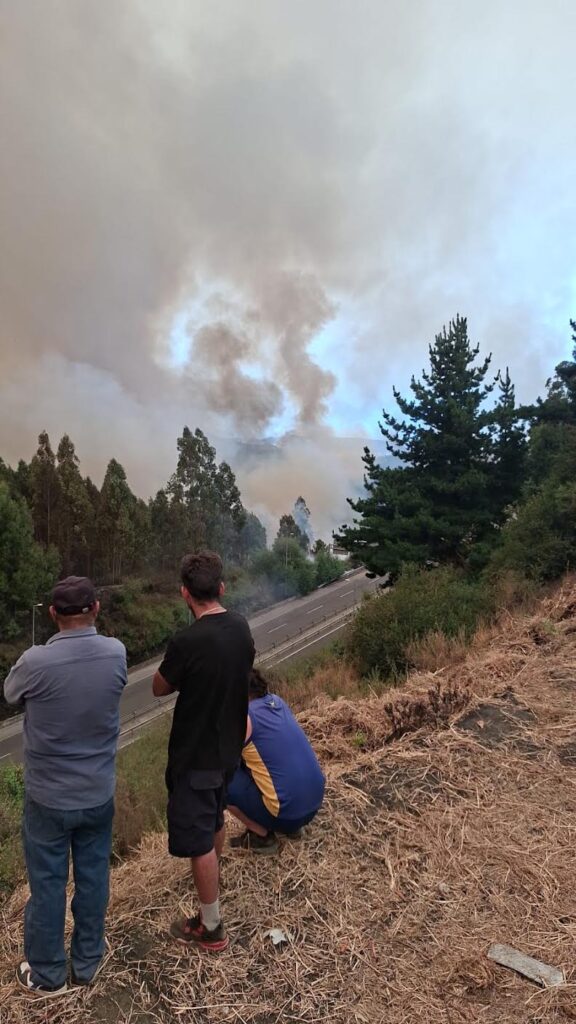
On clear days, Villa Montahue, on the hilltops south of Penco, has a beautiful view of the mouth of the Andalién River in Concepción Bay and, sometimes in summer, a sea breeze cools the air. But for the past week, smoke has enveloped everything, penetrating everything, and the flames from the fires in Penco and surrounding areas light up the horizon less than a kilometer away.
Inside a house, three neighbors gather to share some tea. They have had an exhausting day, but they are not calm. Benilde Gutiérrez and sisters Kimberly and Pamela Monsalve, members of the Villa Montahue Health and Environment Committee[1], know that at any moment a spark could reach their homes, not far from the communities of Lirquén and Punta de Parra, where 21 people died and more than 1,800 houses were destroyed. More than 20,000 people have been affected by the tragedy that began in the early morning of January 17, according to the Interior Ministry.
These days the heat is unbearable, but they cannot open the windows because toxic smoke would enter, affecting their eyes, throat, bronchial tubes and causing severe headaches. Fire truck sirens and emergency alarms ordering evacuation from danger zones sound constantly. Sleeping is impossible, as they must remain “alert minute by minute to every possible risk,” says Kimberly Monsalve.
Eight years ago, Villa Montahue experienced its first fire threat. And just a few months ago, in September and October 2025, there were also intentional attempts to set on fire pine and eucalyptus plantations around the municipality of Penco. “Since 2017 there has been a radical change, and every year we have to worry about someone setting fire to our land. We understand that we live in a sacrifice zone,” says Kimberly Monsalve.
Since 2017, the risk conditions combining human factors and natural elements have not changed, making this community especially vulnerable to fires.
Ricardo Barra[2], director of the EULA-Chile Center for Environmental Sciences at the University of Concepción, explains that “this fire phenomenon has to do with several things that converge simultaneously.” First, there is climate change, with rising temperatures, reduced rainfall, and altered wind patterns. “That is the background scenario,” he emphasizes, “but not everything is climate change’s fault — it also depends on how we structure the landscape.” The core problem, he says, is the lack of regulation over how the forest–urban–rural interface is designed and developed; in other words, the proximity of monoculture plantations to populated areas.
Concepción has expanded around forest plantations without adequate urban planning. This is compounded by the lack of regulation establishing minimum distances between plantations and homes. Under megadrought conditions, these plantations become fuel and conduits for fire.
The residents of Villa Montahue know this from direct experience. Their housing complex was created to provide homes for those who lost theirs in the February 2010 earthquake and tsunami. Before that catastrophe, Kimberly, Pamela, Benilde, and many neighbors lived closer to the beach, in the Baquedano neighborhood. After the tsunami, they fled with nothing and remained for months as refugees in tents.
The solution originally offered by the government did not include the 43 families who, like them, had lived as extended-family residents behind relatives’ houses. They were eventually placed in an emergency settlement with inadequate wooden shacks. It took four more years for them to receive permanent, solid, two-story homes in what is now Villa Montahue. However, Villa Montahue was built on a hill just meters from pine and eucalyptus plantations — a fact ignored by those who planned the housing complex.
The risk, Barra explains, is not only proximity to a forest, but the characteristics of these highly combustible monoculture plantations in the context of climate change.
In the late 19th and early 20th centuries, radiata pine was introduced near Lota and Coronel to build underground coal mine tunnels. It was also planted to control soil erosion. Later, eucalyptus was introduced from Australia. Both species adapted very well to the conditions of this region of Chile, with rapid growth and reproduction. They largely replaced native forests across much of the central-southern zone, driving a major forestry industry.
However, it was Decree Law 701, imposed in 1974 by the dictatorship, that gave a major boost to pine and eucalyptus plantations. While between 1965 and 1973 the state had invested in national parks, research, and forest management, Decree Law 701 accelerated the destruction of native forests and reinforced land concentration in the forestry industry. This directly benefited the forestry sector, one of the pillars of the new extractivist economic model established by the military regime in Chile. In 1985, another decree law promoted the export of wood chips (largely from native species), eucalyptus leaves, and other products through tariff reductions. This process further strengthened large forestry companies such as Celulosa Arauco, CMPC, Matte-Angelini and Copec. By the end of 1987, 30% of coastal native forests had been eliminated and replaced by pine, according to CODEFF (Comité por la Defensa de Fauna y Flora).
Just a few kilometers from Concepción’s main square lies the Nonguén National Park Reserve, a remnant of the native forest that once covered the coastal mountain range. Here one can still walk beneath the shade of Chilean hazel, canelo, peumo, coigüe, arrayán, roble, and olivillo trees, along with dense, moist undergrowth of shrubs and ferns. Barra notes that the 3,000 hectares of this forest fulfill “a fundamental function that many people in Concepción of which they are unaware: it provides very high-quality drinking water to the community of Penco. Without this forest, Penco would have no water.”
The characteristics of native forests — diversity, humidity, and species types — make them far more fire-resistant than plantations. In contrast, pine and eucalyptus can burn like tinder and create highly combustible environments by drying out the soil.
The EULA-Chile Center, which Barra directs, worked on the regional climate change action plan and warned of this scenario. “These phenomena will intensify and become much more frequent. Science is clear: less water, more drought, drier winters. True, fires existed before but not with this magnitude, intensity, frequency, or duration. That creates a social problem: the poorest are those who suffer the most.”
Health and Environment Committee members know this firsthand. These days they prepare breakfasts and lunches for families who have lost everything, as well as offering emotional support. Other neighbors clear brush to create wider firebreaks, while some hose water on their houses. “People in the poorest areas are the ones most affected. And no one — neither the forestry companies nor the municipality — takes responsibility,” says Kimberly.
Among the urgent measures recommended by Barra, he highlights education and community organization. “People must become aware that we are facing a critical socio-environmental scenario requiring collective action. Collaborative work with active community participation in prevention is needed.” He also recommends creating shelters incorporated into urban design, such as vegetation-cleared spaces for evacuation. But, he emphasizes, the only way to change the model is through state regulations requiring corporate accountability. “This goes beyond ideology. When the forest burns, their business burns too.”
He also warns of another human risk factor: “Our country does not learn much from these lessons. In a few months, this fire will be history. Except for those who lost a home or a family member, few will remember.”
It is important to note that a movement of organizations began several decades ago that calls attention to environmental problems affecting the Biobío Region. They address issues such as pollution, environmental degradation, monoculture, and wetland conservation. A movement in Penco-Lirquén has actively opposed the installation of a rare earth mining project and mega energy projects in the coastal Penco-Talcahuano area.
For 30 years, Lautaro López coordinated the Concepción branch of the EPES Foundation until its closure in 2024. He states: “The task today is to strengthen this socio-environmental movement, as the only way to protect the environment and territories. At the very least, regulations must be passed to prevent these mega-fires. It’s a long-term objective, but change in the extractivist forestry model is urgently needed.”
Outside, smoke continues to hang over Villa Montahue, but inside the homes something else circulates as well: organization, solidarity, living memory. The same women once displaced by the sea now support other families facing fires. The country may forget, the news may change topics, and promises may fade, but in these neighborhoods memory is preserved through concrete actions. And perhaps in that united community lies the most positive prospect for preventing the next tragedy.
[1] The Villa Montahue Health and Environment Committee was formed in 2012 by the EPES Foundation (Popular Education for Health) which had an office in Concepción from 1982 to 2024.
[2] Ricardo Barra was a member of the EPES-Concepción board of directors.