

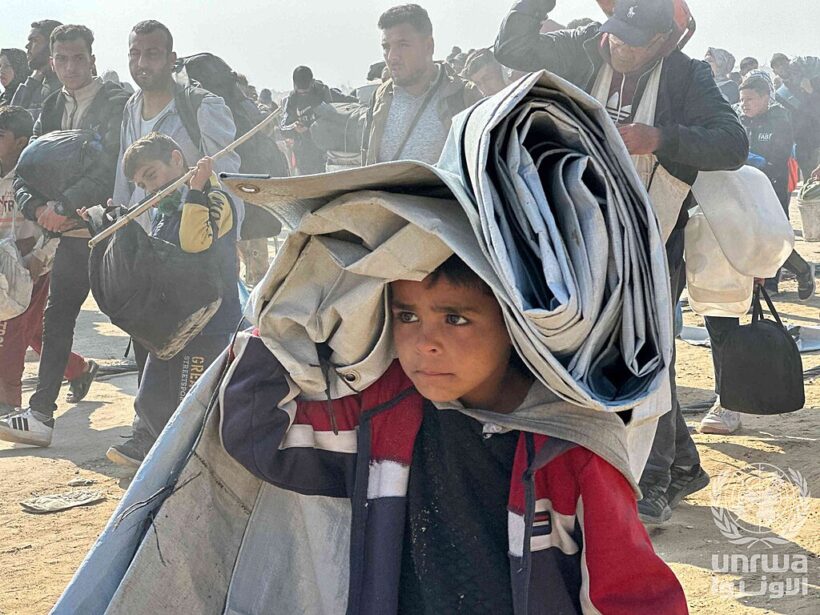
The demolition and subsequent burning of the headquarters of the United Nations Relief and Works Agency for Palestine Refugees in the Near East (UNRWA) in East Jerusalem, carried out by Israeli authorities on 20 January 2026, do not constitute an isolated episode nor a simple administrative dispute. It is an act that goes beyond the framework of the Israeli-Palestinian conflict and is inscribed in a structural rupture of the international legal order that emerged after the Second World War. By its nature, its symbolism and its scope, this event constitutes an attack against the system of collective protection that humanity established to prevent the return of barbarism.
UNRWA was created in 1949 by the United Nations General Assembly through Resolution 302 (IV), as a direct response to the forced displacement of more than 700,000 Palestinians following the 1948 war. Since then, its mandate has been eminently humanitarian: education, health, food assistance and basic protection for a refugee population that, unlike any other collective in the world, has never seen its legal status resolved nor its right of return recognized by Resolution 194 (III) of the General Assembly itself. The very existence of UNRWA is therefore the living proof of a prolonged political failure of the international community, but also a minimal barrier against the absolute collapse of Palestinian civilian life.
That barrier was deliberately attacked.
In the words of the Commissioner-General of UNRWA, Philippe Lazzarini:
“A lost moral compass opens a barbaric new era: after Israeli officials compete to take credit for storming and destroying a United Nations compound in occupied East Jerusalem, others call for the annihilation of an entire community of UNRWA staff.”
This statement is not rhetorical. It is an empirical acknowledgment of an unprecedented fact in the recent history of the United Nations: authorities of a Member State not only carry out the demolition of a site protected by international immunity, but publicly celebrate the act and tolerate—if not encourage—calls for the physical elimination of international civilian staff.
Lazzarini continues:
“These statements from officials of a Member State cannot be tolerated by the Member States sworn to the UN Charter. These actions must be taken to the highest level and fought against.”
Here the legal core of the problem is activated. The UNRWA headquarters in East Jerusalem is a United Nations site, protected by the 1946 Convention on the Privileges and Immunities of the United Nations, by the UN Charter (articles 2, 105 and related provisions), and by customary international law guaranteeing the inviolability of international missions. East Jerusalem is, moreover, occupied territory under international law, pursuant to the Fourth Geneva Convention of 1949 and multiple Security Council resolutions, including resolutions 242, 338, 476 and 478.
Occupation does not confer sovereignty. It does not authorize demolition. It does not permit the destruction of property belonging to international organizations or civilians, except for imperative military necessity, which is absent in this case.
Lazzarini describes the facts with precision:
“Early this morning, Israeli forces stormed the UNRWA Headquarters, a United Nations site, in East Jerusalem. Bulldozers entered the compound and began demolishing buildings inside it under the watch of lawmakers and a member of the government.”
This point is crucial. It was not an uncontrolled action nor an operational excess. There was institutional presence, political supervision and, therefore, direct State responsibility. The subsequent burning of the compound further aggravates the violation:
“After having been stormed and demolished by the Israeli authorities, the UNRWA Headquarters in occupied East Jerusalem has now been set on fire. There are no limits to the open defiance of the United Nations and international law in the Occupied Palestinian Territory.”
From a legal perspective, this set of acts cumulatively violates the UN Charter, the Vienna Convention on Diplomatic Relations by functional analogy, the Convention on the Privileges and Immunities of the United Nations, the Fourth Geneva Convention, the Rome Statute of the International Criminal Court—in particular provisions relating to extensive destruction of property and attacks against humanitarian personnel—and fundamental principles of international humanitarian law such as distinction, proportionality and the protection of civilian objects.
But the scope of the act goes beyond positive law. Lazzarini formulates it as a warning that addresses the entire international community:
“What happens today to UNRWA will happen tomorrow to any other international organization or diplomatic mission, whether in the Occupied Palestinian Territory or anywhere else in the world.”
Here the central thesis is revealed: this is not an attack against a specific agency, nor even solely against the Palestinian people. It is a general rehearsal for the demolition of the multilateral system. If a State can destroy a United Nations installation in occupied territory with impunity, without real consequences, then no humanitarian, diplomatic or international enclave is safe. The precedent is universal.
Lazzarini concludes:
“This is not just an attack on UNRWA; it is an attack on the international system and on the rule of law itself, and it must be met with the strongest possible response from all States committed to upholding international norms.”
From a historical perspective, UNRWA has been the target of systematic campaigns of delegitimization precisely because it embodies an uncomfortable memory: that of a displaced people whose legal existence contradicts the narrative of conflict closure. Attacking UNRWA is an attempt to erase that memory, dismantle protection mechanisms and force a solution through humanitarian exhaustion.
From an ethical perspective, the destruction of a humanitarian agency in a context of extreme crisis constitutes a form of structural violence that transcends its direct victims. It affects the very idea of shared humanity, the one that, after Auschwitz, Srebrenica and Rwanda, swore that certain limits would never again be crossed.
If one day the International Court of Justice or the International Criminal Court is able to fully exercise its mandate without political obstruction, these acts will have to be examined under the strictest light of international law. The demolition of UN facilities, the persecution of humanitarian personnel and the open contempt for international obligations are neither neutral nor debatable acts: they are serious violations that generate State and individual responsibility.
Until then, Lazzarini’s text stands as a historical document. Not only as a denunciation, but as a record of warning. When the moral compass is lost, it is not an institution that falls first. It is the very principle of humanity that is left exposed to the fire.



