

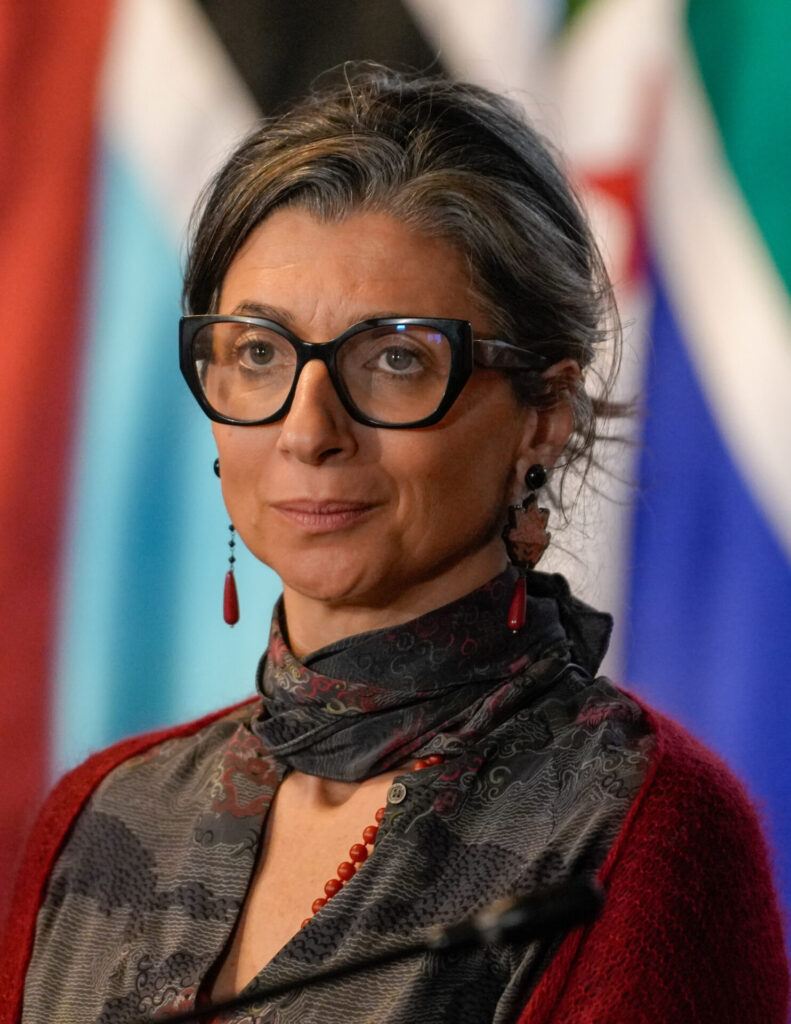
In times of systematic intimidation, complicit silences and institutional cowardice, the joint decision by the Vrije Universiteit Brussel, the University of Antwerp and Ghent University to award an honorary doctorate to Francesca Albanese is not a routine academic gesture. It is a stand. It is an ethical affirmation. And above all, it is a declaration of intellectual independence in a global climate in which telling the truth has become an act of risk.
For the first time in their history, in a solemn ceremony to be held on April 2 in Antwerp, these three Flemish universities — all of them benchmark institutions in Europe in research, international law, social sciences and the humanities — have decided to jointly confer the highest academic distinction on a jurist whose professional trajectory embodies with rare coherence the values the university claims to defend: rigor, honesty, courage and service to the public good. This is neither a coincidence nor a symbolic concession. It is a community of the highest intellectual level choosing to speak with a single voice.
Francesca Albanese is an international lawyer with a solid, extensive and deeply respected career in the field of human rights. Before assuming in 2022 the position of United Nations Special Rapporteur on the situation of human rights in the occupied Palestinian territories, she worked for more than a decade as a legal adviser and expert within various UN mechanisms, specializing in international humanitarian law, civilian protection, forced displacement and state responsibility. Her mandate was renewed in 2025, an explicit recognition of her technical quality and the independence with which she has exercised a function particularly exposed to political pressure.
The official statements issued by the universities are clear and deliberate. In their joint declaration, the institutions underline the “exceptional commitment of Francesca Albanese to the protection of human rights and the strengthening of international law”, as well as her ability to exercise her mandate “with professional independence and legal rigor in contexts of extreme polarization”. This is not empty praise: it is an accurate description of a career built on evidence, law and responsibility.
From the Vrije Universiteit Brussel, its rector has insisted that the university is not a neutral space in the face of injustice, but a place where critical thought must remain free from external pressure. The University of Antwerp has stressed that this joint recognition expresses a shared conviction: that academia has an inescapable social responsibility when international law is systematically violated. Ghent University, for its part, has emphasized that honoring Albanese is honoring the principle that research and legal analysis cannot be subordinated to campaigns of intimidation or to contingent political interests.
That last point is not minor. Because the announcement of the doctorate has been followed, as was predictable, by a smear offensive driven by Zionist organizations that operate as political lobbies, not as academic actors. We are not speaking of religious communities or cultural identities. We are speaking of organized political structures that, for years, have sought to discredit, silence or expel from the public sphere any voice that documents the crimes of the State of Israel and the colonial and violent nature of the Zionist project in its current expression.
The pattern is familiar and crude: distortion of statements, unfounded accusations, media pressure, veiled threats to institutions, moral blackmail through the instrumental use of antisemitism. None of this withstands serious analysis. And none of it has been enough to make three elite universities retreat. On the contrary: they have reaffirmed their decision with clarity, laying bare the abysmal distance between rigorous intellectual work and the dirty game of those who confuse intimidation with argument.
The background to this dispute is not abstract. It is material. It is human. It is bloody. The reports presented by Francesca Albanese to the United Nations constitute one of the most severe and meticulously substantiated documentations of the destruction of Gaza. In them, the rapporteur explains that, when considering not only direct deaths caused by bombings and military attacks, but also indirect deaths caused by induced hunger, the collapse of the health system, the deliberate destruction of civilian infrastructure, dehydration, preventable diseases and massive forced displacement, the real number of Palestinians killed reaches, at a minimum, 680,000 people, a civilian population composed overwhelmingly of children, women and the elderly.
This figure is not rhetorical. It is not propaganda. It is the result of applying legal and epidemiological standards historically used to assess mortality in contexts of mass destruction. And it is, moreover, a conservative figure. Albanese herself has been explicit in stating that the impossibility of counting the dead with precision — bodies under the rubble, destroyed records, razed hospitals — is part of the crime itself. Genocide does not only kill: it erases.
Faced with that reality, the reaction of the Zionist organizations that today attempt to sabotage this academic recognition is not a defense of ethics or historical memory. It is the reaction of a political apparatus that knows itself exposed, challenged and increasingly isolated in the face of evidence. It is the symbolic violence of those who cannot refute the facts and instead choose to attack the one who names them.
The response of the Belgian universities is therefore profoundly significant. They are not rewarding an opinion. They are recognizing a professional life dedicated to law, rigorous research and the defense of the most basic principles of international legality. They are saying, without ambiguity, that the university does not bow to political bullying or moral blackmail. They are reminding us that knowledge does not submit to power when power commits crimes.
Francesca Albanese is not a fleeting figure nor an occasional provocateur. She is a solid jurist, a serious researcher and an international public servant who has assumed the cost of saying what many prefer to silence. And that is why she is attacked today. And that is precisely why she is honored.
Neither all the money, nor all the influence, nor all the disinformation machinery of the criminals who today ravage Gaza will be able to silence an honest voice. Much less extinguish her brilliance. Because when intelligence is exercised with ethics, and the university remembers its reason for being, the truth always finds where to stand.
And this time, it is sustained by a community of the highest academic level that has decided not to look the other way.



