

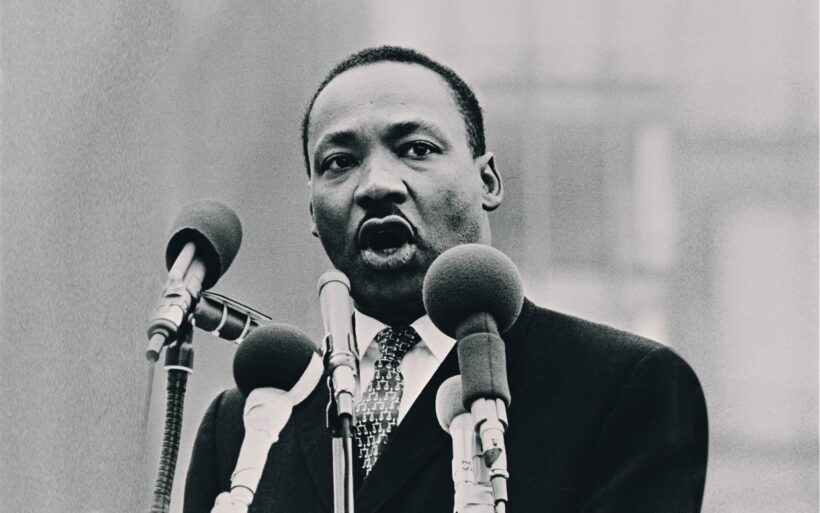
To speak seriously of Martin Luther King Jr. today is already to enter into conflict with the form in which he is publicly remembered. King survives as a moral icon precisely because his thought has been stripped of its antagonism. He is invoked as a patron saint of patience and civility, a figure used to discipline protest and reconcile injustice with order. In this sanitized form, King functions as an ideological device: proof that freedom can be achieved without structural rupture, redistribution, or confrontation with power.
By Sam Ben-Meir
This King is a fabrication. The question, then, is not how King should be honored, but why his most radical commitments have become structurally unreadable within liberal memory.
The historical King—the King who matters—emerges only when we follow the trajectory of his thought beyond civil rights reform and into a direct confrontation with capitalism, imperialism, and the social totality that sustains both. By the end of his life, King no longer fit within the coordinates of American liberalism. That is why his legacy had to be neutralized. King was not merely a moral critic of injustice. He was becoming a theorist and practitioner of systemic antagonism, a figure whose fidelity to universality could not be reconciled with liberal capitalism without falsification.
From the beginning, King rejected the liberal fantasy of gradualism. Liberalism tolerates injustice so long as it proceeds slowly, legally, and politely. King refused this temporal logic. Nonviolent direct action was not a plea for recognition but a strategy of disruption. Birmingham was not persuasion but crisis; Selma was not dialogue but exposure.
In the Letter from Birmingham Jail, King does not ask to be included. He indicts the very idea that justice can be deferred without consequence. “Justice too long delayed is justice denied” names a structure, not a sentiment. The demand for patience is itself a technique of domination, converting suffering into an administrative problem and freedom into a promise endlessly postponed.
Slavoj Žižek’s distinction between subjective and objective violence clarifies what King grasped intuitively. The deepest violence of American society was not the visible brutality of police dogs and batons, but the normalized violence of segregation, poverty, and exclusion—the violence of an order that presents itself as neutral. King’s nonviolence was not pacifism. It was a refusal to grant that order moral innocence by mirroring its self-image. Even here, King already exceeds liberal moralism.
The decisive break comes later—not in tone, but in King’s understanding of the system itself. After the legislative victories of the mid-1960s, King drew a conclusion liberal America could not accept: legal equality without economic transformation is a lie. The end of segregation did not end poverty; it revealed it more starkly. Inclusion exposed exploitation.
King named this explicitly. In 1967 he declared that society required a “radical redistribution of economic and political power.” This is not reformist rhetoric. It is a direct challenge to capitalism as a system organized around inequality. The same year, at Riverside Church, King named the United States “the greatest purveyor of violence in the world today,” linking racial domination at home to imperial war abroad. With this sentence, King crossed a threshold. He no longer spoke as a moral critic within the system, but as an analyst of the system itself.
At this point, King’s position can no longer be grasped through the language of rights or recognition; it requires a theory of universality. King did not argue for Black freedom as a particular identity claim. He argued that Black suffering exposed the falsity of American universality itself. This is why he rejected both white liberal paternalism and Black nationalism as final horizons. The former preserved domination; the latter risked reproducing it in inverted form. King’s claim was more radical: freedom is indivisible or it is nothing.
At Memphis, standing with striking sanitation workers, King gave this universality its starkest form. Two men had been crushed to death in a defective truck. The workers carried signs reading I AM A MAN—not a demand for recognition, but a declaration so bare it exposed the lie on which the city rested. King spoke of labor, expendability, and a nation that could finance war but could not keep its workers alive. Police sealed the streets. Windows broke. Order trembled. King knew the risk. He knew the movement was fracturing. He knew the Poor People’s Campaign had crossed a line civil rights was never meant to cross. Still he returned, binding himself to a struggle no longer legible as moral appeal. The night before he was killed, he spoke of the promised land without illusion that he would enter it. This was not reconciliation. It was fidelity.
It is here that the liberal opposition between King and Malcolm X collapses. The familiar contrast—King as reasoned nonviolence, Malcolm as dangerous extremism—serves an ideological function. It allows liberal society to canonize King only by opposing him to Malcolm, transforming the former into a harmless moral symbol and the latter into a warning.
Once we shift from tactics to diagnosis, the opposition dissolves. Malcolm X grasped earlier what King arrived at later: that inclusion within a violent order is itself a form of violence. Malcolm named the antagonism without remainder; King insisted that it must not be allowed to harden into an ontology. The difference between them was not analytic but ethical—whether antagonism should define the whole of social reality or remain the site from which transformation becomes possible.
Žižek implicitly stages this rapprochement in his writings on violence and civil rights. Against liberal celebrations of nonviolence, Žižek argues that figures like King functioned as necessary translations of militant antagonism into a universal register capable of destabilizing the symbolic order. Malcolm names the wound; King insists it indicts the whole. Liberal memory requires their separation because their convergence would expose liberalism itself as inadequate.
This also clarifies the meaning of King’s nonviolence. It was not morally superior to militancy; it was strategically superior under specific historical conditions—and cannot be universalized as a moral norm. Nonviolence was a discipline of universality, a refusal to let the struggle collapse into reciprocal domination. It sought not to preserve order, but to expose the violence on which order depended.
What liberal ideology cannot abide is not King’s anger but his diagnosis: that liberalism itself functions as a regime of objective violence, maintaining injustice precisely by appearing humane, procedural, and patient. The fabrication of a harmless King is not an accident of memory, but the condition under which liberalism survives its own contradictions.
King’s assassination was therefore not merely a historical crime; it functioned—within the logic of American power—as a means of restoring a stability his universality had placed in question. By 1968 he had become intolerable. He was building multiracial class solidarity. He was naming capitalism and empire as inseparable. He was threatening to unite the poor across racial lines—an existential danger to the existing social order.
Systems do not fear criticism; they fear universality. King’s insistence that exploitation anywhere indicts the whole could not be absorbed. It had to be erased, then repackaged. This is why the King we are offered today is safe. His critique of capitalism is omitted. His opposition to empire is forgotten. His demand for redistribution is ignored. In his place stands a moral icon compatible with neoliberal pluralism.
King did not die for a dream of inclusion. He died for a truth liberalism cannot bear: that freedom is incompatible with a social order built on exploitation, hierarchy, and permanent war. His courage was not merely the courage to suffer, but the courage to remain faithful—to universality, to equality, to the idea that human beings are not means.
If King is safe today, it is not because he was misunderstood, but because his demands have been refused—and we live off that refusal.
Sam Ben-Meir is an assistant adjunct professor of philosophy at City University of New York, College of Technology.