

by Asif Showkat Kallol (Dhaka Bureau)
As Bangladesh counts down to its 13th general election on 12 February, political attention is increasingly focused on a group that could determine the outcome: swing voters.
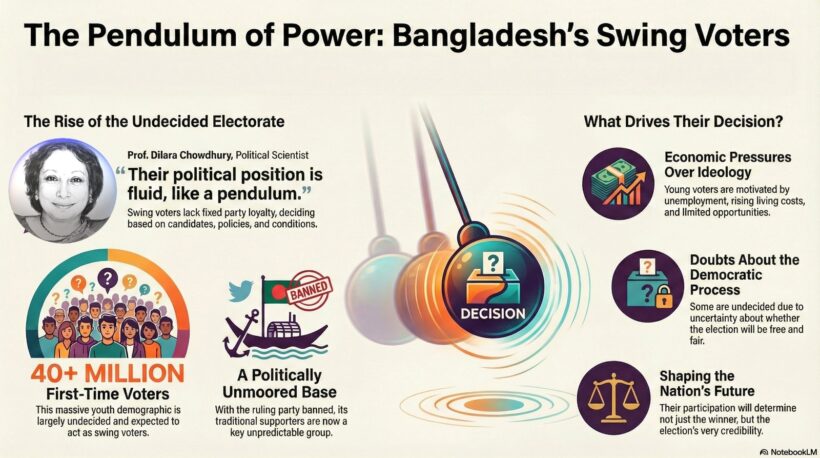
With more than 40 million first-time voters entering the electorate and the ruling Awami League barred from participating, analysts say a large segment of voters now falls into a politically undecided category. Their choices could reshape the electoral landscape in ways not seen in recent years.
A pre-election survey conducted jointly by Projection BD, the International Institute of Law and Diplomacy, the Jagoron Foundation, and Narrative suggests a tightly contested race. According to the findings, 34.7% of voters intend to support the Bangladesh Nationalist Party (BNP), while 33.6% plan to vote for Jamaat-e-Islami. Smaller parties, including the National Citizen Party and Islami Andolan Bangladesh, account for around 10%, while 17% of voters remain undecided. The results were unveiled at a press conference at Dhaka’s National Press Club recently.
Political scientists define swing voters as those without fixed loyalty to any party, whose decisions are influenced by candidates, policies, economic conditions, and broader political developments. While they may lack strong partisan attachment, their collective influence can be decisive.
Dr. Dilara Choudhury, former Professor of the Department of Government and Politics at Jahangirnagar University and a researcher on South Asian geopolitics and international security, told the press agency Pressenza, “Swing voters do not belong firmly to any one party, but they play a crucial role in determining election outcomes.”
According to the Bangladesh Election Commission, the country has about 127.6 million registered voters. Analysts believe many young voters, casting ballots for the first time, remain undecided and are likely to behave as swing voters.
The fate of voters traditionally aligned with the Awami League is another source of uncertainty. With the party absent from the election, its support base is politically unmoored. Analysts suggest a substantial portion of these voters may shift allegiance or abstain, making them a pivotal yet unpredictable force.
Opposition leaders argue that the rise of swing voters reflects broader disillusionment with the political system rather than a sign of healthy democratic competition. ‘The real question is not who swing voters will support, but whether voters believe their votes will matter,’ said a senior opposition figure on condition of anonymity. ‘Without credible guarantees, many people may stay away from the polls.’
Civil society groups have also warned that voter apathy, especially among young people, could undermine the legitimacy of the election. Some activists argue that first-time voters are influenced more by economic pressures- such as unemployment and rising living costs- than party ideology.
‘The youth are not undecided because they are confused,’ said a Dhaka-based rights activist. ‘They are undecided because none of the political actors have convinced them that real change is possible.’
While the concept of swing voters is relatively new in Bangladesh, it is well established in countries such as the United States and the United Kingdom, where swing voters and ‘swing states’ often determine the outcome of closely contested elections. ‘Swing voters move from one side to another,’ Chowdhury explained. ‘Their political position is fluid, like a pendulum, which is why they are described as swing voters.’
Analysts caution that Bangladesh’s political context differs from Western models. Weak institutional trust, concerns over electoral management, and limited space for opposition campaigning could constrain the impact of swing voters, regardless of their numbers.
As campaigning intensifies, parties are expected to target economic grievances, governance failures, and promises of stability to win over undecided voters. Whether these appeals will translate into broad participation and a credible contest remains uncertain.
What is increasingly clear, analysts say, is that the behaviour of swing voters- whether they turn out, abstain, or realign politically- may shape not only the result of the 13th general election but also the future credibility of Bangladesh’s democratic process.
The Author:

Asif Showkat Kallol: Head of News at The Mirror Asia & Contributor, Pressenza- Dhaka Bureau.



