

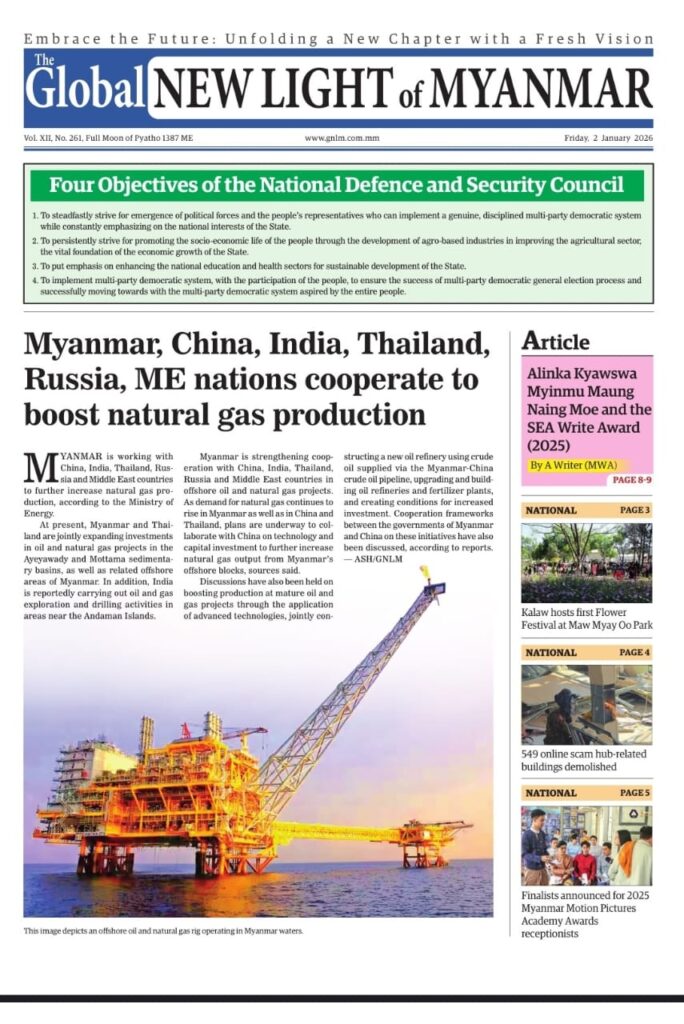
The global community may denounce the ongoing three-phase elections in Myanmar (also known as Burma or Brahmadesh) as a probable way to transform the Southeast Asian country into a multi-party democracy, but the military rulers continue enhancing business ties with its neighbours, including India. The poverty-stricken country is now working with different nations to increase natural gas production. According to the military-run newspaper Global New Light of Myanmar, the country of 55 million people is strengthening cooperation with a number of foreign countries in various offshore oil & natural gas projects. At present, Myanmar and Thailand are jointly expanding investments in oil & natural gas projects in Ayeyawady and Mottama sedimentary basins, along with offshore areas, reported the daily, adding that India has been carrying out oil & gas exploration and drilling activities in areas near the Andaman islands.
Meanwhile, the armed forces (popularly known as Tatmadaw) completed the first phase of the general election on 28 December, even though a civil war-like situation continues to haunt the Land of Golden Pagodas. The electoral exercise covered 102 out of 330 townships (loosely termed as constituencies), even though many localities evaded the voting as they were not under the control of the military regime led by Min Aung Hlaing. The anti-military ethnic groups, people’s defence forces, and other armed resistance outfits, which currently rule over one-third of the trouble-torn Myanmar territories, strongly opposed the polls. So the junta-appointed Union Election Commission (UEC) planned for elections in 274 townships, while the rest have been declared as disturbed and unstable (mostly under Rakhine, Sagaing, and Shan provinces).
The voting took place under heavy security arrangements in major cities like Naypyitaw, Yangon, Mandalay, along with the townships under the Bago and Ayeyarwady regions, where the pro-military party Union Solidarity and Development Party (USDP) is already declared the winner in 89 constituencies for the 330-member Pyithu Hluttaw (lower house of Myanmar Parliament). The polling witnessed mostly elderly voters, who came out to vote with no hope but to get rid of threatening actions by the military dictators. The young voters, who are not hailing from military families, largely boycotted the election. A junta spokesman claimed that 52 percent of over 11.50 million voters exercised their franchise in the first phase of polling. One can remember that the last two national elections in 2015 and 2020 (amid the fear of the Covid-19 pandemic) recorded around 70 % voter turnout, where the Nobel laureate Daw Aung San Suu Kyi-led National League for Democracy (NLD) achieved landslide victories defeating the party of retired military generals.
The UEC had earlier canceled the registration of several mainstream political parties, where over 40 political entities, including the NLD, did not re-register with the electoral authorities. Only six political parties, namely the USDP, National Unity Party, People’s Pioneer Party, Myanmar Farmers Development Party, Shan & Nationalities Democratic Party, and People’s Party are allowed to field candidates across the country, where 51 smaller parties are entitled to take part in regional assemblies. Since the Buddhist majority country witnessed a military coup on 1 February 2021 (overthrowing a democratically elected government in Naypyitaw), over 7,500 people lost their lives in the anti-military turmoil, as the government forces exercised indiscriminate crackdowns, including air strikes on crowded places, hospitals and even schools. Thousands were arrested, and over 3.6 million people were displaced in the last five years. Currently, 20 million people are in desperate need of urgent humanitarian assistance. No less than 5,40,000 children are estimated to suffer from acute malnutrition across the underdeveloped country. A large number of pro-democracy leaders had left their home places to enter neighbouring Thailand, China, India, and Bangladesh to escape the military atrocities.
The United Nations, a number of governments in the West, along with Japan, Australia, etc and the global human rights groups criticized the election as not being free, fair and incisive in nature. Terming the election a sham designed only to legitimize oppressive military rule in Myanmar, the anti-junta activists argued that the election would hardly help in installing an independent civilian regime as the dictators want to play a trick to avoid the international sanctions. However, military chief Hlaing, who voted at a polling station in Naypyitaw, asserted that the electoral exercise would strengthen the country’s democratic process. The election was also rejected by the National Unity Government (an exile authority of Myanmar), as it claimed that the junta continues airstrikes over civilian populace.



