

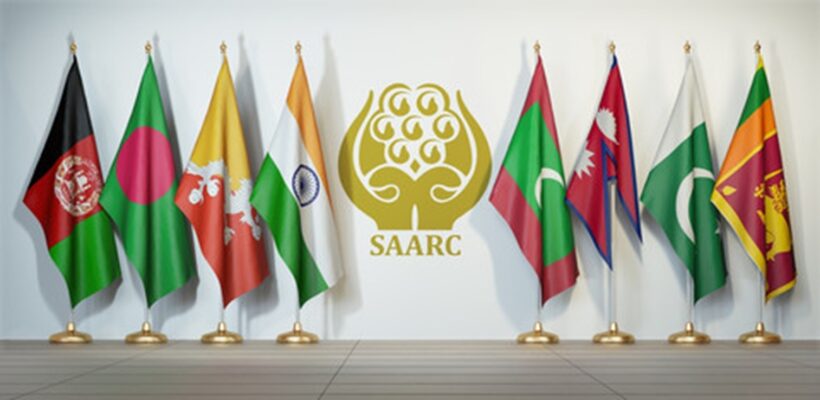
Amid ongoing diplomatic tensions and security concerns between India, Pakistan, and Bangladesh, the process of reviving the South Asian Association for Regional Cooperation (SAARC) has officially begun! It has been reported that this initiative is being spearheaded by Bangladesh, a strategic partner and one of the founding architects of the organization.
Recently, Professor Dr. Muhammad Yunus, Chief Adviser of the Interim Government of Bangladesh, emphasized the necessity of revitalizing SAARC, stating that it is essential to revive the organization by any means necessary. He expressed hope that SAARC will re-emerge as a meaningful platform for the nearly two billion people of South Asia. He made these remarks during meetings with regional leaders from various South Asian countries who arrived in Dhaka last Wednesday (December 31) to attend the funeral of three-time former Prime Minister Begum Khaleda Zia. Shofiqul Alam, Press Secretary to the Chief Adviser, confirmed this during a briefing at the Foreign Service Academy on Thursday (January 1) afternoon.
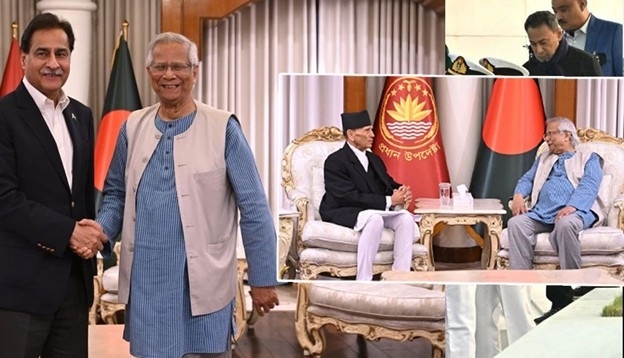
Sardar Ayaz Sadiq, the Speaker of the National Assembly of Pakistan (Left), and Bal Nanda
Sharma, the Foreign Minister of Nepal (Insert), met with Muhammad Yunus, the Chief Adviser
of the interim government, during their recent visit to Dhaka. Photo Courtesy: Daily Jugantor.
The Press Secretary informed that on the day of Begum Khaleda Zia’s funeral (December 31), Sardar Ayaz Sadiq, Speaker of the National Assembly of Pakistan, and Bala Nanda Sharma, Foreign Minister of Nepal, paid a courtesy call on the Chief Adviser. Additionally, on Thursday (January 1) afternoon, Maldivian Minister Dr. Ali Haider Ahmed and Sri Lankan Minister Vijitha Herath met with Dr. Yunus. During these meetings, the Chief Adviser conveyed the same message to the regional leaders: that it is urgent to revive SAARC by any means. He noted that the gathering of regional leaders to pay their respects to Begum Khaleda Zia is clear evidence of the existence of the SAARC spirit. Professor Yunus remarked, ‘The spirit of SAARC is still alive and well, and we must preserve and revive it. I wanted to organize a gathering of SAARC leaders, even if only for five minutes.’
Notably, several regional leaders from South Asia arrived in Dhaka to attend the funeral of Begum Khaleda Zia. The funeral was attended by Sardar Ayaz Sadiq (Speaker of the National Assembly of Pakistan), Lyonpo D. N. Dhungyel (Foreign Minister of Bhutan), Dr. S. Jaishankar (External Affairs Minister of India), Bala Nanda Sharma (Foreign Minister of Nepal), Vijitha Herath (Minister of Foreign Affairs, Foreign Employment, and Tourism of Sri Lanka), and Dr. Ali Haider Ahmed (Minister of Higher Education, Labour, and Skills Development of the Maldives). Among them, all except the Indian External Affairs Minister Dr. S. Jaishankar held courtesy meetings with Professor Muhammad Yunus.
The SAARC Summit is the highest policy-making forum of the organization, consisting of formal meetings of the heads of state or government from the eight member countries. The primary objectives of this summit are to develop mutual relations, accelerate economic growth, and resolve regional issues through dialogue. The current member states are Bangladesh, India, Pakistan, Sri Lanka, Nepal, the Maldives, Bhutan, and Afghanistan (which joined in 2007).
During SAARC Summits, various important agreements and declarations are signed to foster socio-economic and cultural development. A joint declaration is issued at the end of each summit, serving as the organization’s action plan for the year. Despite bilateral tensions, the summit provides an opportunity for top leaders to sit at the same table. Although a summit is supposed to be held at least once a year, political instability or bilateral disputes often hinder regular organization. For instance, the 19th SAARC Summit was scheduled to be held in Pakistan in 2016. However, following a major terrorist attack on the Uri army base in Indian-administered Kashmir on September 18 of that year, which killed 19 Indian soldiers, India blamed Pakistan and boycotted the summit. Bangladesh also decided to boycott the summit due to Pakistan’s continuous interference in its internal affairs and adverse reactions regarding war crimes trials. With Bhutan and Afghanistan supporting India and Bangladesh, the 19th Summit was postponed. Since then, the regional bloc has remained largely dysfunctional, with no formal full-scale summit held to date.
When asked about the revival of SAARC, a senior official from the Intergovernmental Organizations and Consular Affairs wing of the Ministry of Foreign Affairs of Bangladesh, speaking on condition of anonymity, stated: ’We are aware of the current Interim Government’s interest in SAARC. However, these matters are primarily overseen by the SAARC Headquarters.’
The primary visionary behind the formation of SAARC was the then-President of Bangladesh, Ziaur Rahman. In the late 1970s, he proposed the idea of a regional cooperative organization for South Asia. In 1980, he officially wrote to the leaders of these countries proposing a regional bloc. Although it did not reach fruition during his lifetime, his initiative led to the formation of the organization in 1985. The journey began with the first SAARC Summit held at Suhrawardy Udyan in Dhaka, where the heads of state and government of seven countries signed the SAARC Charter. Currently, the Prime Minister of Nepal serves as the Chairman of SAARC. However, the position of Secretary-General is crucial; Md. Golam Sarwar of Bangladesh is the current Secretary-General, having assumed office on March 4, 2023. The SAARC Secretariat is located in Kathmandu, the capital of Nepal.



