

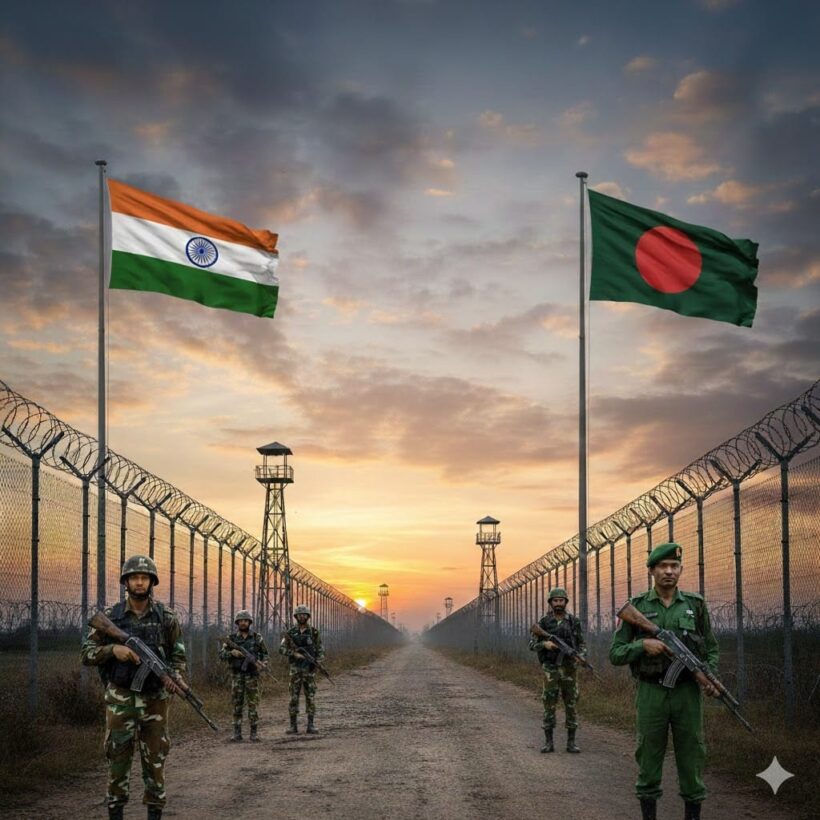
The India-Bangladesh border has emerged as the most volatile geopolitical flashpoint in South Asia. Unprecedented activity by the Indian Army in the Siliguri Corridor- popularly known as the ‘Chicken’s Neck’- and Dhaka’s subsequent diplomatic maneuvers signal a complex turning point in bilateral relations.
The Siliguri Corridor in West Bengal, a narrow strip of land only 22 kilometers wide, serves as the sole artery connecting mainland India to its eight northeastern states. It remains the most sensitive point in India’s defense strategy.
Recently, the Indian Army established a permanent military base in Chopra, West Bengal. Additionally, new garrisons and infantry units have been deployed in Bihar’s Kishanganj and Assam’s Dhubri.
While the Border Security Force (BSF) traditionally oversees border security, ‘corps-level’ movements of the Indian Army are now being observed in the corridor. India claims these ‘precautionary measures’ are intended to ensure the corridor remains secure amidst regional instability and the recent political landscape in Bangladesh.
Dhaka has expressed profound concern over the movement of heavy weaponry and troops across the borders of Bangladesh’s northern districts, such as Panchagarh and Nilphamari.
The Bangladesh government views this militarization as contrary to neighborly norms, arguing it disrupts the natural border environment. This military buildup has also created psychological pressure and panic among civilians living in border areas. Dhaka has explicitly stated that for the sake of bilateral relations, coordination between the BSF and Border Guard Bangladesh (BGB) is preferable to military deployment.
In light of the border situation and other prevailing disputes, Bangladesh’s High Commissioner to New Delhi, M. Riaz Hamidullah, has been recalled to Dhaka on an emergency basis.
While officially summoned for high-level consultations, diplomatic circles view the move as a ‘formal protest’ or a ‘stern stance.’ Bangladesh appears to be recalibrating its strategy in response to India’s repeated concerns over Bangladesh’s internal affairs and the heightened military activity at the frontier.
Analysts suggest that India aims to fortify its security perimeter around the Siliguri Corridor to insulate its northeastern states from any developments in Bangladesh. However, this ‘over-caution’ is sending a negative signal regarding Bangladesh’s sovereignty. Conversely, by recalling its envoy, Dhaka is signaling that unilateral pressure or military posturing will not facilitate better relations.
Security experts in Bangladesh emphasize that while the ‘Chicken’s Neck’ is strategic for India, maintaining normalcy at the border is fundamental for Bangladesh. A swift diplomatic dialogue is now essential to bridge the growing trust deficit. Failure to do so could jeopardize long-standing stability in South Asia.
Touhidul Islam, a faculty member of the Department of Peace and Conflict Studies at Dhaka University, believes that both parties must refrain from provocative rhetoric or actions to de-escalate tensions.
He remarked that both nations should uphold the core spirit of the ‘Treaty of Friendship’ and other existing Memorandums of Understanding (MoUs). ‘It is vital to consolidate the legal and moral foundations of the friendship by following established international norms,’ he said. He further suggested that dialogue must move beyond formal meetings to include experts and civil society to resolve misunderstandings.
‘Both Bangladesh and India are pivotal partners in South Asian geopolitics. Reducing border tensions through conflict transformation is essential for a peaceful environment, which is indispensable for the economic prosperity of both nations,’ Mr. Islam added.



