

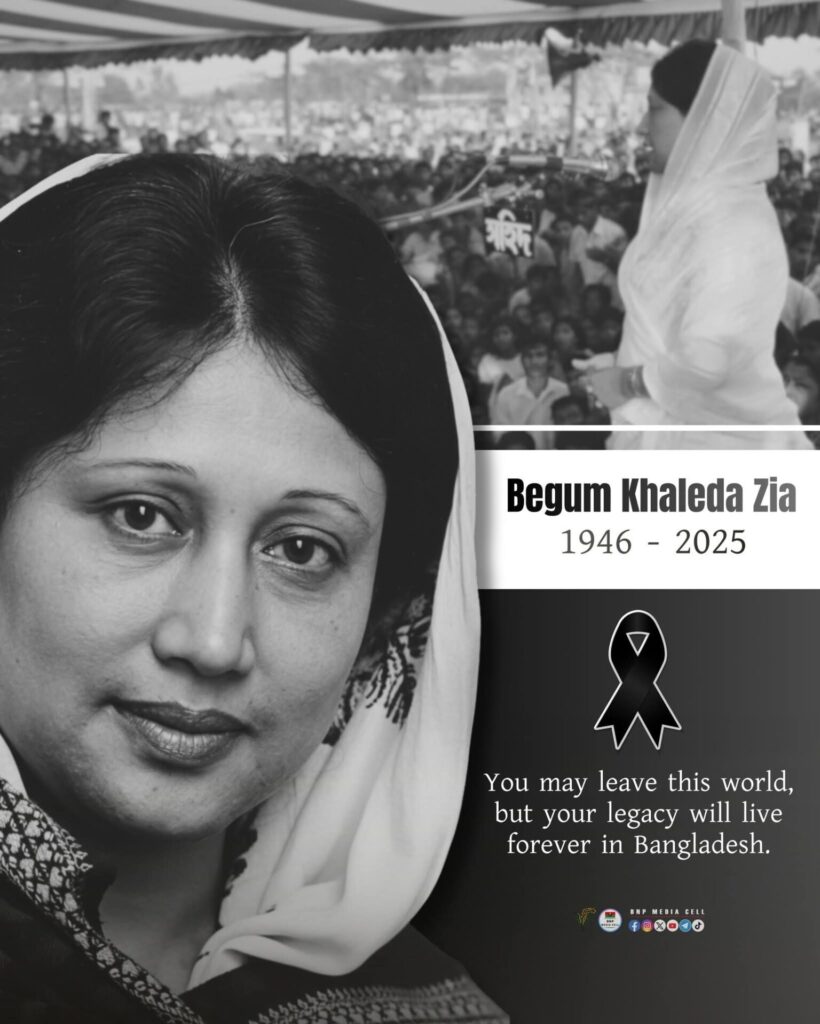
The entire nation of Bangladesh is overwhelmed with grief following the death of Begum Khaleda Zia, the country’s first female Prime Minister and a figure renowned in political history as the ‘Uncompromising Leader.‘ On the morning of December 30, the people of Bangladesh were struck with profound sorrow upon waking up to the news of her passing.
Begum Khaleda Zia, a three-time Prime Minister of Bangladesh, had been suffering from various age-related ailments for a long time. She breathed her last at a local hospital in Dhaka early Tuesday morning. With her passing, the 80-year-old legendary political figure brought an end to a colorful and illustrious life.
The death of this veteran, iconic politician has cast a deep shadow of mourning over the political landscape of Bangladesh. In an immediate address to the nation, the Chief Adviser of the Interim Government, Dr. Muhammad Yunus, expressed deep grief, condolences, and respect. Recalling her multifaceted political career, he stated, ‘In the death of Begum Zia, the nation has lost a great guardian. Her leadership remains a unique example in the country’s democratic journey.’
Following her passing, a public holiday has been declared for Wednesday, along with a three-day state mourning period. The funeral prayer (Janaza) for the deceased will be held on Wednesday at 2:00 PM at the South Plaza of the National Parliament Building. Subsequently, she will be buried with state honors next to the grave of her husband, the late President Ziaur Rahman.
President Mohammed Shahabuddin, Chief Adviser Dr. Muhammad Yunus, the Chief Justice, the chiefs of the three branches of the armed forces (Army, Navy, and Air Force), and leaders of all political and social organizations in the country have expressed their condolences.

Begum Khaleda Zia was sworn in as the first Prime Minister of Bangladesh on March 20, 1991. Begum Khaleda Zia was sworn in as the first Prime Minister of Bangladesh on March 20, 1991. Photo: Courtesy of Daily Prothom Alo.
In the history of Bangladeshi national politics, Begum Khaleda Zia will endure as a symbol of democracy, firmness, and uncompromising principles. Notably, she was never defeated in any democratic election; she contested 18 seats across four general elections and won every single one. As a three-time Prime Minister, she established herself at the pinnacle of national leadership through her distinct policies on foreign investment, women’s empowerment, and state governance.
Numerous countries around the world have expressed their condolences. Neighbors, including Indian Prime Minister Narendra Modi and Pakistani Prime Minister Shehbaz Sharif sent messages of sympathy. Tributes were also received from the governments of China, Germany, France, Bhutan, Japan, the United States, the United Kingdom, the European Union, and the United Nations. Additionally, Indian External Affairs Minister S. Jaishankar and the Speaker of the National Assembly of Pakistan, Sardar Ayaz Sadiq, are expected to arrive in Dhaka on Wednesday to pay their final respects.
Tarique Rahman, the eldest son of Begum Khaleda Zia and Acting Chairman of the Bangladesh Nationalist Party (BNP), who recently returned to the country after 17 years, said in a message: ‘Khaleda Zia will remain immortal in the democratic transition of Bangladesh.’ The BNP has announced a seven-day mourning program. All political parties, cultural organizations, and sports bodies in the country are in mourning, and social media timelines are flooded with tributes from people of all walks of life.
Amidst this atmosphere of grief, the nation remembers Begum Khaleda Zia’s steadfast leadership, her struggles, and her political contributions. Her unwavering stance on the path of democracy and her role in women’s empowerment are viewed by all as unforgettable legacies.
Her passing marks the end of a significant chapter in history; yet, she leaves behind a brilliant example of inspiration, struggle, and an endless love for the country.



