

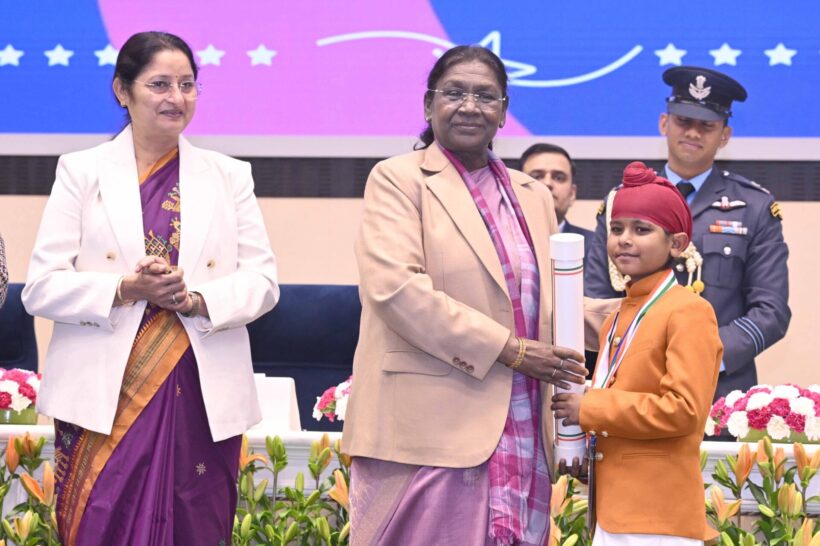
History repeats itself, but a few are fortunate enough to get the recognition. The spiritual world, especially the Sikh world, is proud of the act of kindness, humility and service to mankind exemplified by Bhai Kanhaiya Ji, who is widely known for his water seva during Sri Guru Gobind Singh Maharaj Ji’s time on the battlefield.
Once again in history, a 10-year-old Sikh boy, Sharvan Singh, resident of a village hardly 2 kilometres from the India-Pakistan border in Punjab’s Ferozepur District, has earned national recognition for his act of compassion, exceptional courage, and sense of patriotism by serving ‘Milk-Lassi and Water’ to the Military Persons deployed near his village during Operation Sindoor.
Akal Takht’s former Jathedar, Giani Harpreet Singh in a tweet on 26th December, 2025, said, “Even on the battlefield, the spirit of selfless service and fearless courage, as exemplified by Bhai Kanhaiya Ji and Sikh history, has always continued to inspire our younger generations.
During the war-like situation with Pakistan, 10-year-old Sharvan Singh from Firozpur, Punjab, displayed remarkable selfless service by providing tea, water, and ice to our soldiers.
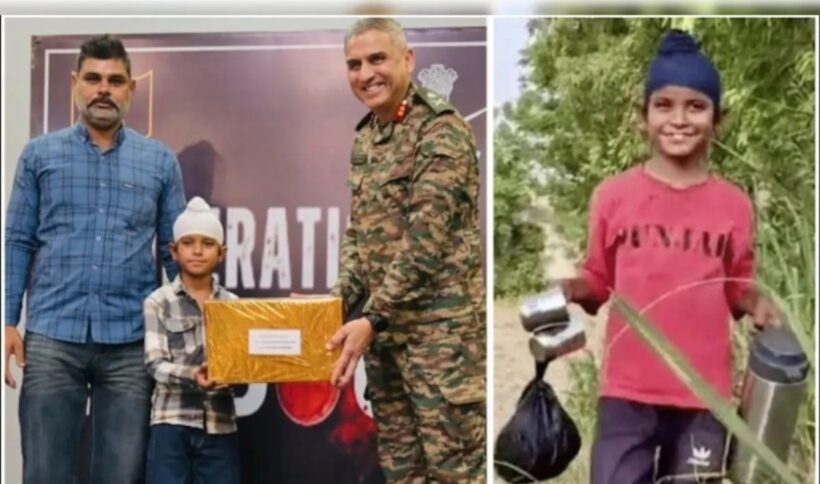
SHARVAN SINGH SUPPLYING TEA TO MILITARY PERSONS DURING OPERATION SINDUR–PHOTO.
In recognition of this noble act, he has been honoured with the ‘National Child Award’ by the Honourable President of India, Mrs. Droupadi Murmu. I commend Sharvan Singh and, while appreciating his spirit of service, courage, and humanity, appeal to the people of Punjab to connect their children with the teachings of Sikh history—values of service, compassion, and bravery”.
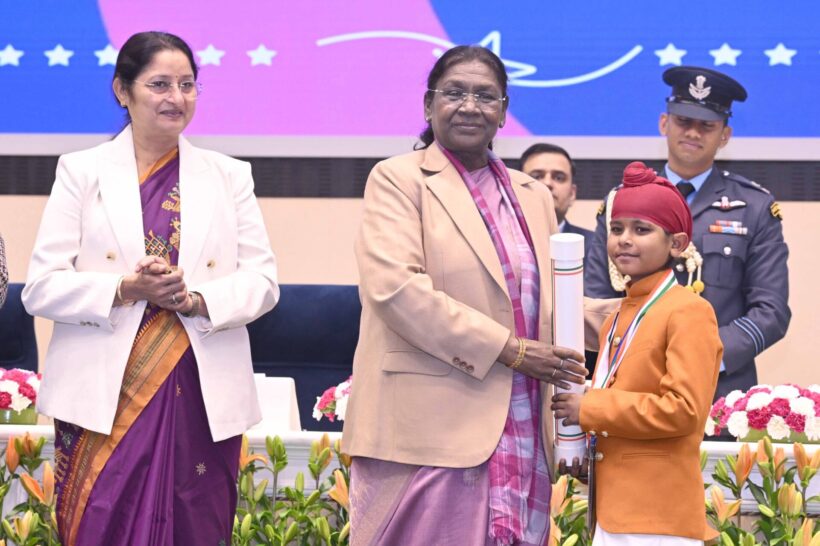
PRESIDENT MURMU-HONOURING SHARVAN SINGH-PHOTO CREDIT -PIB
While presenting the Pradhan Mantri Rashtriya Bal Puraskar to Sharvan Singh and other children for their exceptional achievements in the fields of Bravery, Social Service, Environment, Sports, Art & Culture and Science & Technology at a ceremony held in New Delhi on December 26, 2025, on the occasion of ‘Veer Baal Diwas’, the President of India, Smt Droupadi Murmu, said that about 320 years ago, Guru Gobind Singh Ji—the tenth Guru of the Sikh faith and revered by all Indians—and his four sons made supreme sacrifices while fighting in support of truth and justice. She said that the bravery of the two youngest Sahibzadas, is honoured and respected both in India and abroad. She remembered with reverence the great child heroes who laid down their lives with pride for truth and justice.
It is pertinent to mention here that Sikhism is the religion that always keeps humanity as its service motto. It had not only given the religious Gurus, who preached equality without any discrimination of caste and creed, service to humanity, compassion, and a deep sense of spirituality, but also gave the brave heroes, who martyred their lives for the protection of religious freedom and the rights of the oppressed. History can never forget the unparalleled, supreme, and extraordinary sacrifice of Guru Arjan Dev Ji, Guru Teg Bahadur Ji, Mata Gujri Ji, and the younger Sahibzadas — Baba Zorawar Singh Ji and Baba Fateh Singh Ji. The brave heroes like Sardar Bhagat Singh, Sardar Udham Singh and others, who fought against the tyranny of the English rulers for the sake of the country, are and will also remain the lighthouse for the present and coming generations.
Bravery, humanity, kindness and fearless actions are the main elements in Sikhism. Presently, these elements can also be noticed even in the children of the sect. The story of ten-year-old Sharvan Singh, amidst the risks associated with war during Operation Sindoor, who regularly delivered water, milk, and lassi to the Indian soldiers stationed at the border near his home, reflects the ‘Bravery, Humanity, Kindness and Fearless actions’.
President Murmu said that the greatness of a country is certain when its children are filled with patriotism and high ideals. Ten-year-old Sharvan Singh, amidst the risks associated with war during Operation Sindoor, regularly delivered water, milk, and lassi to the Indian soldiers stationed at the border near his home.
Smt. Murmu was happy to note that the children have showcased their exceptional talent in various fields such as bravery, art and culture, environment, innovation, science and technology, social service, and sports. She said that it is because of talented children like the seven-year-old Vaka Lakshmi Pragnika that India is considered a chess powerhouse on the world stage. Ajay Raj and Mohammed Sidan P, who saved the lives of others with their bravery and intelligence, deserve all the praise they receive. Nine-year-old daughter Vyoma Priya and eleven-year-old brave son Kamlesh Kumar lost their lives while saving the lives of others with their courage.
Whereas, the differently-abled daughter Shivani Hosuru Uppara has achieved extraordinary accomplishments in the world of sports, overcoming economic and physical limitations. Vaibhav Suryavanshi has made a name for himself in the highly competitive and talent-filled world of cricket and has set many records. She expressed confidence that brave and talented children like them will continue to do good work and make India’s future bright.
Why Veer Baal Diwas?
On the occasion of the Prakash Purab of Sri Guru Gobind Singh Ji on 9th January 2022, the Prime Minister, Narender Modi, had announced that 26th December would be observed as ‘Veer Baal Diwas’, to commemorate the martyrdom of Sahibzadas Baba Zorawar Singh Ji and Baba Fateh Singh Ji, the sons of Sri Guru Gobind Singh Ji, whose unparalleled sacrifice continues to inspire generations.
Prime Minister Narendra Modi, while addressing the national programme marking ‘Veer Baal Diwas’ at Bharat Mandapam, New Delhi, emphasized that on this day, the nation remembers the brave Sahibzadas, who are the pride of India and represent the pinnacle of indomitable courage and valour. PM Modi stated that these Sahibzadas broke the boundaries of age and stage, standing like a rock against the cruel Mughal empire, shaking the very existence of religious fanaticism and terror.
The Prime Minister stated that every year, children who achieve remarkable feats in different fields for the nation are honoured with the Pradhan Mantri Rashtriya Bal Puraskar (PMRBP), and this year too, 20 children from across the country have received the award.
Underlining that Veer Bal Diwas is a day filled with emotion and reverence, Modi remembered Sahibzada Ajit Singh Ji, Sahibzada Jujhar Singh Ji, Sahibzada Zorawar Singh Ji, and Sahibzada Fateh Singh Ji, who at a very young age had to confront the greatest power of their time. He emphasized that their struggle was between the fundamental ideas of India and religious fanaticism, between truth and falsehood, with one side led by 10th Guru Shri Guru Gobind Singh Ji and the other by the cruel rule of Aurangzeb. The Prime Minister noted that although the Sahibzadas were very young, Aurangzeb was determined to break the morale of Indians to force conversions, and thus targeted them. He stressed that Aurangzeb and his commanders forgot that Guru Gobind Singh Ji was no ordinary man but the embodiment of penance and sacrifice, and the Sahibzadas inherited this legacy. He declared that despite the entire Mughal empire’s might, not one of the four Sahibzadas wavered.
Voices Against Naming the Day as ‘Veer Baal Diwas’
Some voices, though with feeble frequency, are being raised to rename the ‘Veer Baal Diwas’ as “Sahibzada’s’ Balidan Diwas”, to commemorate the exemplary martyrdom of Sahibzadas.
Aman Arora, State President of the Aam Aadmi Party and Cabinet Minister in the Punjab Government, on stated that the observance of ‘Sahibzadas’ Balidan Diwas’ would be a more appropriate and dignified tribute to the unparalleled martyrdom of the Chhote Sahibzadas than the term Veer Bal Diwas, as it resonates more profoundly with the deep-rooted sentiments of the Sikh Sangat.
Delhi Akali chief Paramjit Singh Sarna has said the demand to rename ‘Veer Bal Diwas’ as ‘Sahibzadey Shahadat Diwas’ was grounded in historical accuracy, ethical reasoning, and the party’s stated position going back several years.
Emphasizing his point, Sarna said that the phrase ‘Veer Bal’, while emotionally evocative, was broad and imprecise, and risked obscuring the specific historical event being marked. “This is not a general observance of childhood courage. It commemorates a recorded shaheedi in which the Sahibzadey were bricked alive for refusing to renounce their faith. The term ‘Sahibzadey Shahadat Diwas’ conveys that reality directly, without dilution.”



