

By Rita Bhowmick
These are two historical photographs from the Liberation War of 1971. In one, Colonel M.A.G Osmani (Muhammad Ataul Gani Osmani), the Commander-in-Chief of the Bangladesh Forces under the Provisional Government of Bangladesh, is seen signing autographs during a visit to the Bangladesh Field Hospital in Bishramganj, which was constructed with thatched. He is surrounded by several doctors and nurses. This photograph is displayed on the wall of Gallery 3 at the Liberation War Museum in Agargaon, the capital.
The second photograph features Colonel M.A.G Osmani alongside doctors, nurses, and other distinguished individuals. On the left side of this photo are Dr. Nazimuddin, Dr. M.A. Mobin, Captain Dr. Akhtar Ahmed, Sector 2 Commander Major Khaled Mosharraf, A.K.M. Shamsuddin, Reshma Amin, and Saeda Kamal (Tulu). Also present are Colonel M.A.G. Osmani, Minu Billah, Asma Nisar, Dalia Salahuddin, Captain Dr. Sitara Begum, Zakia Sultana, and * Captain Noor (one of the four engineers). In the back row are Morshed Chowdhury, Shamsul Haque, Subedar Mannan, T. Hossain, Dr. Zafrullah Chowdhury, Sultana Kamal (Lulu), Brigadier Gupta, Syeda Ubaidunnahar Khuku Ahmed, and Belal.
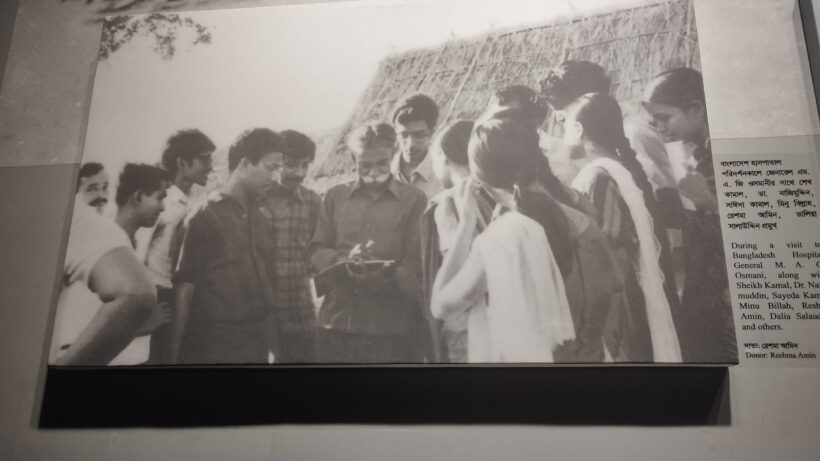
Colonel M.A.G Osmani (Muhammad Ataul Gani Osmani), the Commander-in-Chief of the Bangladesh Forces of the Provisional Government of Bangladesh, is seen signing autographs during a visit to the thatched Bangladesh Field Hospital in Bishramganj. He is surrounded by several doctors and nurses. Photo: Courtesy of the Liberation War Museum.
Regarding this photo, freedom fighter and human rights activist Sultana Kamal (Lulu) says that Hablu Banerjee, the bodyguard of Netaji Subhas Chandra Bose from Comilla, had donated nearly one and a half acres of land in the lychee gardens of Bishramganj for the Bangladesh Field Hospital.
In October, the number of patients at the Bishramganj Bangladesh Field Hospital increased. Dr. M.A. Mobin decided to expand the hospital. Another medical ward with 60 beds was built to the right of the old barracks. During this time, Colonel M.A.G. Osmani came to visit the hospital. He inquired about the patients’ welfare from the doctors and nurses. He was very pleased with the hospital’s operations. Taking the opportunity, Sector 2 Commander Major Khaled Mosharraf explained to him that more funds were needed for the hospital. Colonel Osmani promised to help as much as possible.
Sultana Kamal added, ‘We felt very good talking to him that day. After staying in that secluded place for four consecutive months, it felt wonderful when someone came to visit us. At other times, it felt like this was our only life; we couldn’t even remember spending time in any other way.’
Regarding her joining the Bangladesh Field Hospital, Sultana Kamal said, ‘Two sisters, along with Squadron Leader Hamidullah and his family and Shahadat Chowdhury, reached the hospital in Sonamura on June 16. Initially, we two sisters served as nurses under Captain Dr. Akhtar Ahmed. At that time, Sector 2 Commander Major Khaled Mosharraf showed us a ray of hope. He told us how to work. The joy those few words of encouragement gave us is indescribable. He also told us, ‘More girls need to come. A force cannot be formed with just two people.’ About half an hour after saying this, the Commander left for the Battle of Belonia.”
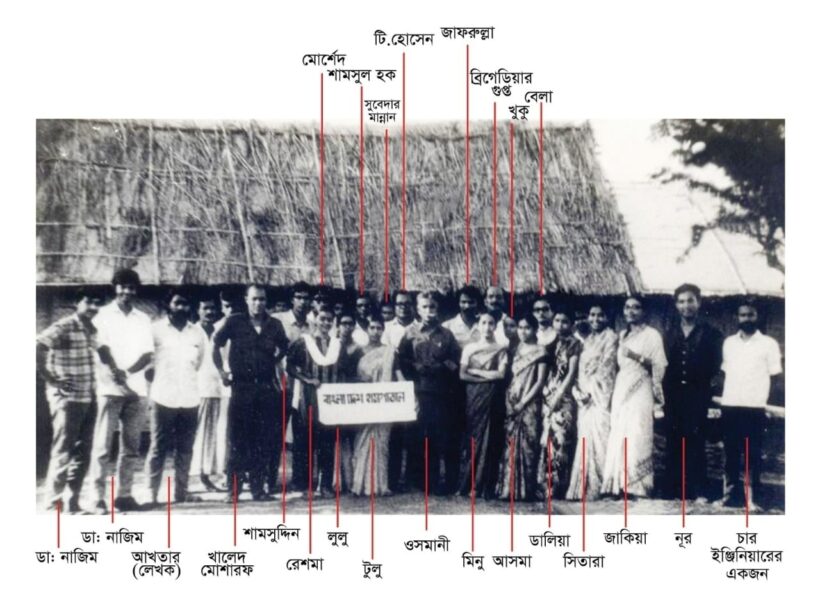
Colonel M.A.G. Osmani (Muhammad Ataul Gani Osmani), Commander-in-Chief of the Bangladesh Forces of the Provisional Government, with doctors, nurses, and other dignitaries during a visit to the Field Hospital during the Liberation War in 1971. Photo: Courtesy of the Liberation War Museum.
Syeda Ubaidunnahar Khuku Ahmed, wife of Captain Dr. Akhtar Ahmed (the spokesperson for the hospital), also served as a nurse there. Regarding Colonel Osmani’s arrival, she said, ‘Captain Dr. Akhtar Ahmed knew the Commander-in-Chief was coming to inspect the hospital, but he didn’t let any of us know. He kept it a secret. When Colonel Osmani approached the hospital, we heard the sound of many cars. Everyone shouted, ‘Colonel Osmani is coming!’ As soon as we heard this, we all ran toward the cars. He stayed at the hospital for 10 to 15 minutes. While taking the photo, Reshma Amin and Saeda Kamal (Tulu) held the banner of the Bangladesh Field Hospital. He discussed hospital matters with Major Khaled Mosharraf, Captain Dr. Akhtar Ahmed, Dr. Zafrullah Chowdhury, Dr. Nazimuddin, Dr. M.A. Mobin, Dr. Kiran Shankar Debnath, and Sultana Kamal (Lulu). Sultana Kamal spoke to him on our behalf. We girls stood at a distance watching him. We couldn’t hear the discussion, but Colonel Osmani addressed us, saying, ‘The girls are working, I feel good seeing this.’ He inspired us in our service to wounded freedom fighters. We requested a photo with him. He took the photo and then departed.’
Freedom fighter and dancer Minu Billah, who joined the hospital on September 1, 1971, said of the visit, ‘He was discussing various aspects of the hospital and the war with our commanders and doctors. I never imagined I would see and hear a man so closely- the man who was directing the fight to defeat the Pakistani occupation forces for the victory of Bangladesh. I listened to his words from a distance, fascinated. This was my first chance to see Colonel M.A.G. Osmani up close. Before leaving, he stood among us for a group photo.’
Freedom fighter Reshma Amin recalled, ‘Colonel Osmani came in mid-October. We were overwhelmed with emotion to see him in person. We had nothing to entertain him with. We were given Indian ‘Calcivita’ (Vitamin C) tablets to eat. We used to make a drink out of these tablets. Suddenly, it occurred to me to make a mug of Calcivita juice for him. No sooner thought than done. Colonel Osmani had a white mustache and black hair. When he took a sip from the mug, the orange color of the juice turned his mustache orange. Seeing this, we laughed inwardly. He also inspected the living arrangements for the girls so that he could facilitate funding for future developments.’
Captain Dr. Akhtar Ahmed and other doctors had asked Asma Nisar and Saeda Kamal (Tulu) to write ‘Bangladesh Hospital’ on a piece of paper. Regarding this, Saeda Kamal (Tulu) said, ‘We made a banner out of a thick piece of paper and wrote ‘Bangladesh Hospital’ with a black ink pen. When we stood for the photo with Colonel Osmani, Reshma and I held the banner. I was to the right of Colonel Osmani, and Minu Billah was also there. My elder sister, Sultana Kamal (Lulu), stood behind and between Reshma and me. This photo is something we will cherish in the depths of our hearts forever.’
The Author:
 Rita Bhowmick: Senior Reporter and Contributor, Pressenza- Dhaka Bureau.



