

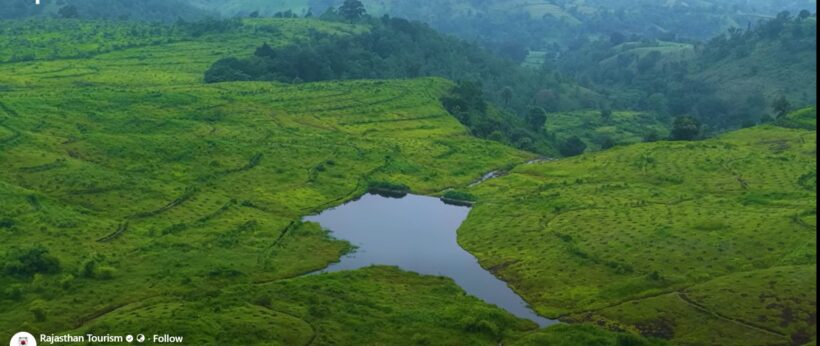
The coming generations will hardly believe that there was a chain of the oldest mountains, namely the Aravalli hills, on the Indian earth and they will read only in books that the hills spread over 800 km from Gujarat to Delhi, through Rajasthan and Haryana, ever actually existed. Reason: The recent Supreme Court decision. On November 20, 2025, a Supreme Court bench passed a vital judgement over the definition of the Aravalli Hills, India’s oldest mountain range, accepting the recommendations made by a committee spearheaded by the Union Ministry of Environment, Forest and Climate Change (MoEFCC). The Court ruling has narrowed the new definition of the Aravalli hills to the extent of 100 metre elevation threshold, resulting in the outage of hills parts below 100 meters in height from the definition of mountains category, which will exclude over 90% of the range from protection, allowing large-scale mining.
The former Chief Minister of Rajasthan, Ashok Gehlot warns that this decision is not about environmental protection; it is a ‘red carpet’ for mining mafias. History will never forgive the injustice the government is inflicting upon future generations by inviting the Thar Desert right up to Delhi’s doorstep.
This recent controversial redefinition will have severe negative effects on the environment and public health in North-West India, particularly the Delhi-NCR region.
Ashok Gehlot tweeted on December 16, 2025, “The Aravalli range is not just a mountain for Rajasthan; it is our ‘protective shield.’ Limiting it to a ‘100-meter’ scope based on the Union Government’s recommendation is tantamount to signing a ‘death certificate’ for 90% of the state’s Aravallis. The most alarming fact is that 90% of the Aravalli hills in Rajasthan are lower than 100 meters in height. If these are excluded from the definition, it is not merely a change of name, but the removal of a legal shield. This directly implies that the Forest Conservation Act will no longer apply in these areas, allowing for unfettered mining.”
Supporting his point, Gehlot states that a mountain is defined not by its height, but by its Geological Structure. A small rock is part of the same tectonic plate and mountain range as a towering peak. Separating the two is scientifically irrational.
How will the vanishing Aravali chain affect the environment and ecological balance? Mr. Gehlot explains that the Aravalli is a wall that prevents the Thar Desert from expanding. Experts warn that even smaller hills (ridges) of 10 to 30 meters are equally effective in blocking dust storms. Opening these small hills to mining is akin to personally inviting the desert to expand into Delhi and Eastern Rajasthan. The rocky structure of the Aravallis intercepts rainwater and channels it underground. These hills act as groundwater recharge zones for the entire region. Removing them is an invitation to drought in North-West India, a region already grappling with water scarcity.
The Aravalli is the barrier that stops the deadly heat waves from the west and prevents the Thar Desert from encroaching upon the fertile plains of Eastern Rajasthan, Delhi, and Uttar Pradesh.
Kumari Selja, a former Union Minister, and Sirsa MP, in a press statement on 3rd December, criticizing the decision to remove hills below 100 metres in height from mining restrictions in the Aravalli mountain range, calling it a reckless assault on India’s environment and the future of generations to come, said the decision is anti-environment, destructive, and a result of the government’s misguided policies that are pushing natural resources towards a crisis.
Kumari Selja said the Aravalli is not merely a mountain range-it is the ecological lifeline of North India. It protects the Rajasthan-Haryana-Delhi region from desertification, plays a critical role in water conservation, and safeguards the livelihood and lives of millions of people. In such a situation, giving mining mafias a free hand is utterly irresponsible. She added that the government’s move is a dangerous step towards legalising illegal mining and destroying the environment. The destruction of the Aravalli hills will directly and severely impact water sources, greenery, groundwater levels, and public health. Kumari Selja warned that Haryana and Delhi-NCR are already facing severe pollution and water scarcity. Weakening the Aravalli range could trigger an environmental disaster for the entire region.
It is a well-established fact that the Aravalli hills chain is the oldest mountain on Earth. It spans over 800km from Gujarat to Delhi (through Rajasthan and Haryana). The highest peak in the Aravalli Range is Guru Peak on Mount Abu.
The Forest cover in the Aravalli chains not only preserves humidity in the atmosphere, but it also modulates wind direction and its flow, regulating rainfall patterns and checks drought across some northern states. It also serves as pollution barricades to the Delhi- NCR areas, which are even presently facing higher AQI despite this Hills chain’s role in trapping pollutants. What shall be the position of Delhi-NCR pollution, when there will be no Aravali to give protection?
Concludingly, we can say that the Aravallis act as a crucial natural barrier, blocking dust and sand storms from the Thar Desert from spreading into the fertile Indo-Gangetic plains. Their disappearance would allow the desert to expand eastward, impacting agriculture and quality of life for millions.
The Hills serve as natural wind regulators and “lungs” that filter the air. Losing this natural shield would significantly worsen air quality in the Delhi-NCR region, leading to increased respiratory illnesses like asthma and bronchitis, and other health problems.
The highly fractured and weathered rocks of the Aravallis function as a critical natural water recharge zone, allowing rainwater to percolate and replenish aquifers. Their degradation disrupts this process, leading to further drops in already dangerously low groundwater levels and water scarcity in the region.
The range is a biodiversity hotspot, home to hundreds of bird species and endangered mammals like leopards, hyenas, and jackals. The destruction of their habitat forces wildlife into human settlements, increasing human-wildlife conflict.
The loss of vegetation cover and changes in topography impact local rainfall patterns, moderate wind velocity, and contribute to increased heat stress and extreme weather events throughout North-West India.
Many rivers and seasonal streams originate in the Aravallis, including the Banas, Luni, Sahibi, and Sakhi rivers. Many of these rivers have already disappeared due to environmental degradation and over-exploitation, and further loss of the hills will exacerbate water insecurity.
What disasters our next generations will have to face, we can imagine and when even imagination seems to be so dreadful, then what shall be the real danger? Will we inherit such a destructive situation for our coming generations? Shouldn’t we have a rethought over redefining the Aravalis? Before it’s too late, shouldn’t we take into account the warning given by Ashok Gehlot, “History will never forgive the injustice the government is inflicting upon future generations by inviting the Thar Desert right up to Delhi’s doorstep”.



