
My Dear Friend,
As a person who joined my local YMCA in 1979 as a youth and then became an Executive Secretary of the National YMCA in 1988, I had the opportunity to work with the people in the North and East, where many Tamil and Muslim communities live.
I first went to Jaffna in 1989 when the Indian Peace Keeping Force (IPKF) was in control of the area.
To go to the North, we had to get permission from the Indian Peace Keeping Force in addition to the approval of the Ministry of Defence in Colombo at the time.
When we arrived in Vavuniya (border of Northern province), the IPKF Major was reluctant to give us permission because a military operation was underway beyond Kilinochchi.
But we took responsibility for our own lives and came to Jaffna that day only after getting his permission.
On that trip, we visited several YMCA houses built for the people who had come to the North after the 1983 South riots against Tamils. These houses were in areas of Paranthan and Kilinochchi, in small villages of Iyakachchi and Bharathapuram. I still have the photographs from that journey.
When we arrived in Jaffna, there was no electricity anywhere except in a few main locations. We stayed at the house of a brother in the Navaly area. We spent that night under the light of a kerosene lamp. While we were talking, we suddenly heard the sound of dogs barking. That’s when our brother in Navaly, Jaffna, said, “Here come the IPKF soldiers.”
After that visit, I went to Jaffna several times whenever a period of peace emerged, even while the war was ongoing. I can’t forget the voyage through Kilali lagoon by LTTE boats in 1992.
I had a great love for the people of the North and East. That love remains the same. Some may not agree with me, but I have tell you that during the war and during temporary periods of peace, some people of Jaffna had slightly different ideas about an Eelam state.
Many did not have a clear idea about a separate state. However, they could not tolerate the discrimination caused by the dominant Sinhala governments.
While building a separate state was not their necessity, an environment where they could think of an alternative was also not created at that time.
The narrow-minded Sinhala governments that ruled the South always thought only about protecting their power.
There were plenty of opportunities to offer a solution acceptable to the Tamil people in the North and East, but the leaders in the South were not ready due to the influence of extremist religious groups in the South.
I went to Jaffna several times during the peace agreement period sponsored by the Norwegian government. On one occasion, while I was standing at an LTTE checkpoint, a young boy with one arm missing approached me. He couldn’t speak Sinhala( my mother language), but I understood the question he asked me in Tamil.
“Where are you going?”
I said I needed to get the pass. He understood the word “pass.” He took me to the front of the line, spoke in Tamil to someone (I don’t know who), and got me the pass before the others.I don’t know why this young boy helped me… I thanked him in broken Tamil, saying “Nandri”. I think he must have been a young man who lost an arm in the war…He might have understood that I was someone who loved his people.
That’s how I feel.
It mattered to me when people died in the war; I always felt that the one who died was my own brother or sister.
That is why I love peace so much, my brother.
I believe that peace is not just the absence of war. It is a question of justice that goes much further.
But whatever we do, it is very important that we Sinhalese, Tamil, and Muslim people live together.
That can only be done if we understand each other correctly. In doing so, we must be ready to respect everyone’s identity. Because our identity is our dignity.
Today, there is no armed conflict, people are moving from here to there and vice versa. But, do our brothers and sisters in North and East feel that they are inclusive? I doubt…..
I worked hard to bring the National People’s Power (NPP/JJB) government to power. Even today, I am a member of the NPP National Steering Committee.
Anura Kumara Dissanayake, our President is a man with compassion and empathy.
If not for the threat of extremist religious forces in this country, Anura Kumara Dissanayake would do many more things for the Tamil people in the North and East.
In fact, at this time, he is forced to somehow balance Sinhala nationalism with the needs of the Tamil people.
The responsibility of individuals and groups like ours is to somehow create a feeling for peace, reconciliation, and national unity among the extremist people in the South, even more so than among the people in the North.
This country belongs to all of us.
If we develop this country in the right direction, and we establish a system where the country’s resources and wealth are justly shared among everyone, none of us will need to separate or want separate countries.
While working at the YMCA and Caritas Sri Lanka, I have done many things for peace and reconciliation. Many of those efforts were successful, but some were not. The reason for that was the lack of support for many of our programmes from the people who ruled this country. But now we have a good opportunity. Truly, the majority Sinhala people in our country are not racists. It is these racist Buddhist forces that set this country on fire for the sake of their own survival.
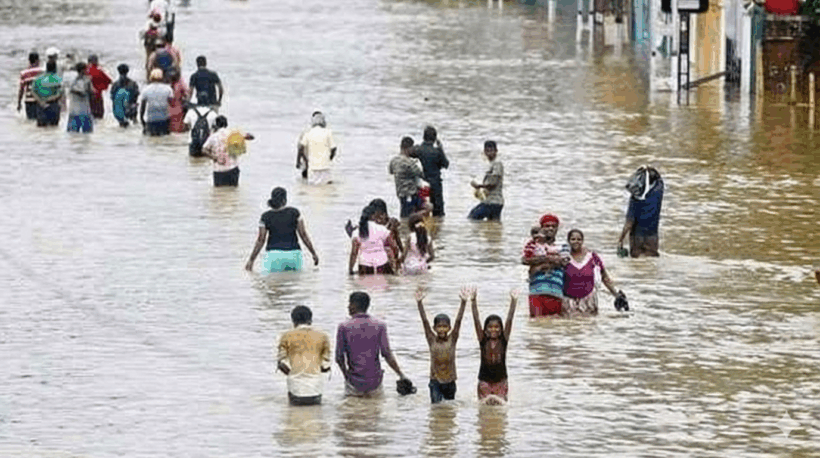
By this time, you are aware of the damage caused to Sri Lanka due to the cyclone, floods, and landslides. Under the current disaster situation, the people of our country have given a new meaning to the word solidarity. The UN representative in Sri Lanka has also spoken very highly of this.
In this disaster situation that has arisen, a programme should be implemented that fosters solidarity regardless of race, religion, caste, language, or region. Various non-governmental organizations may have already submitted such ideas and proposals. What I believe is that whoever initiated it must be a programme that goes beyond such institutionalized programmes, a programme with the full participation of the people that unites our Sinhala, Tamil, and Muslim people and allows them to share their lives together.
This could be the reconstruction of houses destroyed by the great floods or landslides, the restoration of their lost farmlands, or support for businesses. This should be a programme that goes beyond mere financial aid, a programme where people dedicate their time and labour. You may intervene through your organisation or the government to come forward to support such an initiative.
If you have any thoughts on this, I would like to discuss them.
Let us use this unexpected disaster and calamity to build peace, reconciliation, and national integration.
Thanks for taking the time to read this long letter.
Take care,
Yours sincerely
Aruna Shantha Nonis