
In 1971, the brave women of Bengal took on the responsibilities of organizing freedom fighters, managing various organizational activities in refugee camps, risking their lives to shelter freedom fighters in their homes, and distributing leaflets and pamphlets.
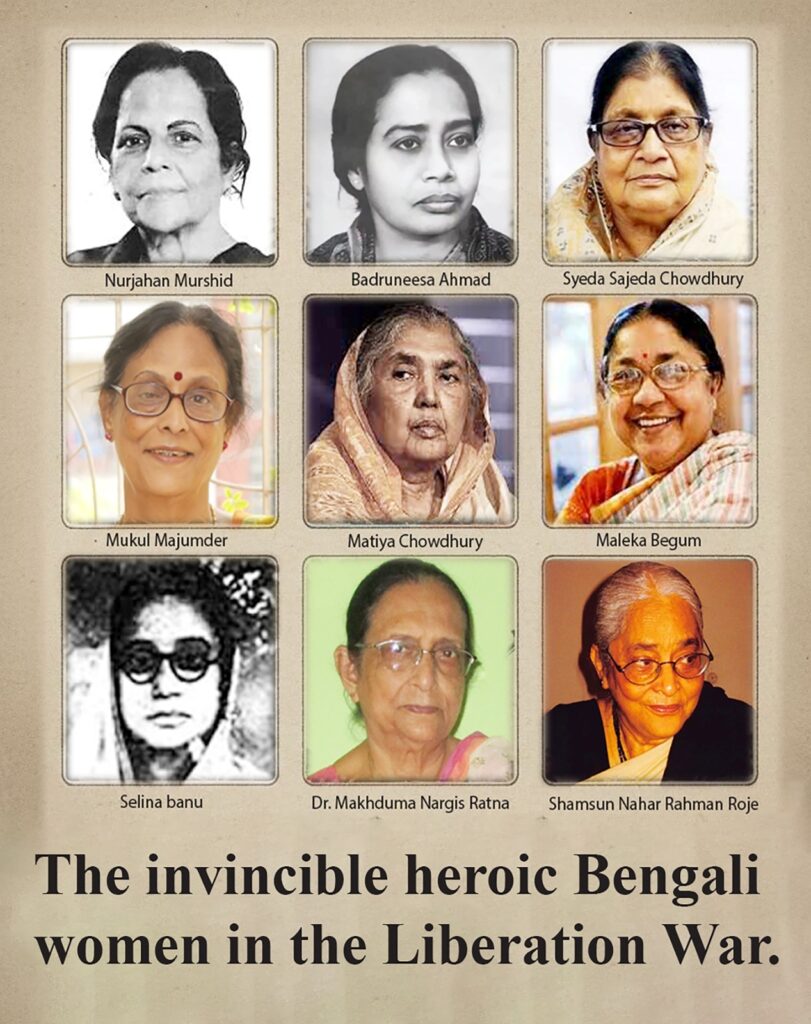
Among the women organizers who played important roles in the Liberation War were the elected members of the reserved women’s seats of 1970: Nurjahan Murshid (Women’s Seat-1), Rafia Akhtar Dolly (Women’s Seat-2), Syeda Sajeda Chowdhury (Women’s Seat-3), Momtaz Begum (Women’s Seat-4), and Badrunnessa Ahmed (Women’s Seat-7). Additionally, women leaders such as Motia Chowdhury, Maleka Begum, Dr. Makhduma Nargis Ratna, Dr. Nurun Nahar Chowdhury, poet Sufia Kamal, Shamsun Nahar Rahman Rose, Selina Banu, Ashalata Sen, and Ayesha Khanam also played crucial roles.
MNA Nurjahan Murshid played a key role as a representative of the Provisional Government of Bangladesh in Delhi to garner support and recognition for Bangladesh. She was part of a three-person delegation that met with Indian Prime Minister Indira Gandhi. Subsequently, she met with President Shri V.V Giri, Defense Minister Jagjivan Ram, Foreign Minister Swaran Singh, Speaker Dhillon, Education Minister Siddhartha Shankar Ray, Industries Minister Moinul Haque Chowdhury, and Leader of the Opposition Fakhruddin Ali Ahmed.
In her book Amar Kichu Smritikotha (Some of My Memoirs), Nurjahan Murshid wrote that as a representative of the Mujibnagar Government, she addressed a joint session of both houses of the Indian Legislature in the Central Hall of the Delhi Parliament House, demanding recognition of the State of Bangladesh from the Government of India. She met with the Governors and Chief Ministers of Bombay, Lucknow, and Madras to garner support for Bangladesh’s struggle for liberation. She also campaigned for the Liberation War by touring various places in India. When she spoke on this issue at the joint session of the Indian Parliament, the military President of Pakistan, Yahya Khan, infuriated by her actions, issued an order, in her absence, to sentence her to 14 years of imprisonment and confiscate her property.
MNA Badrunnessa Ahmed served as the President of the Mujibnagar Women’s Rehabilitation activities and a women’s organizer in Mujibnagar. Acting on the instructions of the Prime Minister of the (Provisional) Government of Bangladesh, Tajuddin Ahmad, she inspected refugee camps and submitted reports. She ensured the proper distribution of relief materials, including medical aid, among the refugees and arranged for women from the refugee camps to be sent for freedom fighter training.
MNA Syeda Sajeda Chowdhury organized training with dummy rifles at her residence on Indira Road in Dhaka during the first week of March, preparing girls for participation in the war. In early June, with the cooperation of the Mujibnagar Government and the Government of India, she established the ‘Gobra Mohila Muktijoddha Camp’ (Gobra Women Freedom Fighters Camp) in Gobra, Padmapukur, Kolkata. She served as the director of this camp. After returning home following independence, she made a significant contribution to the rehabilitation of women who were tortured during the Liberation War of ’71. She served as the director of the ‘Nari Punarbashon Board’ (Women’s Rehabilitation Board).
Under the direction of MNA Syeda Sajeda Chowdhury, Mukul Majumder served as the Assistant Director of the ‘Gobra Mohila Muktijoddha’ Camp on Mahendra Roy Lane in Kolkata. Freedom fighter Mukul Majumder stated, “Syeda Sajeda Chowdhury instructed me to look after the problems of the girls at the camp. I diligently followed those instructions. The first batch of 16 trained girls was sent to the battlefield. Another 16 were prepared. A total of 32 people were prepared in two batches. Each trainee received a monthly allowance of one hundred Taka.”
She further said, “I used to visit the Liberation War camps with Syeda Sajeda Chowdhury. Sometimes, I would go to refugee camps and recruit girls. Twenty-seven girls studying in Class IX-X were selected from the Salt Lake Refugee Camp. Among them, Shirin Banu Mitil and three other girls were brought to the camp. The remaining 22 were taken to the Salt Lake Refugee Camp by a school teacher named Upendranath. These girls were trained here, batch by batch. Some of them were sent to Bishramganj Hospital in Agartala and Kuptakhali Camp.”
Around October, news of the arrival of the Seventh Fleet was received. Led by MNA Rafia Akhter Dolly, many girls from the camp, including Mukul Majumder, took to the streets of Kolkata. The streets of Kolkata resonated with their slogan, ‘Send the Seventh Fleet back, send it back.’ Their photos, along with the news, were published in Kolkata’s Amrita Bazar Patrika.
MNA Rafia Akhter Dolly traveled to Kolkata, Jadavpur University, and various areas including Kolkata, Bongaon, and Barasat, to garner public opinion, raise funds, and collect clothes for the liberation struggle. She also established an organization called ‘Sayera Banu Sewing Center’ in Kolkata to make clothes for the refugees and freedom fighters. She collected relief from various foreign aid agencies and distributed it in refugee camps through the ‘Khairunnessa Kalyan Samiti’ in Park Circus, Kolkata.
MNA Momtaz Begum participated in the discussions on the formation of the Mujibnagar Government as an organizer of the Liberation War. Ashalata Sen organized expatriates while she was in New York. Additionally, many unsung women formed small groups and camps in different parts of the country to carry out organizational work. Syeda Isabella of Sirajganj was involved in all the training activities for the freedom fighters at the Roumari Youth Camp.
NAP leader Motia Chowdhury attended the conference of the Assistance Committee in Delhi in support of the Liberation War. She presented Bangladesh’s case as a refugee. Furthermore, she and Maleka Begum, the General Secretary of the Bangladesh Mohila Parishad (Women’s Council), held small meetings in the Basirhat area of West Bengal to inspire the refugees.
In this context, freedom fighter Maleka Begum said, “On the invitation of the Indian Women’s Federation, Motia Chowdhury and I went to Delhi to attend an international conference. There, we had the opportunity to discuss matters with the President of India, V. V. Giri. On the other hand, in support of the Liberation War of Bangladesh and against the barbarity of the Pakistani army, Australian citizens went on a hunger strike in front of the Australian Embassy in Delhi in July 1971. To garner the support of Indian girls, Free [Frida] Brown, the leader of the Women’s International Democratic Federation, Motia Chowdhury, and I joined the hunger strike with them. We campaigned in various places, starting from Kolkata to Jalpaiguri, Panipat, Haryana, Punjab, and Delhi.”
She added, “We conducted a widespread campaign across India on issues like the Liberation War, the genocide by the Pakistani army, the torture and brutality against women, and the imposed war on the freedom-loving people. This organized effort had a significant positive impact on Indian women’s society. Leaders of the Indian Women’s Federation, including Aruna Asaf Ali, Renu Chakraborty, Bimala Farooqi, Gita Mukherjee, Bani Dasgupta, Ila Mitra, Kalpana Dutt (Joshi), Bidya Munshi, and Nivedita Nag, responded to our appeal and expressed solidarity with the ongoing movement and struggle.”
Maleka Begum issued a statement on September 26, demanding the formation of a United Nations investigation committee into the torture of women by the Pakistani forces. The statement mentioned, “We appeal to the United Nations to draw attention to the extreme persecution of women in Bangladesh and to form a special investigation committee to look into the atrocities committed by Pakistani soldiers against women.”
On October 4, Maleka Begum, on behalf of the Bangladesh Mohila Parishad, appealed to the United Nations to form an investigation committee to probe the incidents of torture perpetrated by the Pakistani forces on women in Bangladesh.
On the other hand, Monoroma Basu, Hena Das, Shanti Dutta, and Selina Banu worked to organize women. During the war, they held meetings in places like Kolkata, Jalpaiguri, Panipat, Haryana, Punjab, and Delhi to garner support from Indian girls. They maintained contact with women in various refugee camps and exchanged views with journalists.
Ayesha Khanam, Dr. Makhduma Nargis Ratna, Dr. Fawzia Moslem, Farida Akhtar, Munira Akhter, Rokeya Begum, Mini Morjina, Mrs. Rauf, Jahanara Begum (Librarian of Dhaka Charukala), and Prof. Lakshmi Rani Aich (Rangamati College), among others, participated in various activities as Liberation War organizers in Agartala. There, they collected information about the atrocities committed by the Pakistani army against women from Bangladeshi newspapers, news, bulletins, and refugees, and completed the task of writing booklets on behalf of the Mohila Parishad.
According to freedom fighter Dr. Makhduma Nargis Ratna, those who came to Agartala to participate in the Liberation War in ’71 were recruited and sent to various training camps. She served as a volunteer. Additionally, she would hold meetings with women in the camps to inspire them. She also treated patients in the refugee camps.
Poet Sufia Kamal and Shamsun Nahar Rahman Rose remained in Dhaka during the 1971 Liberation War and, evading the Pakistani forces, sent many freedom fighters and intellectuals to India. With the help of Shamsun Nahar Rahman Rose, Professor Rehman Sobhan and Professor Anisur Rahman of the Economics Department of Dhaka University reached India safely just a few days after March 25.
Regarding this, fashion designer Bibi Russell stated, ‘My mother helped many talented individuals reach India safely via my maternal grandfather’s house in Beraid. Professor Rehman Sobhan came to our house right after March 25. He had long hair and sideburns. Everyone knew him. To prevent any danger on the way and ensure no one recognized him, I gave him a makeover, changing his style and attire. He had hair on his hands; I cleaned them. I put a hat on his head, dressing him up as a Moulvi. They walked some distance from our house, then took a launch to Cumilla via local contacts. From there, they were sent to Kolkata via Agartala through the Cumilla border. In late April, economist Dr. Nurul Islam and artist Debdas Chakraborty, and in the first week of May, government official Jamil Chowdhury, went to my maternal grandfather’s house in Beraid. From there, my mother sent them to Agartala via courier. In late May, economist Dr. Swadesh Ranjan Bose and journalist Abdul Gaffar Chowdhury were sent in the same way. My mother could speak Urdu. If she ever ran into trouble, she would speak to the Pakistani soldiers in Urdu.’