

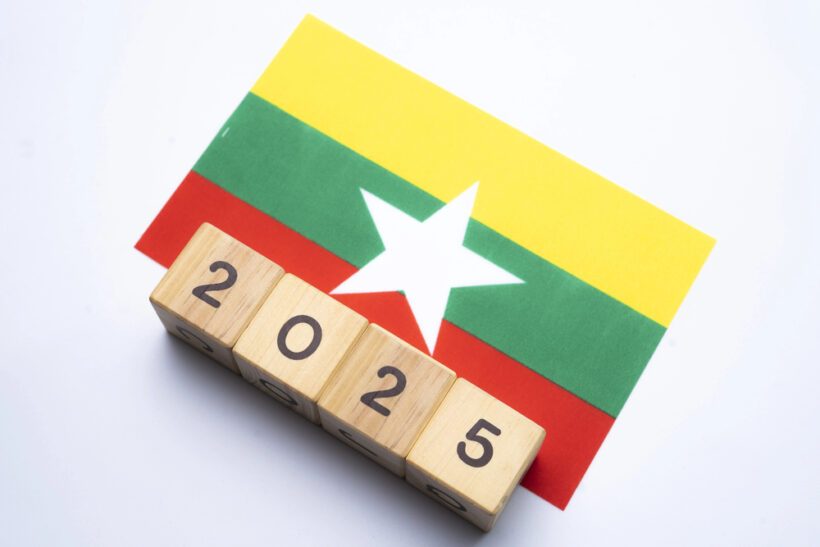
On December 29, elections will begin in Myanmar – the Burmese call them sham elections —which will be held until January 11, 2026, with a subsequent phase. Meanwhile, the junta’s army has been heavily bombing villages in the areas occupied by the Resistance for months, attempting to reclaim lost territory and gain a broader electoral base. According to the Burmese magazine Mizzima, the elections have been heavily promoted by China, which is pushing for international recognition of the junta; to this end, it will send observers to monitor the elections alongside Belarus and Russia. One wonders how these countries, which have never held democratic elections, can have observers experienced in democratic elections. They are not the only ones standing by the military junta; India is also actively supporting Myanmar’s elections by sending infrastructure, polling stations, and other resources, including observers to monitor the proceedings.
The elections have been called by the same military junta that seized power on February 1, 2021, ending the decade-long democratic experiment with the party led by Aung San Suu Kyi. In the last elections in November 2020, the party had garnered 80% of the vote, while the military junta’s party had garnered a humiliating 6%. Having imprisoned Aung San Suu Kyi, then seventy-six, and thrown away the key, the military junta launched a harsh crackdown, arresting political representatives of the Pro-Democracy Party, harshly repressing protests, and persecuting the hundreds of thousands of people who joined the vast civil disobedience movement, or CDM for short, that had swept not only the capital Yangon but also Myanmar’s major cities. At dawn on February 2nd, teachers, nurses, doctors, public administration employees, and students took to the streets, refusing to work and study in those facilities that no longer served the democratic government but the military junta. A shining example of mass civil disobedience.
Last September, I traveled to Thailand’s border with Myanmar to interview Burmese women exiles who were forced to leave their homeland and their lives. Staunch members of the Civil Disobedience Movement (CDM), they cannot return because they would be arrested. They live in exile and actively support the resistance fighting across the border. They recognize the National Unity Government (NUG), formed by parliamentarians elected in the last democratic elections of 2020, as their legitimate government. Their hope is to return the democratic government to Aung San Suu Kyi once the resistance has won.
K.S.M. was undoubtedly the most dramatic interview of all. Minister of Internal Affairs for the Lisu ethnic minority in Northern Shan State, where she hails, she was elected in the 2020 democratic elections. K.S.M. has not left the country and has decided to remain by her people’s side as minister of the NUG, the shadow government. She finds herself in the midst of war, with the military junta on one side and the ethnic minority’s troops fighting alongside the army for democracy on the other. Shan State is divided in two; the junta’s army controls the south, while the north is in the hands of the Resistance, allied with the Lisu. Ethnic minorities in Myanmar have been fighting military rule since 1962, when General Ne Win ended 14 years of democratic rule and their demand for a confederate state; their guerrilla forces have allied themselves with the Resistance in some areas.
The village where K.S.M. had to take refuge, had no water or electricity, and it was impossible to stock up on food because the junta’s army blocked the roads. She and the other villagers therefore find themselves in a dire situation: the junta’s planes bomb them every day, and the death toll in the village increases daily. K.S.M. is not the only NUG parliamentarian to find herself in a war zone. Half of the democratically elected government in 2020 is not in exile but is stationed inside Myanmar, and many of its ministers are living in hiding, sharing the fate of civilians targeted by the junta’s troops, who consider them its enemies. They share the fate of a population traumatized by the bombings: children unable to go to school and feeling even more abandoned, unable to process their trauma with their teachers and peers; adults unable to work, who have lost their jobs, who have lost their homes, who lack the money to rebuild their homes. K.S.M. is worried that if the military junta remains in power much longer, the country will sink deeper into trauma and poverty.
Even the democratic NUG government can’t do much for them. There’s no internet in their area, so contact with the NUG isn’t regular or up-to-date, and often it’s not even aware of their plight. The only way to communicate is through Starlink, an extremely expensive system, which she used to speak to me. K.S.M. must remain in Northern Shan State, and if the junta’s troops advance, she’ll be forced to abandon her village and take refuge in the forest with the surviving civilians. I ask her if there are any internally displaced person camps where they can take refuge, but she tells me it’s impossible to set them up because the bombings are constantly requiring civilians to move. She concluded our conversation by appealing to the international community to withdraw its support for “this terrorist military junta,” which is carrying out acts of war it shouldn’t, such as bombing villages, schools, and civilians, specifically aimed at killing children and women -does that remind you of anyone else?
Source: Mizzima News “Spring Revolution” 4 December 2025
The interview with K.S.M. is in “Resistenze. Da Gaza all’Afghanistan al Myanmar,” by Fiorella Carollo, Multimage, November 2025.



