

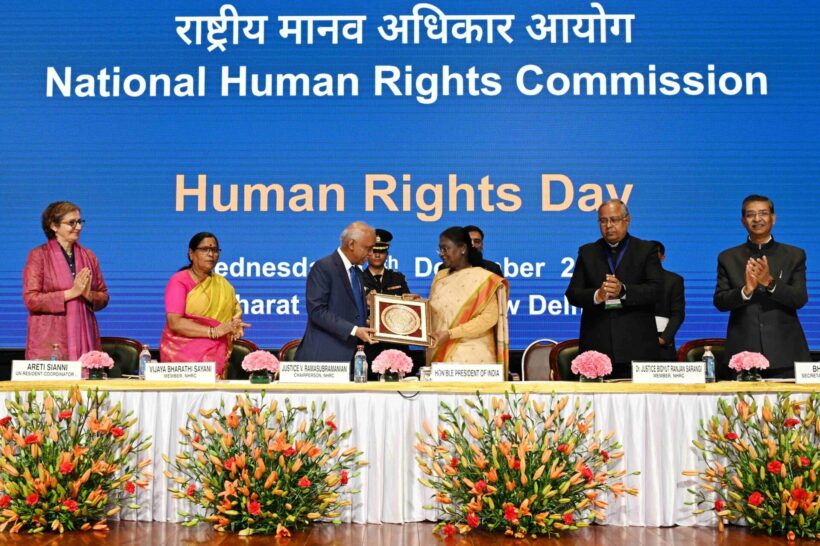
Addressing the Human Rights Day celebration, organised by the National Human Rights Commission, in New Delhi on Wednesday, the President of India, Smt. Droupadi Murmu said that Human Rights Day is an occasion to remind us that the universal human rights are inalienable and they form the bedrock of a just, equitable, and compassionate society. Seventy-seven years ago, the world came together to articulate a simple yet revolutionary truth: that every human being is born free and equal in dignity and rights. India played an important role in shaping a global framework of human rights. Our freedom fighters envisioned a world rooted in human dignity, equality, and justice.
The President emphasized that human rights must be ensured for all, including the person in the last mile, in keeping with the philosophy of Antyodaya. She stated that each and every citizen should be an active participant in the nation’s development journey towards building a Viksit Bharat by 2047. Only then can development be called inclusive in the real sense.
President Murmu said that human rights are contained in the vision of our Constitution. Human rights promote social democracy. Human rights encompass the right to live without fear, to learn without barriers, to work without exploitation, and to age with dignity. We have reminded the world that human rights cannot be divorced from development. Also, India has always adhered to the timeless truth: ‘There is no peace without justice and there is no justice without peace.’
Our commitment is clear: to build a nation where every individual can live with freedom, respect, and equality, and where human rights are not only protected, but celebrated. Human rights are contained in the vision of our Constitution. Highlighting our Constitutional objectives, Babasaheb Dr. Bhimrao Ambedkar had said, “We must make our political democracy a social democracy as well.” Human rights promote social democracy. Human rights encompass the right to live without fear, to learn without barriers, to work without exploitation and to age with dignity. We have reminded the world that human rights cannot be divorced from development.
She highlighted that India embraced the Universal Declaration of Human Rights as a co-creator of a universal moral covenant which resonated deeply with our civilizational ethos. Our ancient value of ‘Vasudhaiva Kutumbakam’, which means that the world is one family, is reflected in the idea of universal human rights. It is only apt that India’s sustained commitment to the human rights principles has been recognized globally. It is evidenced by our unopposed election to the United Nations Human Rights Council for a three-year term commencing in 2026 for the seventh time.
The President was happy to note that the National Human Rights Commission, the State Human Rights Commissions, along with the judiciary and civil society, have functioned as alert sentinels of our Constitutional conscience. She noted that over the past few years, the National Human Rights Commission has taken Suo motu cognizance of numerous issues concerning people from the Scheduled Caste and the Scheduled Tribe communities, as well as women and children. She also noted that the Human Rights Commission held extensive discussions on the subject of Human Rights of Prison Inmates during its Foundation Day celebrations this year. She expressed confidence that the discussions would yield useful results.
The President said that women’s empowerment and their welfare are key pillars of human rights. She was happy to note that NHRC has organized a conference on women’s safety in public places and workplaces. She stated that the conclusions drawn from such conferences can prove crucial in ensuring women’s safety and empowerment.
Underlining the role of women leaders in drafting the Universal Declaration of Human Rights, President Murmu said, “Hansa Mehta, one of the fifteen women members of our Constituent Assembly, was also a member of the group engaged in the drafting of the Universal Declaration of Human Rights. She suggested a foundational change to the draft. She ensured that the rights enshrined in that global charter were expressed, not in terms of the ‘rights of man’, but in the inclusive and universal expression, ‘rights of all human beings.’ That such a historic shift was brought about by the expansive vision of an Indian woman is a matter of enduring pride for every Indian”.
The President said that the NHRC gives expression to certain ideals of the State and the society. The Government of India has been translating such expressions into action on a scale never seen before. Over the last decade, we have witnessed our Nation move ahead with a different approach – from entitlement to empowerment and from charity to rights. The Government has been working to ensure that everyday essential services like clean water, electricity, cooking gas, healthcare, banking services, education, and improved sanitation become available to all. This uplifts every household and secures dignity.
The President said that recently, the Government has notified the implementation of a major reform through the four Labour Codes related to wages, industrial relations, social security and occupational safety, health and working conditions. This transformative change lays the foundation for a future-ready workforce and more resilient industries.
The President called upon every citizen to recognize that human rights are not the sole responsibility of governments, the NHRC, civil society organizations, and other such institutions. She said that protecting the rights and dignity of our fellow citizens is a shared duty. This duty rests with all of us as members of a compassionate and responsible society.



