

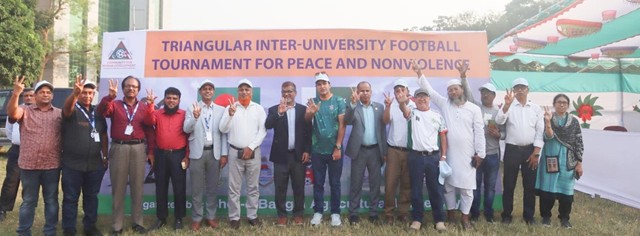
In the heart of South Asia, where borders and histories often separate, a football ground in Dhaka recently became a living symbol of unity, love, and human connection. The ongoing Triangular Football Series among Pakistan, Bangladesh, and Nepal is not merely a sporting event—it is a celebration of shared humanity and an embodiment of the belief that peace and friendship can be nurtured through sports.
The opening match took place at the Sher-e-Bangla Agricultural University Football Ground, where Bangladesh and Nepal competed in an atmosphere charged with youthful energy and optimism. The stadium was brimming with life—students, faculty members, and citizens filled every seat, and even the rooftops of nearby hostels were crowded with enthusiastic spectators waving flags and cheering their teams. It was a moment of joy that transcended competition.
The Vice Chancellor of Sher-e-Bangla Agricultural University inaugurated the series, offering warm greetings to the visiting teams and officials. Players stood proudly in their team shirts and caps adorned with special logos representing peace and unity. The colors of the jerseys were more than fabric—they were symbols of a shared vision for a region that dreams of coexistence, compassion, and respect.
What made the event truly inspiring was that the youth were at the heart of it all. Students volunteered as organizers, security personnel, hosts, and coordinators. From preparing meals and arranging accommodations to managing logistics and welcoming guests, they did it all—with smiles, sincerity, and a sense of purpose. Their selfless commitment embodied the very essence of peace: the idea that when young people work together, barriers begin to fade, and bridges of understanding are built.
But beyond the football matches and youthful enthusiasm lies a deeper, emotional story—one that connects Pakistan and Bangladesh in a complex yet heartfelt bond. Once one nation until 1971, the two countries share a history of love, pain, and brotherhood that time could not erase. Despite decades of separation, the warmth between their people remains alive—visible in gestures of friendship, hospitality, and mutual respect during events like this.
When the Pakistani team visits Bangladesh, it is not just a journey across borders—it is a journey through shared memories and rediscovered affection. The smiles, the handshakes, the songs of welcome—all reflect a quiet truth: that love never truly dies, and friendship can heal the scars of the past. Sports, especially football, become the language through which this reconciliation speaks—simple, sincere, and human.
The triangular football series is thus much more than a tournament; it is a message of peace, love, and care that echoes across South Asia. It reminds us that nations divided by history can still be united by hope. The sight of Bangladeshi students cheering for Nepal, or Pakistani players applauding their hosts, reflects a region yearning to move beyond the politics of division toward a culture of mutual respect and human dignity.
In the laughter of youth, the cheers from the crowd, and the camaraderie on the field, one can hear the soft but powerful message of a new South Asia—a South Asia that dreams of peace, led by its young generation. The dream of humanists, who believe in the moral strength of compassion over conflict, is taking shape on the football ground.
As the sun sets over Dhaka’s Sher-e-Bangla campus and the players walk off the field, one truth stands clear: football has become more than a game—it has become a bridge of hearts. And through these bridges, perhaps one day, the entire region will rediscover the meaning of unity—not as a political idea, but as a shared human experience of love, friendship, and peace.



