

by Maxine Lowy. Journalist, editor and translator.
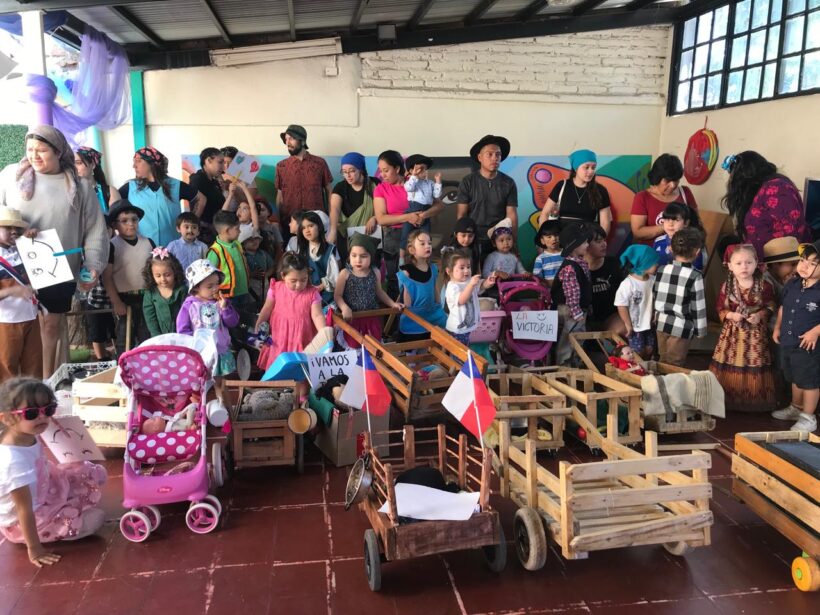
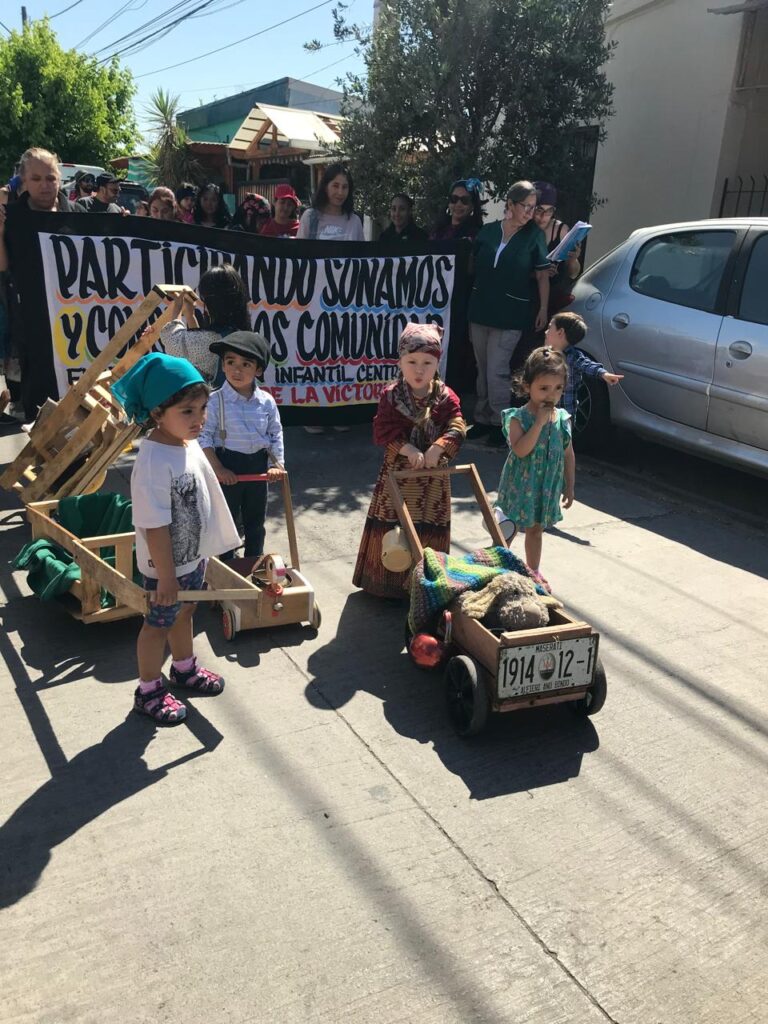
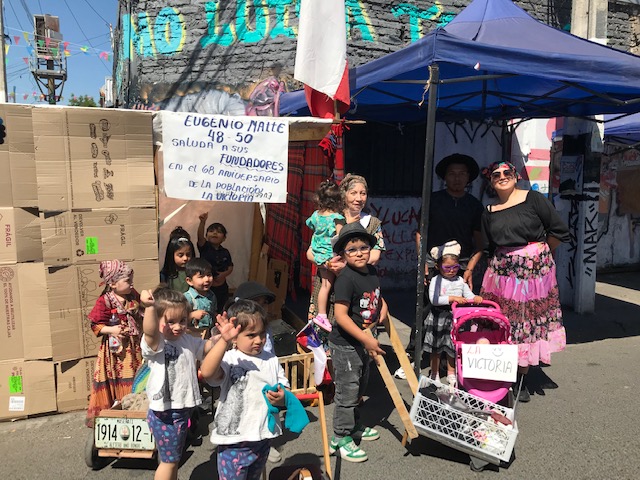
“Let’s go to La Toma!” “Youth and glory, La Victoria!” Twenty children alongside their parents and preschool educators chant and sing as they parade through the streets of their neighborhood on the morning of October 30.
They are the new generation —some are great-grandchildren—of the 1,200 families who arrived at Chacra de la Feria in the early hours of October 30, 1957, hoping to exercise their right to live with dignity. It was a dream that materialized in the first organized land occupation on the continent, which gave birth to Población La Victoria in the southern part of Santiago. It also set a precedent for dozens of similar land-reclamation actions that would emerge in the 1960s, contributing to the creation of Chile’s Ministry of Housing and Urbanism.
The thousands of people who formed the columns that night, with carts pulled by horses and carrying bundles on their shoulders, had been living precariously along the Zanjón del Agua, a canal that carried Santiago’s industrial and human waste. Many had arrived from rural provinces during the mass migrations of the 1950s, hoping for better horizons. Instead, they became mired in a harsher poverty than the one they had left behind in the countryside.
The occupation of that tract of land was not a spontaneous action. After a series of fires destroyed flimsy dwellings, the residents came together to create the Pro-Land Occupation Committee. The land they decided to take, with support from local union and political leaders, belonged to the government agency CORVI (Housing Corporation), during the second term of President Carlos Ibáñez del Campo.
Among those who raised a Chilean flag on four poles to hold up a tent were the grandparents of Rossani Lagos, a member of the administrative staff and community outreach coordinator for the kindergarten and nursery school, Jardín de La Victoria. Her grandfather worked at the Yarur textile factory near the Zanjón, but his wages were only enough to afford a makeshift wooden shack for his eight children. On the night of October 30, one of Rossani’s uncles joined the land occupation to secure a spot for the family; the rest arrived the following day. Her future parents—both still teenagers—met and fell in love during the occupation. Rossani, born two years later, grew up hearing stories from her parents about the long lines to get water and how they had to wash outdoors. That spring, rain and scorching sun bred illnesses, leading to the deaths of twelve babies.
Rossani was also told about the collective efforts that created community kitchens, a preventive health committee and a self-governance committee.
Solidarity came not only from within the occupation but also from compassionate outsiders who joined in to support the cause. Among the volunteers who ended up staying and became neighbors were Alicia Cáceres, founder of the Jardín de La Victoria in 1970, and her husband Enrique Meneses, who owned a vehicle that helped transport women and children to the occupation site. The couple’s first home was made of adobe, and from their yard, other families dug earth to build their own houses. Their daughter, Aly Meneses Cáceres, is now the director of the early childhood division at the Nuestra Señora de la Victoria Foundation.
Alicia Cáceres was active not only in the kindergarten but also in the Christian base community and other social organizations. She once said:
“When I arrived at the land occupation, I learned and discovered so many things. […] I feel alive connecting with others and fighting for a better quality of life in health and education […] united with others, listening to others, and contributing my part.”[i]
Rossani Lagos agrees:
“The most important thing for us as Victorians is to feel responsible for each other’s well-being. When you feel emotional attachment for something, you take responsibility for it and care for it. Teaching that value begins with a sense of belonging to the place where you settle or happen to live.”
A sense of responsibility for others forms the foundation of both the pedagogy and everyday life among everyone connected to the kindergarten. It isn’t limited to the annual programming of theater, music, murals, and tributes to the founders during every October. Nor is it confined to September, when André Jarlan—a courageous French priest assassinated during the dictatorship on September 4, 1984, while reading psalms in his room—is remembered. In this iconic neighborhood of resistance, twelve others were victims of forced disappearance or extrajudicial killings. They are commemorated throughout the year. At the kindergarten, passing on the foundational values and spirit of Población La Victoria is an ongoing task during the entire school year.
Aly Meneses emphasizes that point:
“Our educational project carries a community imprint. Understanding that we are part of a social context with a history and memory that we must learn about and know, meaningful learning is built this way so that children recognize and value their surroundings. It’s about working together with others because human beings need to feel part of a community. This is also a space of constant remembrance, where highlighting the rights of boys and girls is fundamental for us.”
Sowing the seeds of a culture of justice and respect for others from an early age is an urgent task, especially in the face of rising criminal activity in certain areas of the neighborhood.
Instilling a sense of belonging and awareness of the community’s history has become even more important in recent years with the arrival of many immigrants to Población La Victoria. Like the first Victorians, they come seeking better opportunities but become vulnerable to exploitation and marginalization. Today, of the 70 children enrolled in this kindergarten and nursery school, supported by the Fundación Integra, 10% come from immigrant families from Peru, Haiti, Venezuela, Colombia, and other Latin American countries. The school’s motto, All Equal, All Different, reflects this commitment to valuing diversity.
Presently, despite harsh policies penalizing land occupation, it is estimated that around 113,887 families (Catastro Nacional de Campamentos 2022-2023, Centro de Estudios TECHO Chile) live in precarious settlements across the country. Approximately 35% of these families are immigrants.
Ronald, who arrived from Peru five years ago, is the father of a three-year-old girl enrolled at the nursery. In Peru, he worked as a film lighting technician; in Chile, he sells goods at the local street market to support the small home he shares with eight family members. As he observes the little ones —mustaches painted on their faces and dressed in vintage costumes, pushing tiny carts made by their parents—he says, “Living in this neighborhood is a new and beautiful experience for me. Since our little girl is Chilean, we also feel part of that era.”
[1] Quoted in the book Sembradoras de Fe y Esperanza: El legado de mujeres de comunidades cristianas populares (Santiago: Editorial Universidad Bolivariana, 2008), a project coordinated by Maxine Lowy.
Alicia Cáceres passed away in January 2017; her husband Enrique Meneses died many years earlier.



