

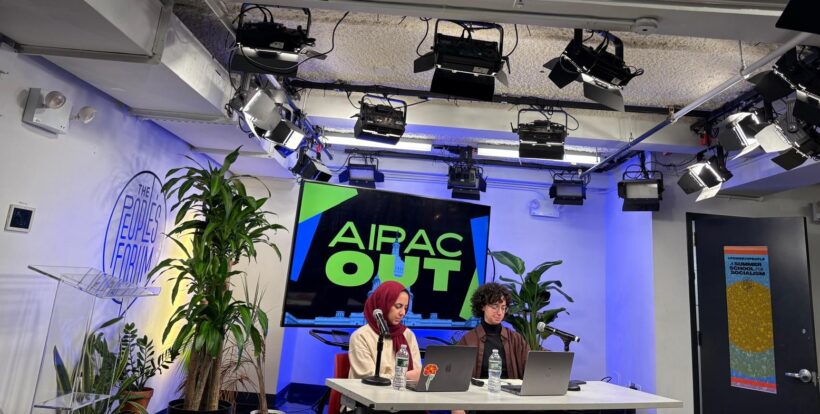
A new campaign has been launched by the highly active People’s Forum; it’s called “AIPACOUT of U.S. politics!” It features a youthful and engaging graphic design and aims to engage millions of US citizens. So this evening, I’ve come to 37th Street again, [and I am] sitting comfortably, listening to reggae music as I await the start of the lecture. You understood correctly: we’ve come here to learn, to gain a clear understanding of what AIPAC (American Israel Public Affairs Committee) is and how it works within society.
This won’t be a presentation event or a rally, but a seminar for activists where they’ll be provided with tools for working in the field. Once trained, the volunteers will work hard to spread information as widely as possible among ordinary people—neighbors, grocers, coworkers, etc. Everyone will have to act with the means at their disposal to bring the silenced truths to light.
Another goal of the campaign is to get people to sign a petition, accessed via a QR code, calling for AIPAC to be excluded from American politics. I don’t think the petition will have any practical effect, but if enough signatures are received, it could scare the opposition and, above all, provide some insight into the level of awareness of the AIPAC problem within American society. Recent polls have shown that a majority of Americans oppose including economic aid to Israel in public spending, so it’s a matter of stepping on the pedal while the engine is hot.
Two young women approach the lectern; they’re setting up the computers from which the slides will be projected. I smile with satisfaction; women again. A funny thought occurs to me, or perhaps it’s a dream: could it be that these new generations are reviving an ancient model of society? A very ancient one, of which we have almost no trace: a system in which women were responsible not only for raising children and caring for the home, but also for the intellectual organization of the community and the transmission of culture to posterity.
The lesson begins, and I’ll try to provide a general summary. Anyone interested in learning more can visit the campaign website, www.aipacout.com.
First, it must be said that AIPAC is currently the most powerful lobby in the United States, having surpassed even the NRA (National Rifle Association), which, from what I understand, is experiencing a crisis. In truth, AIPAC isn’t a single entity; it resembles a sprawling structure; it is, in fact, a consortium of various collective bodies and individual donors. Like any lobby, it aims to influence political and economic decisions: it is estimated that AIPAC spent over $100 million in the last election campaign. However, it doesn’t seek control solely over the party that wins the election (indeed, this could be considered a secondary objective); its work is much more widespread and comprehensive. It is estimated that it has come to control 80% of Congress by directly influencing members and their staff. In fairness, it must be said that today, following the crimes committed by Israel, a certain number of politicians have begun to distance themselves from the lobby, but will this stance last?
AIPAC has also specialized in smearing uncomplimentary politicians (there are few of them) and legislators who persist in upholding public rights. The “Cori Bush case” is a case in point, with AIPAC committing eight million dollars to block her re-election to Congress in 2024, given that Cori had clearly expressed a stance in favor of Palestinian rights.
But beyond formal political action, the agency does much more, and in seemingly more mundane ways. One of its focuses is oversight of educational institutions. With the attitude of a jailer in a panopticon (an architectural model developed by Jeremy Bentham at the end of the 18th century, designed to allow a single guard to observe all the inmates from a central tower, without the latter knowing whether they are being observed or not), it supervises primary schools, high schools and universities, intervening from time to time in the staff in a more or less subtle manner with ad hoc propaganda programs or requests for the specious expulsion of students and teachers, accusing them of anti-Semitism.
Recently, the new way to quell dissent is to redefine terms like “anti-Semitism,” “anti-Zionism,” and “terrorism.” A shiver runs down my spine: is it possible that even some Italian politicians are on AIPAC’s payroll?
The more I listen, the more astonished I am to learn just how many tentacles this octopus possesses; I certainly can’t list them all, but one still deserves mention: the AIEF (American Israel Education Foundation). Formally a charitable organization affiliated with AIPAC, in reality it organizes its activities in direct coordination with the Israeli government. Its unique feature is promoting educational trips to Israel for Jews and non-Jews of all ages. Through this contact, the lobby seeks to identify the most promising, ambitious, and easily manipulated young people to push into society, securing them high-paying, prestigious positions. Controlling American youth seems to be AIPAC’s top objective. With everything we’ve seen in the last two years, I think Netanyahu and the messianic right have really messed up.
Like me, many of you, perhaps all naive, are wondering how it was possible for one powerful group, or more than one, to come to determine almost entirely the politics of a democratic state. But where is democracy? The original sin dates back to 1954, when the Constitutional Court (United States v. Harris) interpreted lobbying (influencing) as an expression of free speech and therefore protected by the First Amendment to the Constitution. Since the 1970s, lobbies have flourished to the point of infesting the entire society.
There are some limitations to excessive power: in particular, a lobby should work for particular interests, but still within its own borders. This is not the case for AIPAC, which openly acts to protect and advance the interests of another sovereign state. I quote from its website: “Its campaigns to defeat US politicians critical of Israel amount to foreign intervention by proxy.” Its very birth is inextricably linked to Israel. In October 1953, Israeli troops under the command of Ariel Sharon, responding to an attack by Palestinian fedayeen that killed three Jewish civilians (two of them children), attacked a town under Jordanian jurisdiction, Qibya, massacring sixty-nine civilians, two-thirds of them women and children. The American public was deeply shocked by the brutal revenge, so much so that Israel was criticized. AIPAC was founded shortly thereafter.
In theory, the lobby should register with the Foreign Agents Registration Act (FARA), which would require a full report and subject it to public scrutiny. This is the point we’ll be fighting over: it’s too easy to think we’ll remain in institutional limbo forever.
We’re wrapping up. We’re all a little confused. Much was known, but having summarized it all in a single sentence is shocking. And this is where I see the makings of a leader emerge. One of the young speakers tells us: “Let’s not be discouraged! Nothing is meant to last forever; we too have some good cards. Many are realizing that the lobby system is impoverishing us all, because the problem in this country isn’t just AIPAC, and this must be made clear in our fight.”
Ah well, then, I take comfort in the fact that I’m not so naive!



