

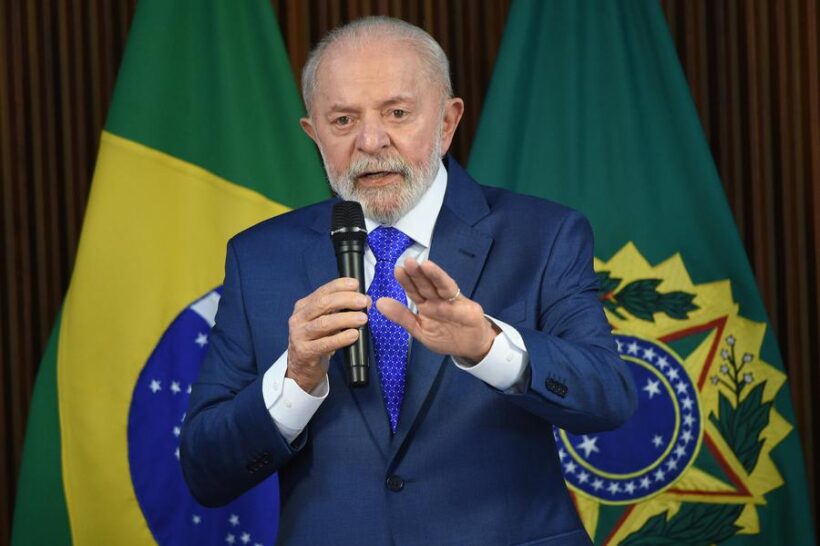
Brazil lacks a popular national project capable of sealing a strategic pact between sectors of the elite interested in the country’s reindustrialisation and popular sectors, mediated by a state capable of leading a sovereign development project, Marco Fernandes writes. Still, it has a chance to resume a ‘proud and active’ foreign policy.
In an interview with Brazilian television, hours after the illegal and unprovoked US attack on Iranian nuclear facilities, Brazil’s former foreign minister, former defence minister, and current special advisor to the president on international affairs, Celso Amorim, declared in an unusual, anguished tone: ‘The international order is over! Whether from the point of view of trade or from the point of view of peace and security. We will have to adapt to this, and it will not be easy.’
When he made this sombre reflection on live TV, Amorim did not imagine that Brazil would be one of the next victims of the ‘end of the international order’. Days after the criminal attack on Iran, in the first day of the Rio Summit, Trump threatened BRICS member countries with extra tariffs of 10% if they engaged in alleged ‘anti-American initiatives’ (without clarifying to what initiatives he was referring). Trump’s attack made headlines around the world for a summit whose importance had been questioned by the Western corporate media, which tends to underestimate the group, especially due to the absence of some of the main heads of state, such as Xi Jinping, Vladimir Putin, and Masoud Pezeshkian.
But for several analysts, Trump’s threat was a sign that the BRICS’ advances, albeit limited, are a cause for concern to the White House.
Two days after the summit ended, Trump turned his ‘tariff cannon’ on Brasilia. Although the US has had a trade surplus with Brazil of around US$ 410 billion over the last 15 years – which undermines the recurring argument that Washington is imposing tariffs to reverse trade deficits – Trump imposed 50% tariffs on Brazilian products.
At this stage, however, it is already clear that Trump is using tariffs to attack President Lula and the Supreme Court (STF), in a calculation that takes into account the 2026 presidential elections. Washington has also invoked the Magnitsky Act, which provides for sanctions against individuals linked to drug trafficking and terrorism, to punish some members of Brazil’s Supreme Court. The US president has outlined the main reasons for his attack on Brazil: he is demanding that Lula suspend the trial of former President Jair Bolsonaro, convicted for 27 years for organizing an attempted coup in January 2023 against the newly elected President Lula, as if the presidency had authority over the Supreme Court. Trump also accuses the STF of disrespecting the ‘freedom of expression’ of American companies and individuals, since the Brazilian judiciary has legitimately sought to regulate social media platforms in criminal cases. In both cases, Supreme Court Judge Alexandre de Moraes is leading the proceedings and became the main target of US sanctions. There are also rumors that Trump is seeking to target the main BRICS countries in order to weaken the group and might have his eye on the world’s second-largest rare earth reserves, located in Brazil. These attacks would therefore be aimed at opening negotiations with the Brazilian government on issues that have not yet been disclosed.
This is the most significant public attack by the US on Brazilian sovereignty, as it transcends the trade conflict and uses tariffs as a political weapon to interfere in the country’s political, judicial, and financial systems. In practice, Washington has imposed sanctions on Brazil. Unbelievably, the coordination of such attacks included the public participation of federal deputy Eduardo Bolsonaro, son of the former president, who fled to the US for fear of being prosecuted and has been meeting with Trump’s inner circle to conspire against his own country. This US manoeuvre called for a change in the course of Brazilian foreign policy and forced President Lula and Itamaraty to reposition themselves in the global geopolitical scenario.
Why has Brazil not yet returned to the center stage of geopolitics? How US destroyed Brazil’s regional strategy
Lula da Silva’s return to power in 2023 generated high expectations for a return to the boldness that characterised his foreign policy during his first two terms. Shortly after being elected in October 2022, Lula announced: ‘Brazil is back,’ meaning that we were back in the game of global politics. However, this has not been the case so far, for various reasons. First of all, we live an increasingly turbulent global scenario, with the escalation of Western attacks against China and Russia – through sanctions, media warfare and a hot war -, the US-backed genocide in Palestine, and a deep political polarization in Latin America and the Caribbean with the rise of the extreme right wing – strongly connected to Washington’s interests. A very different scenario from Lula’s and Dilma Rousseff’s terms (2003-2016).
The foreign policy of Lula’s third term was dubbed ‘active non-alignment’ and sought to mark an ‘equidistance’ between the two major global powers, the US and China. It has been characterised by 1) a defensive-reactive stance and cautious steps, 2) an inability – until now – to lead an effective reorganisation of the two main regional platforms (Unasur and CELAC) that Brasilia helped to create in the 2000s, 3) timid participation in BRICS, in which it had been a leading player in the early years of its existence, and 4) difficulty in proposing strategic partnerships that would bring economic and political benefits to Brazil.
The government’s biggest bet, until now, has been the Mercosur-European Union Free Trade Agreement, which numerous serious analysts in the country – such as Paulo Nogueira Batista Jr. — have already shown will benefit European industry more than the Mercosur economies, and above all, will undermine Brazil’s reindustrialisation efforts. In numerous public statements, the government has consistently emphasised the ‘geopolitical importance’ of this agreement, but it typically avoids discussing its economic nature, which is, to say the least, controversial. Even the Minister of Economy, Fernando Haddad, has already stated that he does not see any major economic advantages in the agreement.
There are a few other objective and subjective elements that explain the change in Brazil’s foreign policy under ‘Lula 3’. Let’s start with the subjective ones. Unlike the previous terms of Lula and Dilma Rousseff, in which the PT – inclined towards Latin American integration and the construction of the BRICS – had greater weight in the government’s direction, Lula’s current term has been constituted as a ‘broad front’ to defeat the far right in the 2022 elections, including centre-right parties with economic ties and ideological preferences for the US and Europe. In addition, President Lula no longer has two brilliant figures from his past foreign policy team: Marco Aurélio Garcia, special advisor on international relations to the presidency (the same position currently held by Celso Amorim) and Samuel Pinheiro Guimarães, former secretary-general of Itamaraty, both of whom recently passed away. Garcia had one important advantage: he was not an Itamaraty’s cadre, so he could do some moves as an “outsider”. He was the secretary for international relations of the Workers’ Party for a long time – fully trusted by Lula and Dilma – and carried with him a vast network of political relations, specially in Latin America. We still have Celso Amorim, a skilled negotiator and one of the architects of the BRICS formation, who is now a key protagonist not only of Brazilian foreign policy but also of the entire Global South. However, the ‘dream trio’, led by Foreign Minister Amorim in the past, is sorely missed in the construction of President Lula’s strategy and in its day-to-day operation.
Publicação conjunta entre o Valdai Club e o Brasil de Fato



