

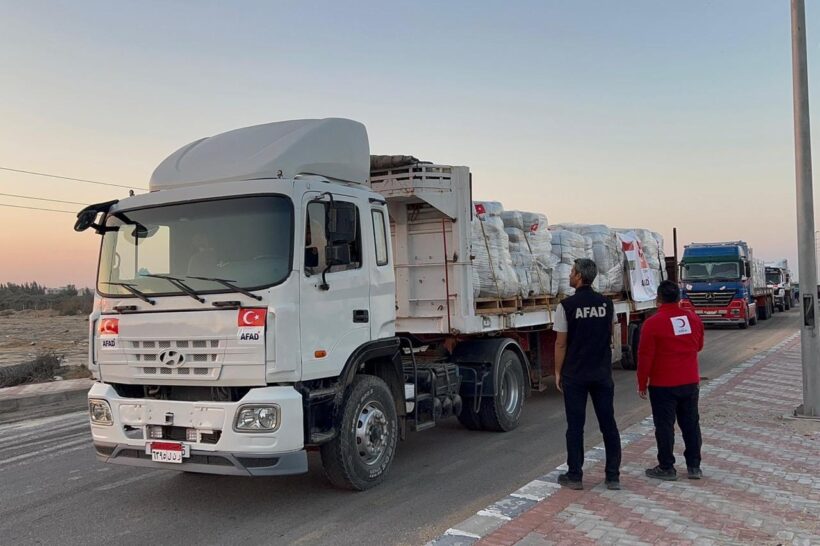
As the fragile ceasefire holds, the humanitarian crisis in Gaza remains on a knife-edge. Tom Fletcher, the United Nations Under-Secretary-General for Humanitarian Affairs and top emergency relief coordinator, told Reuters that “thousands of humanitarian vehicles must enter weekly to avert further catastrophe.”
“We have 190,000 metric tons of provisions on the borders waiting to go in and we’re determined to deliver. That’s essential life-saving food and nutrition,” Fletcher said.
Ceasefire Opens Door, But Access Remains Fragile
Following the October 8 ceasefire, aid operations have seen modest gains. Some 600 aid trucks were authorized under the U.S.-brokered pause.
However, that number was later reduced to 300 per day as a result of disputes over the return of hostage remains.
Fletcher and UN agencies have repeatedly urged Israel to open additional crossings, especially Rafah, which remains closed.
Without more access points, aid remains bottlenecked and cannot reach northern or more remote areas.
Yet even when aid trucks are cleared, distribution inside Gaza is hampered by damaged infrastructure, impassable roads, security constraints, and the danger of looting.
President Recep Tayyip Erdoğan delivered remarks following the Presidential Cabinet meeting:
" Despite all setbacks, nearly 350 of our trucks have entered Gaza, and more than 400 additional trucks await entry.
We dispatched our 17th “Goodness” vessel to the region yesterday,… pic.twitter.com/2svFutLVGz
— Republic of Türkiye Directorate of Communications (@Communications) October 15, 2025
EU and Turkey Step In — But Reconstruction is Political
The European Union has pledged a three-year, €5 billion plan for Gaza’s reconstruction, while also committing to ensuring “rapid, safe and unhindered humanitarian aid deliveries” in coordination with UN agencies and NGOs.
Much of the reconstruction effort is expected to flow through the Palestinian Authority, which the EU supports institutionally.
Meanwhile, Turkey has been among the most active regional actors. President Recep Tayyip Erdoğan announced that 350 Turkish trucks have already entered Gaza, with more than 400 waiting at border crossings.
On October 14, Turkey dispatched its 17th “Goodness” vessel carrying 900 tons of food, baby formula, and other vital supplies to Egypt’s Al-Arish port, to be transferred into Gaza.
Turkey also appointed Ambassador Mehmet Gulluoglu as special coordinator for humanitarian aid to Palestine, deploying him to Gaza to manage aid flows and liaise with UN, Egyptian, and Jordanian authorities.
In addition, Türkiye’s Disaster and Emergency Management Authority (AFAD) has sent an 81-person search and rescue team to help clear debris and assist in recovery inside Gaza.
Erdoğan has signaled that Turkey expects to play a key role in Gaza’s reconstruction, particularly in building temporary housing ahead of winter, and has expressed intent to mobilize financial support from Gulf states, the EU, and the U.S.
Aid, But Not Enough — and Not a Substitute for Political Solutions
Even with the commitments from the EU and Turkey, urgent obstacles remain. Government donors still provide the overwhelming majority of tracked humanitarian assistance, accounting for over 90 % of international funding in recent years.
That dependence underscores the risk of political leverage and conditionality in aid delivery.
Critically, aid cannot replace sovereignty, institutional capacity, or structural reform: long-term recovery in Gaza depends on addressing root political problems, not simply delivering goods. In a region where governance is contested, control over reconstruction funds, access, and priorities is deeply contentious.
Moreover, the recent use of the Gaza Humanitarian Foundation (GHF), a U.S.- and Israeli-backed alternative to UN distribution, has drawn sharp criticism and concern. Human rights groups warn that it may violate humanitarian principles and even international law.
Since May 2025, more than 2,600 civilian Palestinians seeking aid have been reported killed or wounded near aid distribution sites and convoy routes—raising alarm over the safety of aid-seekers.
Wikipedia
The Week Ahead: What to Watch
Border crossings and clearance: Whether Israel fully reopens Rafah and removes restrictions remains essential. Without multiple access points, the scale of aid will remain constrained.
Sustained funding: Donors must uphold pledges and release disbursed funds quickly. Delays or shortfalls could stall reconstruction and deepen suffering.
Coordination and oversight: Transparent, independent oversight of aid distribution via UN and NGOs is needed to prevent politicization, diversion, and casualties.
Integration with political resolution: The reconstruction process must be aligned with efforts toward durable peace, governance, and Palestinian institution-building.
The challenge is pressing: with hundreds of thousands displaced, famine conditions confirmed in parts of Gaza, and essential infrastructure in ruins, every week of delay means more lives lost and more communities destroyed. As Fletcher put it, “we’re determined to deliver” — but the question now is whether the political will, security guarantees, and logistical capacity exist to make that determination real.



