

This is not a polite debate nor an exact translation of a previous article. It is, rather, a warning from the European continent, reminding you of where the path you champion leads in Anglo/American-style, economics-driven countries. We have heard their overlords—technocrats or simply the “ultra-rich”—giving lectures and speeches at universities, economic forums, Davos, or even TED Talks, presenting themselves as the ultimate, evolved model of doing, being, and aiming. But we have decoded for you the true meaning of your slogans: “Social Darwinism is just realism. The law of the jungle. Competence is for losers. A monopolistic position is the only aim for anyone or any corporation that wants to win.”
The Anglo-Saxon liberal rupture, which found its ultimate expression in Margaret Thatcher’s dictum that “there is no such thing as society,” unleashed a financialized capitalism utterly unmoored from human reality. This was not merely a policy shift; it was a philosophical bomb that shattered the very concept of the collective. It provided the ideological fuel for the hyper-individualism that now dominates, a direct precursor to the worst excesses of our current financialized era.
This model does not just create wealthy individuals; it forges modern-day Overlords. In a few short years, it elevates a new class of oligarchs whose power is so vast it warps the very fabric of our democracies. Formally, these individuals have one vote, the same as any other citizen. But their qualitative and relational power constitutes a second, far more potent franchise. Through their capital, their ownership of essential infrastructure, their data empires, and their political lobbying, they dictate to nations. They command outcomes that override the public will, shaping legislation and policy to serve their interests.
Forums like Davos are the concrete manifestation of this parallel, undemocratic governance. They are the stages where this “qualitative vote” is exercised, where a global elite designs the future for billions without a single ballot cast in their name. Let’s be clear: this is not a conspiracy theory; it is the logical endpoint of a system that prizes capital accumulation above all else. It has created a new class of Pharaohs with the power to command the building of their own modern pyramids, subsidized by public wealth and built on the backs of a disenfranchised populace.
This is not the only way. It is a radical, and ultimately self-destructive, experiment in social disintegration.
To the social majorities of Europe, the UK, and the US
The struggle of those 4,000 women in Andalusia is your struggle. It is the same battle being fought against the logic that says a hospital’s balance sheet matters more than a patient’s life, that a shareholder’s return is paramount, and that society is a fiction. It is the fight for the very idea that we have a responsibility to one another and that our democracies must be more than a formal ritual overshadowed by immense, unaccountable private power.
The choice is no longer between left and right. It is between civilization and the bunker. Between a common future we build together, or a fortified, solitary end dictated by a handful of Overlords.
The oligarchs (they do not exist only in Russia or underdeveloped countries—no, no; they are among us too) have their bunkers and their Davos summits. But we have the numbers. We are the memory of what we built from the ruins, as history teaches and shows us. And we have the power, through relentless democratic will, to defend it —nonviolently and without cooperating with the will of domination that has been building up since 2008 (“financialized capitalism”: exclusively elitist and non-constructive). We must an can choose to fight for the former. Our very humanity, and the very essence of democracy, depend on it.
A real story coming from Spain: The outrage that filled the streets and will grow further on
First, understand this is not a distant, abstract policy debate. This is what is happening right now in a modern European nation, and it is sparking mass protests.
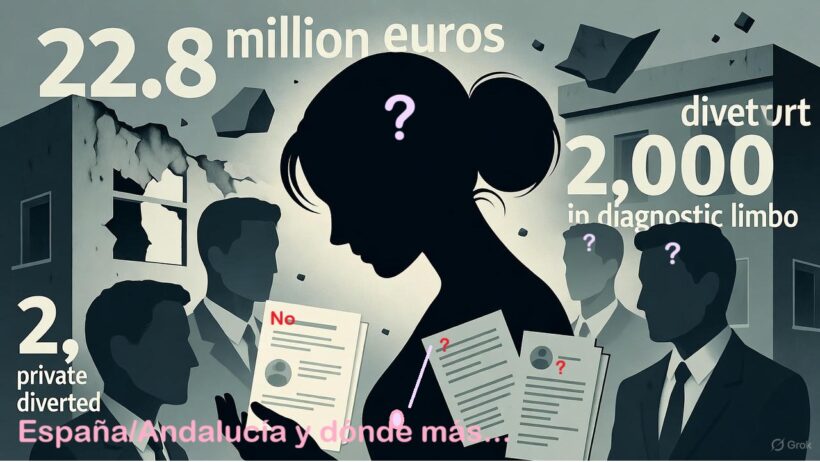
Purificación Fernández died in 2024. Her family received the letter to repeat her mammogram three months after a private oncologist had already detected the tumour. Her story is not an isolated case; it is the human face of a structural collapse. While the regional government of Andalusia diverted €22.8 million to private companies to outsource diagnostic services, and the Spanish healthcare sector became the primary target for over 80% of private investment funds, the public system was left with a chronic shortage of radiologists. This was the perfect storm that left the crucial results of 2,000 or even 4,000 women in an “administrative limbo” for over a year. This is not a simple “glitch”: it is the direct consequence of a model that drains resources from the Public sphere to feed private business, with people’s lives as the currency of exchange.
This is the scandal that has ignited Spain. What the government of Andalusia—a powerful autonomous community with its own parliament, laws, and annual budget—tried to dismiss as a mere “information failure” has been exposed as one of Spain’s most severe cases of medical negligence. This was not a minor administrative error. This was a catastrophic systems failure at the highest level of regional government, which holds devolved power over healthcare. The official admission that around 2,000 women—a figure that patient associations now raise to 4,000—were left in a diagnostic limbo, with delays of up to two years, is not a “glitch.” It is the tip of the spear of a systemic collapse.
The core of the failure was a broken protocol. In cases where mammograms showed “possibly benign lesions,” the affected women fell into a black hole. They were not informed in time that they needed a second test and further analysis. They, in good faith, believed the dangerous adage: “no news is good news.”
This false sense of security has been revealed as a perilous illusion at patient’s level. In oncology, time is not just a factor; it is the determinant between a treatable tumour and a metastatic disease, and death. Every day of delay meant a lost chance for a less aggressive treatment, condemning women to more drastic surgeries and preventable suffering. But the logic of the market, applied to human health, dictated a different calculus. The bottom line for the private stakeholder and the pursuit of profit (€) came first.
In oncology, time is not just a factor; it is the determinant between a treatable tumour and a metastatic disease. Every day of diagnostic delay meant lost opportunities for less aggressive interventions, condemning women to more drastic treatments and preventable suffering. But the penny tellers decided otherwise… Let’s take the best way for the private stake holder and the profit (€).
This is not being passively accepted. The public response has been furious and tangible. The streets of Andalusian cities have seen massive demonstrations. Citizen platforms and medical associations are preparing collective lawsuits. The cry is clear: this is not just administrative incompetence; it is a betrayal of a fundamental social promise.
The “individualistic Bunker Mentality” vs. “The Common Good”: A warning from Europe’s Social Heart
But this is not just a Spanish story. It is the local eruption of a global disease. It is the logical, bloody consequence of a philosophy that has been metastasizing for decades, a philosophy whispered from Silicon Valley to the City of London: you are on your own.
You need not look far for proof. In the United States, health is a luxury good. This leads to a brutal paradox: the world’s highest healthcare spending per capita, yet medical bankruptcy is a mass phenomenon, and life expectancy now trails that of Spain. In the United Kingdom, the NHS, once a proud emblem of post-war solidarity, is being slowly bled dry by systemic underfunding and outsourcing, resulting in waiting lists that stretch into years for essential treatments, turning the “cradle-to-grave” promise into a mantra of “wait-and-see”.
The new oligarchs—the tech and finance billionaires who amassed fortunes by leveraging our collective infrastructure—have responded to the social fractures they help create not by healing them, but by building bunkers. In Hawaii, in New Zealand, they preach a gospel of hyper-individualism and social disengagement. The poor, they imply, are guilty of their fate.
This is a betrayal of the European idea. The Continental Enlightenment conceived the social contract as a pact integrating the human, the collective, and the moral: the economy was to serve the common welfare, not just individual profit. This vision, forged in the ashes of two World Wars, was a conscious rejection of the law of the jungle. It declared that a society is measured not by the height of its billionaires’ walls, but by the depth of its solidarity.
And it worked. For all its flaws, the Spanish public health model—in a country once derided by Anglo-Saxon economists—objectively delivers better, more accessible care at a fraction of the US cost. This isn’t ideology; it’s accounting. It proves that a system built on the principle of health as a public good is more efficient than one treating it as a private revenue stream.
What is happening in Andalusia is a coordinated assault on this principle. The deliberate defunding, the opaque public-private contracts that evade scrutiny, the manufactured crises—these are the tools used to dismantle our common inheritance.
And to those who point to the Netherlands as a privatized utopia, look closer. It is a heavily regulated, state-directed system of private insurers, mandated to provide a universal package. It is regulation, not the market, that makes it work. With only 17 million people and its role as a tax haven, it is a bespoke suit, not a scalable model for larger, more complex nations.
The fortunes amassed since the 1990s prove the economy is working perfectly for a tiny minority. The problem is not a failing economy; it is a failing human consideration. We live on a closed planet, not an infinite frontier. The elite’s bunker mentality is a psychotic break from this fundamental reality.
The Prosperous Middle Path: The European Social Market Economy
So, what is the alternative? The anguished cries of the Spanish middle and working classes are not just a complaint; they are a defense of a proven model. It is the model of the European Social Market Economy.
This is the crucial gradient that is often misunderstood, especially in the UK and US: a strong social contract does not kill capitalism; it makes it sustainable and more prosperous for a much larger share of the population.
Let’s be blunt about the advantageous relationship:
- Your taxes buy collective security. In Spain and much of Continental Europe, citizens invest in a system that guarantees high-quality healthcare without bankruptcy, robust protection if you lose your job, and a dignified retirement.
- This framework acts as a powerful stabilizer, covering life’s major risks from cradle to grave. It creates a more productive and secure society: entrepreneurs can innovate without gambling their family’s health, and workers are healthier, more stable, and thus more productive.
- This does not stifle capitalism; it civilizes it. Germany’s Mittelstand, France’s industrial champions, and Spain’s thriving tourism and tech sectors prove that a regulated market within a strong social state is fiercely competitive and innovative. On the contrary, Germany’s Mittelstand, France’s industrial champions, and Spain’s thriving tourism and tech sectors prove that a regulated market within a strong social state can be fiercely competitive and innovative. Even modern Russia, though with profound flaws, has abandoned hardline communism for a form of state-capitalism, recognizing that some social stability is necessary for economic activity.
The Laboratory of Ruin: A Global Legacy
This path is not inevitable. The Anglo-Saxon neoliberal rupture—championed by Thatcher and Reagan, and intellectually armed by Milton Friedman’s Chicago School of Economics—was a radical experiment. Its dogma of hyper-individualism, captured in Thatcher’s dictum that “there is no such thing as society,” was first road-tested with devastating social costs in the laboratories of Pinochet’s Chile and Argentina’s dictatorship. It was then exported as a universal prescription, one that deconstructed the state, shipped millions of industrial jobs to China and the East, and left the bottom 70% in the US and UK profoundly more insecure. This model preaches that “the best state is a minimal state”—until its own systemic failures, like the subprime crisis it engineered, threaten the foundations of finance. Then, suddenly, it is the people, through their national governments, who must prop up the system with public funds. This is not a sustainable model; it is a self-destructive pact with a partner that only believes in socialism for the rich and rugged individualism for everyone else.
To the social majorities of Europe, the UK, and the US
The struggle of those 4,000 women in Andalusia is your struggle. It is the same battle being fought in your underfunded hospitals and against your soaring medical bills. It is the fight for the very idea that we have a responsibility to one another.
The choice is no longer between left and right. It is between civilization and the bunker. Between a common future we build together, or a fortified, solitary end.
The oligarchs all over the World have their bunkers (or are building them urgently like Noah’s Arks). But we have the numbers —and we vastly outpace them. We have the memory of what we built from the ruins. And we have the power, through relentless democratic will, to defend an alternative path that includes all of us, them included too of course and in nonviolent change.
We must now wield that power to forge a renewed Social Contract —one that serves the benefit of the whole, not the luxury of the few. For the challenges humanity now confronts —from pandemics to ecological collapse— do not discriminate by class or nation; they confront the entire human hive. Our collective future, our very humanity, depends on this choice.



