

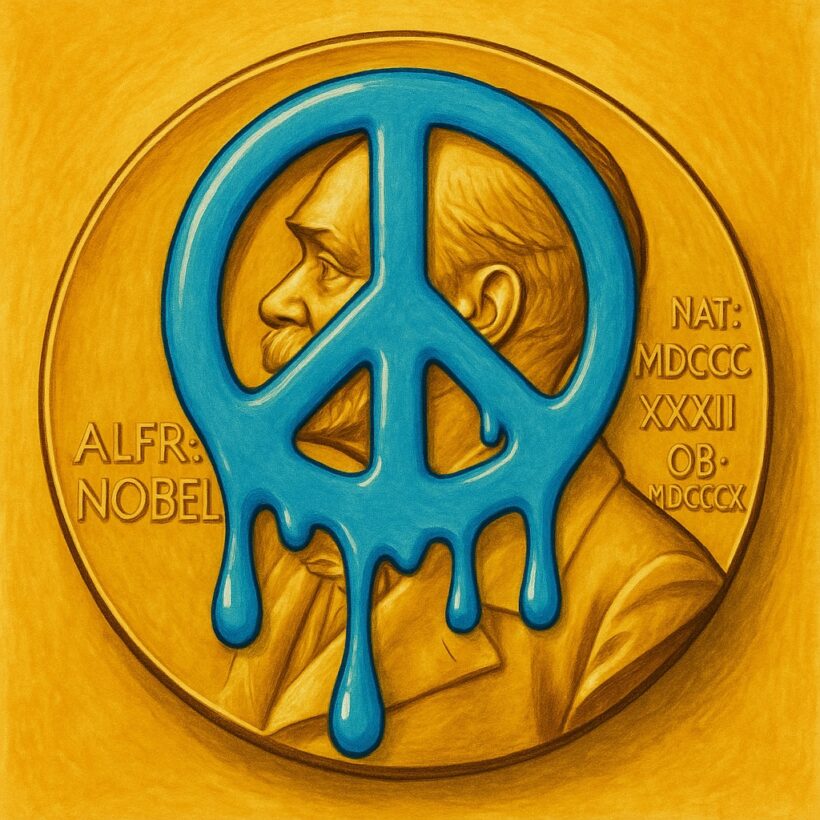
When Alfred Nobel created his celebrated prize in 1895, he imagined honoring those who ‘have done the most or the best work for fraternity between nations, for the abolition or reduction of standing armies and for the holding and promotion of peace congresses.’ A century and a quarter later, the words still sound noble. The actions do not.
This year’s Nobel Peace Prize has once again gone to someone whose moral record stands at sharp odds with the spirit of peace itself—someone who has either openly justified or quietly enabled state violence, occupation, or genocide. Like the great war criminal Henry Kissinger, who received the same prize in 1973 even as B-52s bombed Cambodia and Laos into ash, the current choice proves that the Nobel Peace Prize has long ceased to represent peace. It represents power—its language, its alliances, and its exclusions.
The Pattern of Political Reward
The history of the Nobel Peace Prize is, in many ways, a mirror of Western geopolitics. Consider the roll call:
• Henry Kissinger, whose covert wars and coups—from Vietnam and Chile to Bangladesh—shaped half a century of human suffering. His co-awardee, Le Duc Tho of Vietnam, had the integrity to refuse the prize.
• Barack Obama, who accepted the Peace Prize in 2009 while expanding drone strikes and wars he had not even ended.
• Aung San Suu Kyi, once a global icon of democracy, later complicit in the ethnic cleansing of the Rohingya.
The pattern is clear: the Nobel Peace Prize often rewards managers of empire, not challengers of it. It rewards those who can stabilize the existing order after violence, not those who resist violence at its roots.
The Politics of Exclusion
Equally revealing are the names that never appear. Why has Noam Chomsky, perhaps the most consistent global voice for peace and justice in the modern era, never been considered? His moral clarity against war, imperialism, and propaganda has inspired generations across continents. His associate Edward Said, who gave us the intellectual framework to understand colonial narratives and their persistence, was also ignored.
Why has the prize not gone to Greta Thunberg, who speaks for planetary survival with more courage than all the climate conferences combined? Or to José Andrés and World Central Kitchen, who feed the hungry and displaced in war zones from Gaza to Haiti? Why not to the countless field workers, doctors, teachers, and grassroots peacebuilders in Sudan, Somalia, Congo, Kashmir, Yemen, or the refugee camps of the Mediterranean?
Or to organizations like Brooklyn For Peace that have for decades championed anti-war, pro-justice work at the community level without global recognition? Or to writers and activists like Naomi Klein, who have consistently exposed the links between capitalism, climate disaster, and war profiteering?
Peace as Propaganda
Every Nobel ceremony becomes a spectacle for the same global machinery that profits from war and extraction. Corporate networks broadcast the laureate’s acceptance speech as if the act of televised virtue could erase the bombs falling elsewhere. Newspapers print glossy supplements extolling the ‘hope’ and ‘resilience’ of the awardee, while keeping silent about those buried in the debris of their policies.
This is not peace—it is propaganda dressed as conscience. The Nobel aura sanitizes empire. When a world leader receives the prize, it provides moral insurance for future wars. When a Western-aligned activist receives it, the choice is advertised as ‘universal.’ But the truly universal voices—the displaced mother in Gaza, the indigenous protector of the Amazon, the union organizer in Bangladesh—remain unseen and uninvited.
The Peace Prize, like much of global media, is an instrument of manufactured consent. It tells the educated classes whom to admire, whom to forget, and what counts as ‘peaceful.’ By rewarding establishment virtue, it helps the establishment sleep well at night.
The Silenced Majority
We rarely ask: Who nominates the nominees? Who controls the information pipelines through which candidates are judged? Most members of the Nobel Committee come from elite political or academic backgrounds—precisely the circles most insulated from the consequences of war.
A true peace prize would emerge from the victims of war, not its administrators. It would ask the children of Gaza, the farmers of Colombia, the miners of Congo, and the refugees of the Rohingya camps whom they consider peacemakers.
If that were to happen, we might hear names like Medea Benjamin, Arundhati Roy, or the activists of Doctors Without Borders—not the polished diplomats of the same states that build bombs by day and hand out prizes by night.
The Alternative Vision
The Peace Prize, in its present form, cannot be salvaged—it must be reimagined. Let there be a People’s Peace Prize, chosen not by elites but by global citizens. Let the honor go to those who embody peace not in conference rooms but on front lines of hunger, ecology, and human dignity. Let there be awards for the anonymous nurse in Sudan, the teacher in a Rohingya camp, the tribal guardian of the Amazon forest. Let the word ‘peace’ mean survival, compassion, and solidarity—not polished diplomacy and profitable silence.
Conclusion: Rejecting the Hoopla
When we exclude the truth-tellers, we exclude peace itself. The Nobel Peace Prize, like the journalism that amplifies it, has become a symbol of moral hypocrisy: rewarding power for its rhetoric, punishing conscience for its honesty.
It is time people looked beyond the dazzling Oslo stage lights and examined the sinister, covert politics of this prize. The Peace Prize, in its current form, is a propaganda tool—a glittering award that legitimizes wars, greenwashes imperialism, and rebrands violence as virtue. Citizens of the world must learn to reject the hoopla altogether.
History will not remember the medals. It will remember the people—those who built peace with their hands, hunger, and hearts, and were never invited to Oslo.



