

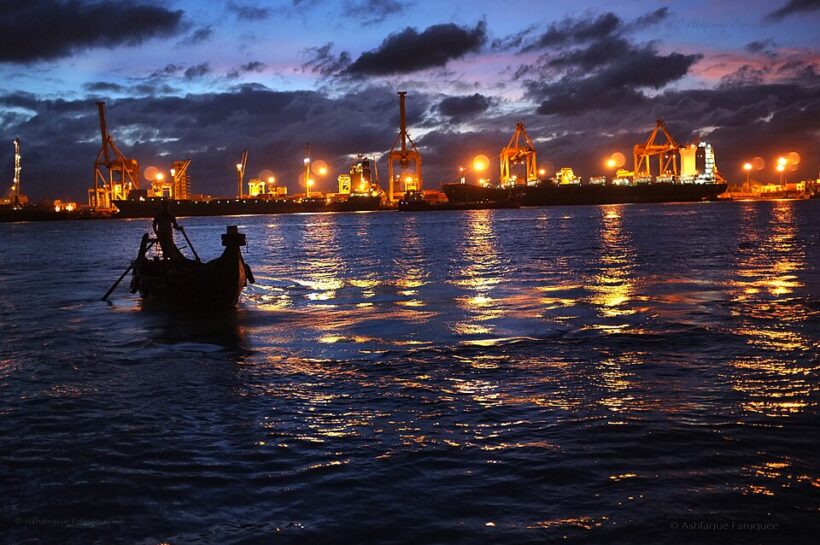
A recent India Today commentary (September 2025) alarmingly depicts Chittagong Port as a threat, transforming a commercial port into a chessboard of global power and endangering Northeast India. It warns that every multinational exercise or visit to Bangladesh is a test of creating influence in the Bay of Bengal, which makes northeast India unstable. In reality, these events are routine and cooperative, not hostile.
By Dr. Mohammad Asaduzzaman
We address the central claims below:
U.S.-Bangladesh Pacific Angel: Humanitarian Aid, Not Threat
The Pacific Angel 25-3 exercise in Chittagong was entirely focused on humanitarian aid and disaster response, not a secret military build-up. Even India Today itself cited it as a humanitarian activity, but it was misconstrued due to the tendency to portray it as a concern for India. Even after the U.S. Air Force confirms the facts, it is illogical to view this negatively. Over a four-day field training, participants practiced setting up mobile medical sites, search-and-rescue operations, and even refurbishing a local hospital. Medical professionals shared best practices during emergency moments, and engineering teams helped local hospitals. So, how can a bilateral humanitarian exercise be a threat to India’s Northeast states? Even though in a non-navy exercise, they portrayed Chittagong port as a threat to the northeast of India. India is a strategic partner of the U.S. (e.g., Quad); from this perspective, it is nonsensical to view humanitarian drills as hostile.
Chinese Naval Visit: Friendship, Not Frontline
India Today highlights China’s October 2024 port call by the training ship Qi Jiguang and ship Jinggangshan, warning that “China is building infrastructure, forging ties, and embedding its presence right on (India’s) doorstep. However, it was a routine naval courtesy visit, which can be described as a goodwill and friendship mission, arranged to deepen mutual understanding and strengthen cooperation. This visit includes friendly activities like bilateral meetings, ship open days, and a deck reception. However, India’s concern seems to be that China has arrived with a naval fleet to establish a naval base. Ultimately, it was traditional friendship, characterized by friendly exchanges and mutually beneficial cooperation. If Bangladesh were aggressively aligning with China, it would not be hosting these naval goodwill events so publicly. Moreover, India’s own geography shows that the Chinese border is closer to the Siliguri Corridor (chicken’s neck). Furthermore, Nepal and Bhutan are more advantageous destinations to impose an embargo on the Siliguri corridor than Chittagong. Bangladesh’s sovereign decision to host China or anyone else is entirely normal and does not automatically pose a threat to India.
Russian Naval Visit: Cooperation Allies
In April 2025, Bangladesh welcomed three Russian warships on a four-day goodwill visit at the Chattogram port. India Today notes this followed a trip to Moscow by “Army Chief Gen. SM Shafiuddin Ahmed”, highlighting the shallow depth of information investigation. General Waker‑Uz‑Zaman became Bangladesh’s 18th Army Chief in June 2024. This (goodwill visit) was explicitly a friendly port call, with joint ceremonies and exchanges planned to strengthen bilateral relations, exchange views on professional matters, and create opportunities for future training and cooperation between the naval officers and sailors of the two countries. Bangladesh has worked with Russia on energy (Rooppur nuclear plant) and defence for decades. A scheduled naval courtesy stop by Russia is not evidence of new malice against India. India, which imports much of its own military hardware from Russia and calls Russia a “time-tested” partner, highlights no obvious disadvantage from Bangladesh-Russia friendship.
Sovereign Outreach & False Alarms
India Today allegedly claims that Bangladesh is accommodating external powers—including China, the U.S., Pakistan, and Turkey. They even mention that America is displeased with Sheikh Hasina over St. Martin’s Island. These allegations are entirely baseless. Bangladesh’s interim government under Chief Adviser Dr. Muhammad Yunus has, in fact, invited cooperation. He (Chief Adviser) explicitly shows interest in connecting with Bangladesh’s neighbouring countries like India (particularly the north-eastern states) and Nepal through Chittagong Port. Bangladesh is welcoming India (and others) to use its ports, not plotting against India.
Bangladesh’s Foreign Adviser Touhid Hossain denied the allegation against the USA of seeking St. Martin. The U.S. government likewise rejected Hasina’s claim. Both Dhaka and Washington have categorized those stories as baseless.
Bangladesh is a sovereign nation with the right to pursue balanced relations. It works with many friendly countries (Japan, Korea, the EU, the U.S., China, etc.) on infrastructure and development projects without harming its neighbours. Regular port visits, joint drills, or infrastructure deals with third countries do not violate any agreement with India. India Today’s cited sentence, “The port may belong to Bangladesh, but its significance belongs to India,” is a view that ignores Bangladesh’s sovereignty.
Dr. Mohammad Asaduzzaman, Professor, Department of Linguistics, University of Dhaka and Director General International Mother Language Institute



