

As a writer, I always feel deeply honored when I get to read a manuscript. It’s not only the opportunity to learn from a colleague, but also to enter an intimate, sacred space of the literary craft. It’s like stepping into an altar before the church doors open for mass.
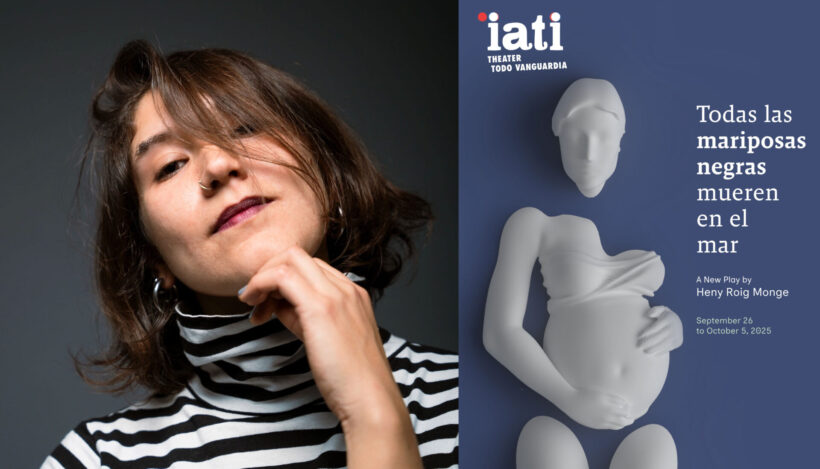
When reading a play, one inevitably wonders about the staging. And in the case of All the Black Butterflies Die in the Sea, by Heny Ilse Roig Monge, that question becomes even more compelling, because Heny approaches her characters with a profound poetic sensibility and a multi-artistic vision that combines choreography and imagery. In other words, she breaks free from words and dialogue; she places emphasis on movement and images.
That makes my imagination soar, and, at the same time, it makes me wonder what interpretation the director will bring to the piece. And I do not doubt that I will be surprised, since IATI Theater in New York has a remarkable track record of presenting high-quality productions.
Don’t miss it. You can see it until Sunday, October 5. I promise you will not only witness a play, but also leave with many questions about our bodies, about gender, and about the identities we derive from them.
And it is also an honor to speak with the author, for in doing so, we gain yet another dimension of her work.
JS: Heny, tell me about your professional career. How did you become a playwright, coming from a background as an actress and researcher? How did your work travel from Chile to be presented at IATI Theater, such an emblematic stage in New York’s East Village?
HRM: Some circumstances in my life came about by simple chance. While studying theater, I took classes with the distinguished playwright Juan Radrigán, who received Chile’s National Arts of Performance Award from the Ministry of Culture, Arts, and Heritage. He was the one who guided me toward writing, and I will be eternally grateful for that gift.
In 2013, during my final year at school, I founded, together with Rayen Castillo, the collective “Matriz,” leading a research project on the pedagogical work of the playwright titled From the Cry to Creation: Discontent as the Soul of Playwriting, Conversations with Juan Radrigán, published by Ediciones Cuarto Propio and included in 2020 in Chile’s first online catalog of performing arts publishers.
As for IATI, I saw an announcement on social media about the 2024 CIMIENTOS residency for playwrights and I applied. IATI informed me that the play had been selected from hundreds of international proposals as one of ten highlighted pieces for its staged reading series. In 2024, I traveled to New York to witness the process with the IATI team, and it was an incredible experience. This year I received the news that the play was chosen for the 2025 Mainstage Season. The rest is part of what we are experiencing today.
JS: You studied at the Pontifical Catholic University of Chile, where you earned your master’s degree, and also at the Universidad Academia de Humanismo Cristiano, with an emphasis on theater pedagogy. That combination of Christian and Catholic contexts—how does it influence the sensibility of your work, if at all?
HRM: That’s a good question. Both universities have very important histories. The Universidad Academia de Humanismo Cristiano was created in 1975, when Cardinal Raúl Silva Henríquez founded a study center to promote pluralism and academic freedom in response to the serious human rights violations affecting Chile, providing a space for the creation and dissemination of knowledge about Chile’s political, economic, social, and cultural reality. The Catholic University of Chile, on the other hand, is one of the most prestigious universities worldwide and was one of the first in Chile to incorporate theater studies at the academic level, what in Chile is called “University Theaters.” In fact, this year its theater school is celebrating its 80th anniversary.
Sometimes decisions are tied to other circumstances. This question actually reminded me that I studied at a convent school, where there was a chapel for prayer and all the symbolism related to that universe. When I think about it, my answer is always that it was there I learned the meaning of ritual—a concept closely linked to the performing arts—and it was at that school that I met the person who inspired me to write this play, to whom it is dedicated.
JS: In your master’s thesis, you explored “the body as a territory of resistance in contemporary Chilean theater.” Could you tell us more about that idea and how you have continued to develop it in your artistic work?
HRM: My practice is based on the concept of counter-conduct, and in that sense, it questions the notions of the body (biopolitics) as a subject of political dislocation—a territory of resistance insofar as it poses a significant rupture with traditional hegemonic representational models. I understand the concept of body as both producer of disappearance and failure, as material for scenic composition within the aesthetic experience generated in performance, and as a site of suspension of representation and social structure.
Lately, as a researcher, I am interested in extracting words from the body—making the word flesh, or embodying the word—allowing a link with the memory that inhabits our first territory, the body. This body contains not only the present memory that shapes us, but also the ancestral, the historical. In this pursuit I have trained in various scenic techniques (Biomechanics, Grotowski, Kalarippayattu, Contemporary Dance with Colectivo La Vitrina), and in recent years I have incorporated Somatic Movement, studying to become a Somatic Movement Educator at the Body Mind Movement School in Chile (Mark Taylor), to approach my scenic process both as researcher and playwright.
JS: When I read the subject of your thesis, I thought of an unexpected connection: the American author Ta-Nehisi Coates, in his book Between the World and Me, speaks of how freedom for African Americans is marked by a physical problem—the body as a site of oppression and the inheritance of slavery. In a parallel way, when we speak of women’s autonomy and rights, we are also speaking of the body as territory. Do you find that connection valid? How does your work dialogue with these discussions around body, memory, and identity?
HRM: Absolutely. Of course, from other historical and political connotations, since unraveling the essential relationships that make up a shared, historically constituted space allows us to deconstruct a place named hierarchically and articulated by absolute truths implying a single line of thinking. In my thesis I focused particularly on understanding conceptualizations of the political in theater—not just as the consequence of partisan manifestos through ideology, but rather as the disarticulation of theatrical discipline itself, breaking the operation of the regime of sensibility, and thus attempting to work from a new configuration of material and symbolic space.
In that sense, Rancière points out, for example, that politics consists in reconfiguring the division of the sensible, in making visible what was not visible.
This play was born from the need to explore the oppression of the female body as a biopolitical entity, starting from the concept of motherhood, to question the role of women in society, understanding the body as the first territory—so crucial in this moment of change, decision-making, and agreements through the social fabric built in encounter. I asked myself: How do we want to relate to each other? How do we want to inhabit our territory? What is it that we still cannot say? How is my body affected? How does it transform? What word inhabits my body that has not yet been verbalized?
JS: I read All the Black Butterflies Die in the Sea as a poem, and I say that as a compliment: the musicality of the language, the power of the images, the precision of the words. But it doesn’t stop there—you work not only with dialogue and narrative, but also with movement described in detail and even with drawings that accompany the stage directions. How do you describe the play from that hybrid point of view? How did you weave in these other languages—visual, physical, rhythmic—that we don’t usually see in a written play?
HRM: Mainly because I am interested in other arts, particularly music and dance. I was also always fascinated by visual poetry. So I realized I needed to build a foundation that would allow me to combine all these universes in the fabric of a play. During the process, Chilean musician, director, and composer Angelo Solari shared with me his thesis Narration and Didascalia for his Master’s in Composition and Theory with a specialization in Musical Theater at the Hochschule der Künste Bern, Switzerland, where he created a specific categorization of didascalias (movement decisions, tone, speed, transitions for the scene and between scenes, etc.).
In that process, Angelo shared with me the conviction that writing could be seen through the lens of composition—understanding composition as the organization of all materialities over time—and that staging is a complexity, a complex of materialities and languages. Therefore, writing can establish rigorous rules that enable a particular notation technique. From this, I began to create my own theatrical framework, one that any professional—whether from music or dance—could look at on paper as theater professionals do, and in this way, we could find a point of encounter through a shared record.
JS: After reading the text, I must confess that I was left with a strong desire to see the staging. What stands out to you about the work of Antígona González in the direction and the choreography of sarAika Movement Collective? How did the staging balance your words with the physical language of the performers?
HRM: From the moment I began writing the play, I knew it was not a simple text, and the path to its staging was not simple either. Both Antígona González and sarAika Movement Collective were very sensitive professionals in understanding the play. With Antígona, we had long conversations, discussing each part of the text, and that gave me a lot of reassurance. As for sarAika Movement Collective, they felt very inspired working with the piece and are considering expanding this collaboration. I believe this dialogue will continue for a while, and that is fascinating.
JS: Finally, I would like to know more about your upcoming projects. What comes after All the Black Butterflies Die in the Sea? And let me take this opportunity to thank you for your time and for allowing me to read the full script.
HRM:At some point, I realized that the themes of my writing practice have to do with the politics of death, thinking of mourning as denunciation and ritual as a possibility of social transformation. Beyond the religious, I am interested in cultural and symbolic reflection on farewell rituals as personal, intimate, and also collective acts—a theme that is not expressed literally in my works. When I write, I do so as an intimate tribute to my dead.
At the moment, I am writing a text where I ask myself: In what ways does a blind person relate to the city?
The conceptual basis, in terms of dramatic structure, is the same, but I change the theme addressed in each piece, and of course, I investigate concepts that the theme itself provides. In this case, I am particularly researching echolocation.
I am grateful for this opportunity, and to you for this interview. You made me remember, reflect, feel deeply, and question myself. Thank you. I feel very honored.
Heny Ilse Roig Monge is a Chilean actress and researcher with a Master’s in Arts from Pontificia Universidad Católica de Chile, where her thesis focused on the body as a territory of resistance in contemporary Chilean plays. She holds a degree in Theater with a minor in Theater Pedagogy from Universidad Academia de Humanismo Cristiano. Her work centers the aesthetics of the body, trauma, and identity. She is co-author of Del grito a la creación: La disconformidad como alma de la dramaturgia, a book of conversations with renowned playwright Juan Radrigán.



