

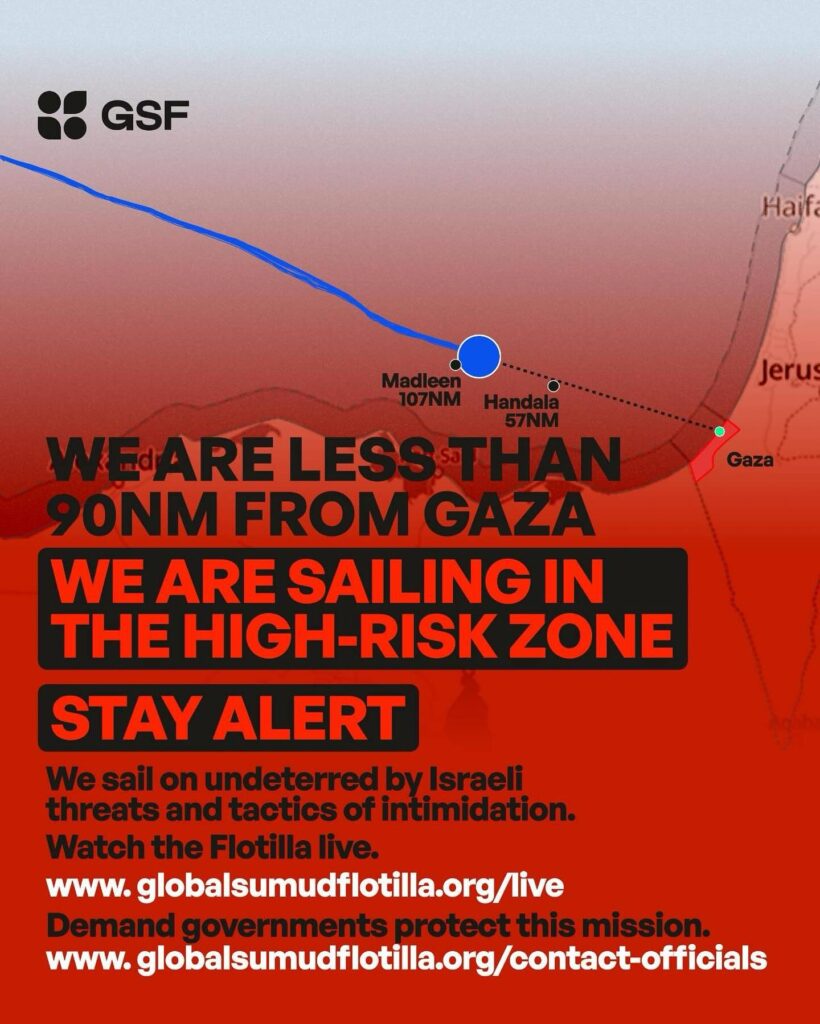
October 1, 2025, 09:36 hours in the Eastern Mediterranean. The Global Sumud Flotilla is about 90 nautical miles—around 170 kilometers—from the coast of Gaza. Still in international waters, but within the “red zone,” the maritime corridor where previous flotillas were violently intercepted, the humanitarian ships continue forward without international escort, heading toward the besieged Palestinian territory.
The night that just passed was a test of endurance and courage. On board, activists, doctors, journalists, and human rights defenders remained on high alert. There was no rest: many spent hours sitting on deck, wearing life vests, attentive to every signal. From the darkness of the sea, Israeli vessels emerged sailing without lights, suddenly appearing and then vanishing after circling the civilian boats. At the same time, dozens of drones flew overhead throughout the night, multiplying the constant noise and psychological pressure.
It was a forced vigil, in permanent tension. The crew confronted fear with discipline, applying safety protocols while documenting every suspicious movement. Physical and emotional fatigue is evident: they are exhausted, yet they stay the course, determined to deliver humanitarian aid to Gaza and break the illegal blockade that strangles more than two million people.
Dawn brought no relief. The flotilla now sails under the invisible gaze of a military power that has already announced its intention to intercept them. The solitude of their voyage—abandoned by European ships that decided to stop at a safe distance—underscores even more the imbalance of forces: a few sailboats and civilian vessels facing the army of one of the most powerful states in the region.
The chronicle of this journey is already, in itself, an indictment: it shows the world how a group of unarmed boats, crewed by citizens and representatives from 45 countries, is pursued and harassed in international waters simply for carrying humanitarian aid. The vigil of this night will be inscribed as a symbol of human dignity in the face of barbarism, and as a reminder that silence is complicity. There, in that solitary passage, our collective dignity is also at stake.



