

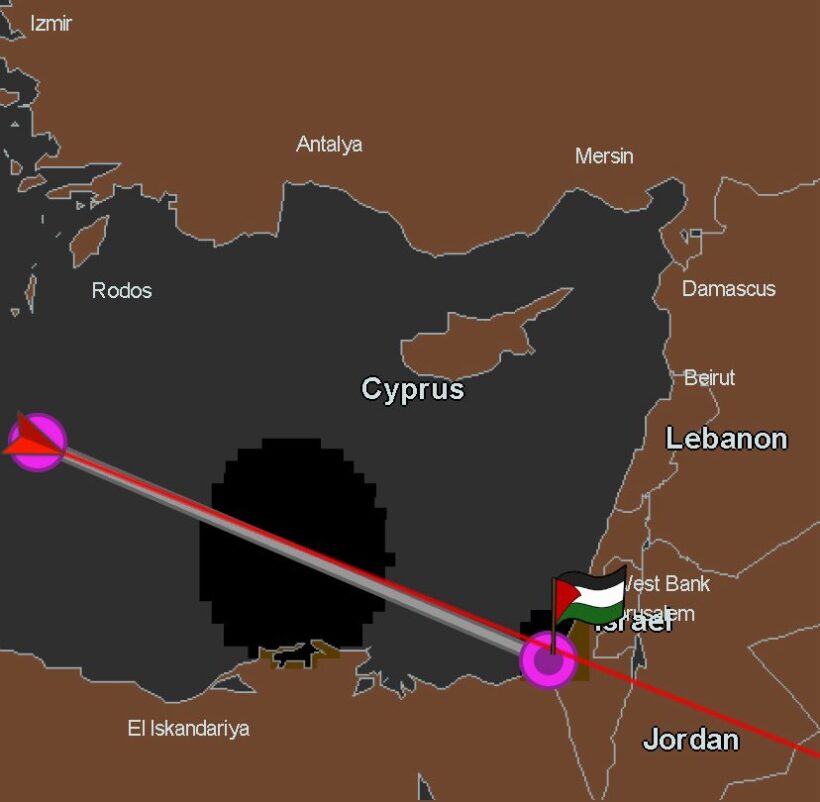
The image is brutal in its simplicity: a convoy of civilian boats loaded with humanitarian aid sails through international waters, 380 nautical miles from Gaza, aiming to arrive between October 2 and 3. Yet a crucial fact changes the dimension of the risk: within the next 24 to 48 hours these vessels will cross the red line that the Netanyahu government has marked and threatened as an “intervention” zone —that is, at any time starting two days from now, and well before the tentative arrival date, they could enter the direct radius of maximum probability of interception or attack. And yet those boats sail alone. No naval power is willing to guarantee their passage; the warships that are mentioned are only for rescue, not for defense.
There is no way to soften it: the Global Sumud Flotilla is advancing unprotected in the heart of the eastern Mediterranean while the powers that in international forums cry out against genocide maintain an operational silence that betrays them. Neither solemn statements nor formal condemnations have turned into any deterrent presence or political decision that puts civilian lives first. The Italian and Spanish frigates —and any distant escort or monitoring— have made it clear that their role is limited to extraction and rescue in case of disaster; they will not act as a prior barrier to aggression. Put plainly: they will be there to retrieve the wounded or the dead, not to prevent the violence that causes them.
This vacuum is not an accident but a choice: humanitarian rhetoric collides with geopolitical calculation. Governments that sign resolutions and issue appeals in international corridors prefer the calculated risk of “sending a message” to the concrete challenge of protection. Apart from a few notable exceptions —brave calls and demands such as those by President Petro— most speeches amount to diplomatic good manners: written and photographic condemnations unaccompanied by measures to protect those trying to break the humanitarian siege and establish a real channel of assistance. The gap between word and deed has a name: abandonment.
Those traveling aboard the Global Sumud know it and accept it with courage —doctors, volunteers, parliamentarians and activists. In a recent communiqué, journalist Arlin Medrano spelled it out: the tentative arrival is October 2–3, and within the next 24 to 48 hours the risk will escalate as the ships cross the “red line” defined by the Israeli government. That time window —those days of maximum exposure— transforms a humanitarian mission into an act of the highest risk. It is not mere logistics: it is a countdown in which every hour is decisive for civilian lives in Gaza.
That the flotilla must rely on the heroism of its crew and the eventual goodwill of frigates that will not intervene by political mandate is an ethical and political affront. It means that the international community accepts, de facto, that the arrival of humanitarian aid can be conditioned by the risk calculations of a state practicing siege. It means that the lives of thousands are subordinated to diplomatic equations and the will to avoid direct military escalation between states. And it means, above all, that the principle of humanity —the basic obligation to prioritize life over sovereignty in the face of famine and deliberate deprivation— has been turned into a negotiable option.
This is not a naïve call for military maximalism: it is a minimal demand for coherence. If one speaks of genocide, of a criminal blockade, of the urgent need for humanitarian corridors, then words must be translated into acts that prevent supplies from being left to rot at sea or convoys from being turned into massacres. The calculated passivity of capitals that display public outrage but shun operational risk is, in effect, a form of complicity: it permits the continuation of the siege and normalizes the solitude of those who risk their lives to reach shore.
The solitude of the Global Sumud is therefore the clearest photograph of a global moral crisis. It mirrors an international community that prefers the decency of words to the responsibility of action. And as the flotilla crosses, in just a couple more days, the line that the Israeli state has marked as red —still in international waters— it is worth asking, with brutal honesty, who answers when the light of diplomacy goes out: international law, human rights, or the cold equation of power that decides how far it is worth risking lives to uphold an ethical mandate?
The answer we give —and the measures that governments and international organizations adopt now— will determine not only the immediate fate of that aid, but the very possibility that the international community can retain any moral credit when the next convoy sets sail and once again finds itself alone on the high seas.



