

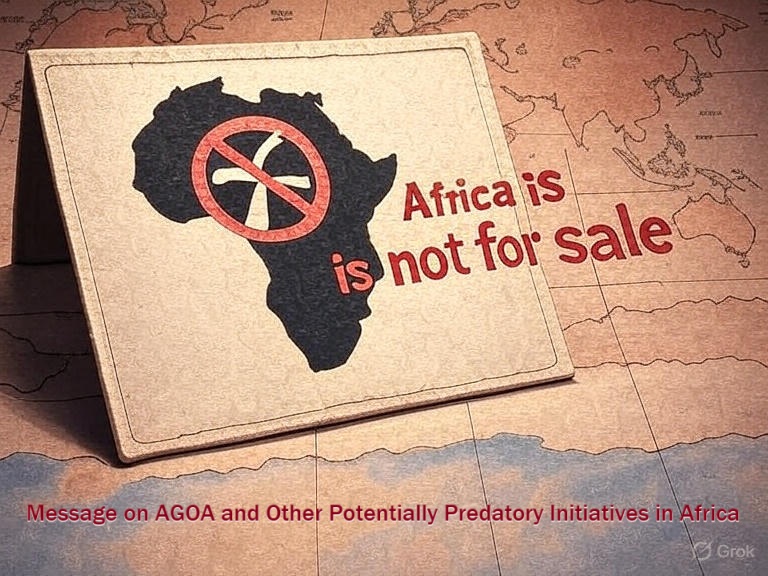
It is striking to see news that some African leaders and exporters express optimism about the extension of the African Growth and Opportunity Act (AGOA). It is jarring to see international press coverage (citing, for example, the Financial Times and Reuters) portraying the current AGOA “update” as a signal of openness and hope.
However, a closer look reveals another reality. That of a continent which, since the 15th century, has been systematically plundered, fragmented, and kept on the periphery of the global economy.
First came the slave trade, along with some agricultural surpluses and initial minerals; then formal colonization, initiated by the carving up of Africa at the 1884-1885 Berlin Conference; later, the neocolonial plunder driven by the World Bank and the IMF in the second half of the 20th century. This brings us to the present day and a new phase of financial, technological, and military dependence.
US administrations (both Democratic and Republican alike) have continued this logic of domination. Donald Trump expressed it bluntly with his slogan “Drill, Baby, Drill” – in another context, but it is the battle cry of a policy of limitless extraction, both domestically and abroad, under the premise that the planet’s resources are commodities at the service of Washington.
This extraterritorial mindset relies on a legal framework that seeks to apply US laws wherever convenient. This drive for dominance explains the network of military bases (the US and UK have dozens on African soil and in surrounding seas), the disproportionate strength of their naval fleets, and indirect action through mercenary firms like Blackwater, now Constellis, and the Wagner Group (formerly linked to Russia and certain oligarchs, though now serving the highest bidder) (see africanews.com, inkstickmedia.com).
All this is combined with an essential fact of our time: The US, UK, and France feel they are losing their footing in Africa. Faced with the old extractivist model imposed from the North and the East, new dynamics are growing. China’s entry with different projects that include building infrastructure and shared value chains; and the emergence of homegrown African regional initiatives seeking to process their minerals. To treat, process, and handle them, at least up to the bulk matter stage, making them transportable and generating more local wealth before export. These are still incipient steps, but they signal a trend: Africa does not want to remain a squeezed lemon, told when, how, and with whom it can trade.
Africa in the Mirror of the Global North
From the slave trade to contemporary mineral plunder, Africa has given the world everything: slaves, rubber, cocoa, oil, uranium, gold, coltan. In return, it has received broken promises, unpayable debts, and crumbs in the form of conditional aid. African gold is extracted amidst corruption and armed violence, with mercenaries guarding irregular mines. It then travels to London, where it is purified and enters the international bullion circuit. The same happens with uranium from Niger, rare earths from the Congo, or oil from Nigeria. The added value always remains in the Global North; Africa is left with craters, pollution, and broken communities.
The mirage of “Development” via AGOA…
AGOA is presented as a tool for cooperation and market opening. But in reality, it functions as a mechanism for political and commercial alignment: those who obey and keep their extractive veins open receive tariff benefits; those who dissent or experiment with sovereign paths—like South Africa or certain emerging regional blocs—are pressured, isolated, or destabilized.
The underlying fear is evident: that Africa might cohere, that it might articulate a Pan-African project capable of protecting its riches and setting its own rules for fair exchange. Because a united and emancipated Africa would mean that uranium, gold, or coltan would no longer leave as cheap raw materials but would begin to be transformed into industrial and technological wealth within the continent. That is the real specter haunting Washington, Brussels, or London.
Mercenaries and destabilization: The other face of “Cooperation”
Whenever movements for African unity emerge, whenever neighboring countries experiment with forms of coordination to defend their resources, the “men in green” appear, the flagless mercenary armies mentioned earlier, funded by networks orbiting Western interests. They are not phantoms: they are the expression of a system that, to perpetuate fragmentation and plunder, needs to bleed strategic territories before they emancipate.
The historical debt and Africa’s future
Oxfam and numerous African organizations insist: the debt is not Africa’s to the Global North, but the Global North’s to Africa. A debt measured not only in money, but in centuries of stolen lives, truncated opportunities, and mortgaged futures.
The continent is not closing itself off to trade; what it rejects is a model that reproduces the logic of gold and uranium: exporting cheap raw materials under corruption, violence, and imposed conditions, so that the final wealth ends up in the vaults of London, New York, or Paris.
That is why, while the extension of AGOA is announced with fanfare, it is worth listening to the deeper voice running through Africa: “We do not want to remain the world’s quarry, nor its agricultural and livestock reserve, nor the backdrop for photo safaris. We want to be the heart of our own development.”
Africa is not for sale (any more)
AGOA: The poisoned candy
It is useful to recall what AGOA exactly is, where it comes from, and under what logic it operates. Its name might suggest a treaty between equals, but in reality, it is a unilateral US law, passed by Congress in May 2000 during the presidency of Bill Clinton. It was not the result of negotiation with the African Union or regional blocs on the continent, but a political decision by Washington, which defined, by and for itself, which African countries could access its market under special conditions.
AGOA opened the US market to about 6,500 African products duty-free, but access was never automatic or universal: it is subject to criteria dictated by Washington. These include “making progress toward a market economy,” “protecting private property,” “facilitating foreign investment,” and “respecting human and labor rights.” These are not abstract principles but conditions that allow the US government to exclude, at any time, countries it deems inconvenient for its foreign policy.
And that is what has happened: over the years, the United States has suspended the participation of Zimbabwe, Ethiopia, Mali, Niger, and others, citing human rights violations or coups d’état. In reality, it is an instrument of reward and punishment: the “eligible” country label is granted to docile governments and withdrawn from those seeking paths of greater sovereignty.
The annual AGOA forums, presented as spaces for dialogue between African ministers and US officials, are little more than consultative instances. Rules are not negotiated as equals, nor are conflicts resolved on a parity basis. Everything is decided in Washington: who gets in, who is kicked out, who complies, and who is sanctioned.
That is the true nature of AGOA: not a co-development pact, but a poisoned candy, a foreign policy tool that, under the veneer of trade cooperation, perpetuates the old logic of extractivism and dependence. That is the true nature of AGOA. It is also a channel for investment and surveillance for the enormous liquidity of Private Equity funds. The old saying fits here: ‘The master’s eye fattens the horse’: that is AGOA, with its men in black… and its mercenaries, when things get tough.
AGOA or African Growth and Opportunity Act(The naked truth or AGOA for dummies)✦ Primary Driver: United States. It was a unilateral initiative by the US Congress, passed in May 2000 during the presidency of Bill Clinton. The United States was the sole driver behind the AGOA initiative, as “a move” at Africa as geostrategic playground. ✦ True Nature: It is not a treaty negotiated between equal partners (Africa-US), but rather a US law that unilaterally decides which African countries can benefit from trade preferences when exporting to the US (duty-free access for about 6,500 products). This is not peer-to-peer mood but it never is with the US at this level. ✦ The Real Strings Attached: To qualify, countries must meet criteria set exclusively by Washington:
The Legal Facade ✦ There is no multilateral treaty signed with the African Union or African regional blocs. “AGOA’s “charter” (if such thing exists) It’s pure mise en scène. It’s simply US legislation, renewed several times (2004, 2006, 2015). The current extension expires in 2025. And Trump said OK go ahaed .
This is not merely an economic strategy; it is a form of structural influence that subordinates African development to the interests of global financial actors (funds), often to the detriment of local economic sovereignty and the population’s access to basic services. Development is strictly confined to what facilitates extraction and transport, neglecting the hinterland’s infrastructure and energy needs. Any further development only happens as a secondary interest near large population centers. Where Power Really Lies
✦ Sole US Discretion: The US administration, based on annual reviews, unilaterally decides which countries keep or lose eligibility. For instance, the US has suspended Zimbabwe, Ethiopia, Mali, Niger, and others at various times, citing “human rights violations” or “coups d’état.” ✦ At AGOA Africa lacks of real bargaining power:
✦ Formal debate or issues are confined to the U.S.-Africa Trade and Economic Cooperation Forum (the “AGOA Forum”: pure mise en scène), an annual meeting for dialogue between African ministers, US officials, and the private sector. But it’s merely a consultative, non-binding space. ✦ In practice, the US is both judge and jury: it sets eligibility, imposes conditions, and doles out benefits. The Core Unmasked Underneath the cooperative veneer, AGOA is anything but a co-development pact or a negotiation among equals. It is, in essence, a 21st-century tool for extraterritorial control, a sophisticated mechanism serving the interests of Equity Funds and other stakeholders who “invest” in Africa under its rules. Think of it as squeezing the lemon, but Version 2.0: it’s not just about extracting raw materials cheaply, but also about structuring African economies to guarantee maximum returns and security for foreign capital. It ensures compliant governments, open veins for profit repatriation, and a legal framework favoring external investors. AGOA creates the optimal ecosystem for a modern form of plunder—one managed by fund managers and corporate lawyers instead of only colonial administrators, but whose ultimate effect is the continued draining of African potential for wealth creation. It’s foreign policy dressed as free trade, ensuring that real power—the power to decide, to punish, and to shape economies—remains firmly in Washington, ultimately serving the interests of those who profit from Africa’s subordinated position in the global system.extractivism. |



